

Rifan Muazin
- Software Development
- October 26, 2026
- 9 views
The Evolution of Memory Safety: Rust’s Ascent and the Community Powering Its Ecosystem
In the landscape of modern software development, few languages have achieved the meteoric rise and cultural impact of Rust. Positioned at the intersection of high-performance systems programming and rigorous memory…
Iffa Jayyana
- Data Privacy and Ethics
- October 24, 2026
- 9 views
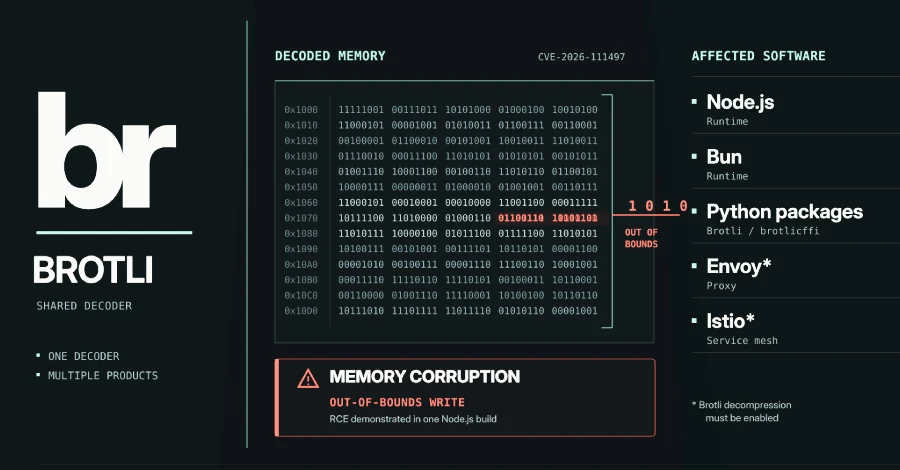
Critical Memory-Corruption Flaw in Google’s Brotli Decoder: A Deep Dive into CVE-2026-111497
A critical security vulnerability residing within Google’s Brotli compression library has sent shockwaves through the global software development community. Tracked as CVE-2026-111497, the memory-corruption flaw affects a vast array of…

Neng Nana
- Artificial Intelligence
- October 24, 2026
- 11 views
Beyond the Memory Wall: How to Master Large-Scale JSON Processing in Python
In the modern data-driven landscape, JSON (JavaScript Object Notation) has cemented its status as the de facto language of data exchange. From web APIs to complex geospatial databases, JSON’s human-readable,…
Azzam Bilal Chamdy
- Logistics and Supply Chain
- October 24, 2026
- 14 views
The Institutional Memory Gap: Why Supply Chains Are More Vulnerable Than Ever
The year 2007 remains etched in the professional psyche of veteran supply chain analysts as a watershed moment of abrupt systemic failure. For those on the ground—such as those witnessing…

Jia Lissa
- Software Development
- October 13, 2026
- 24 views
The Rust Revolution: Balancing Performance and Memory Safety in Modern Systems Programming
In the evolving landscape of software engineering, few technologies have captured the collective imagination of developers as profoundly as Rust. Originally conceived as a personal project by Graydon Hoare at…

Reynand Wu
- Software Development
- September 27, 2026
- 129 views
The AI-Driven Migration: How Google is Automating the Death of Memory Vulnerabilities
In a landmark achievement for cybersecurity, Google’s engineering teams have successfully validated a novel, AI-accelerated methodology for migrating legacy C infrastructure to memory-safe Rust. By leveraging Gemini—Google’s advanced large language…

 Ammar Sabilarrohman


 Lina Hope
The Hidden Human Cost: How CAPTCHA Farms Bypass the Web’s Most Common Security Gate
Asro
- November 5, 2026
- 2 views
 Suro Senen
