Rifan Muazin
For over three years, Luke Wroblewski’s website has hosted a unique digital experiment: "Ask LukeW." Designed as an interactive repository of his life’s work—encompassing decades of product design insights, technical talks, slide decks, and video essays—the tool has functioned as a specialized search engine for his professional output. However, as the field of Artificial Intelligence has shifted from theoretical potential to practical, high-speed implementation, the infrastructure behind the tool hit a plateau.
In a recent overhaul, Wroblewski’s team has fundamentally rebuilt the system. By moving beyond simple semantic keyword matching toward a sophisticated, classifier-based architecture, the new "Ask LukeW" promises to transform from a glorified search bar into a truly context-aware assistant.
The Chronology of an AI Experiment
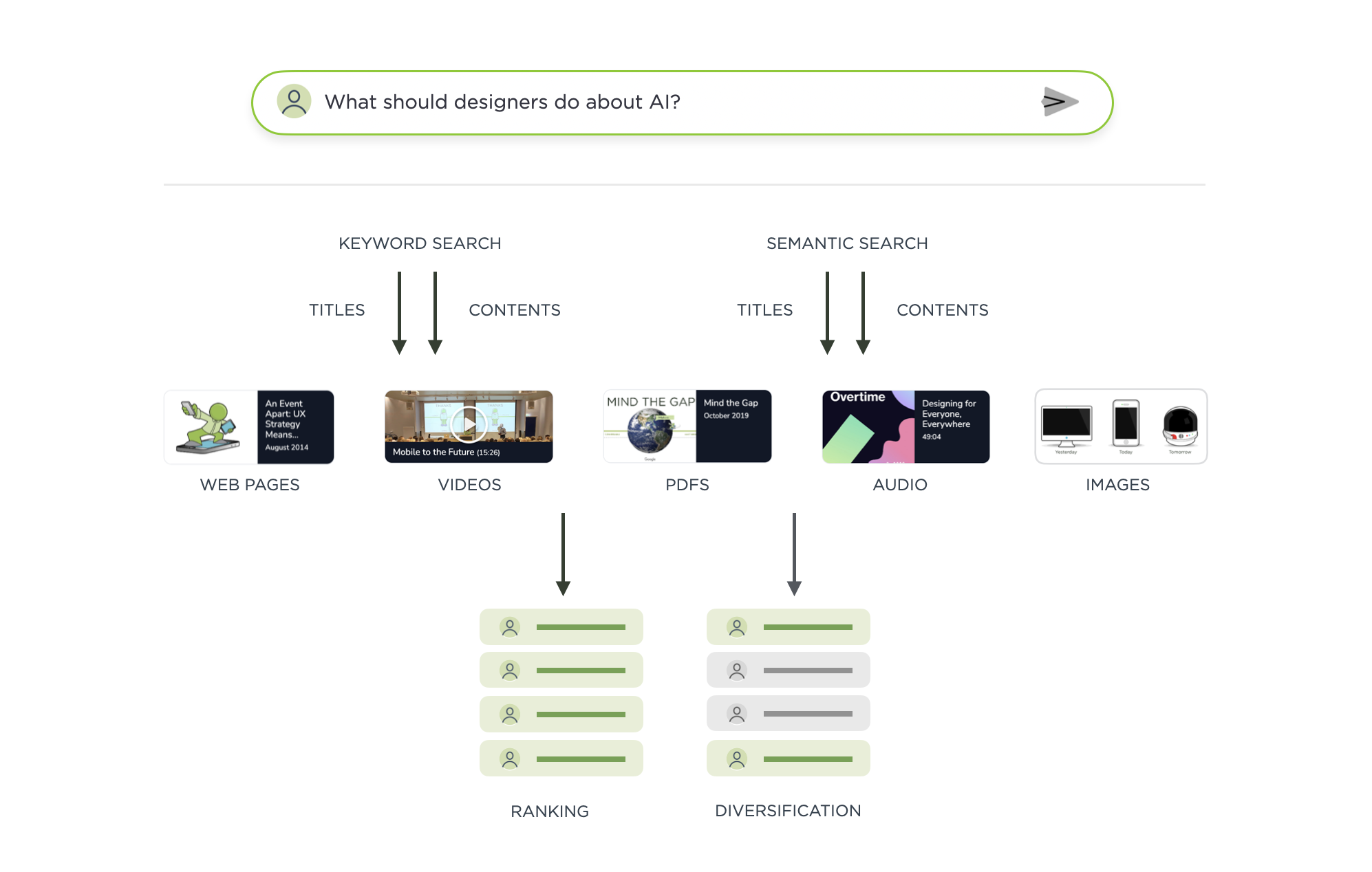
The project began three years ago, during the initial boom of accessible RAG (Retrieval-Augmented Generation) systems. At its inception, the architecture was remarkably uniform. Regardless of the user’s intent—whether they were seeking a precise 2010 citation or a casual off-topic remark—the system followed a rigid, four-pronged approach. It performed dual semantic and keyword searches across both article titles and body content.
This "brute force" methodology was effective enough to handle over 50,000 queries, but it suffered from inherent limitations. Because the retrieval process was agnostic to the type of question being asked, the system often struggled to distinguish between a request for a specific quantitative figure and a desire for general conceptual advice.
As the AI landscape evolved, three key advancements made a rebuild not only possible but necessary:
- Model Velocity: Modern AI models are now fast and cheap enough to perform real-time classification on incoming user queries.
- Expanded Context Windows: Newer models can ingest significantly larger amounts of data, allowing for more comprehensive synthesis of source material.
- Advanced Embeddings: Newer ways to map content into vector space have enabled much higher precision in information retrieval.
Deconstructing the New Architecture
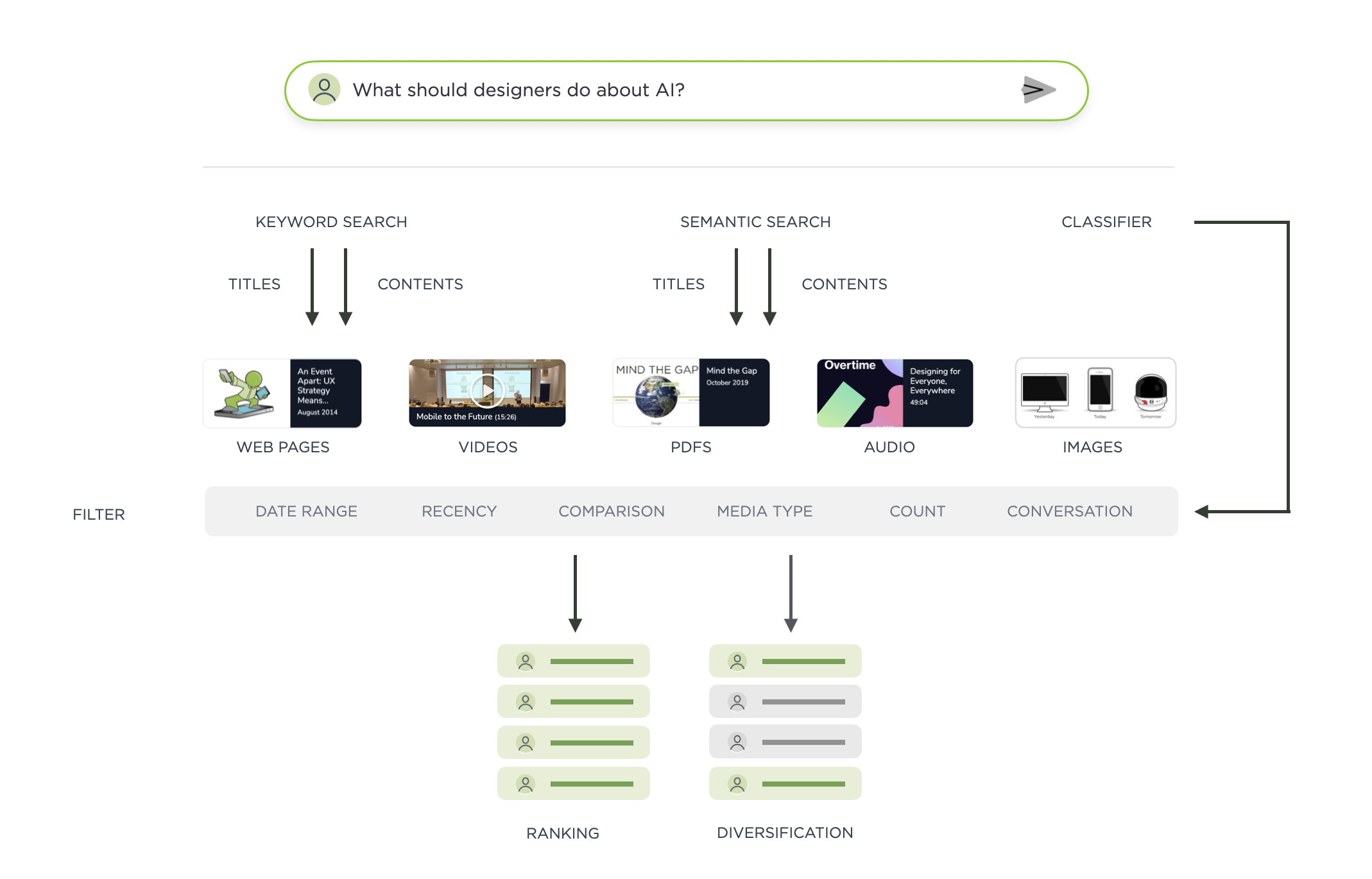
The core innovation of the new system is a "lightweight classifier." Before the search begins, the AI analyzes the user’s intent to determine the optimal retrieval strategy. This classification is stackable; a query can be simultaneously tagged as "temporal" and "media-specific," allowing the engine to tailor its search parameters accordingly.
The Five Pillars of Retrieval
The new system categorizes questions into five distinct domains, each requiring a unique handling process:
1. Temporal Anchoring
The original system was effectively "time-blind." It could find a mention of a topic, but it could not inherently reconcile that mention with a specific year or chronological progression. The new iteration allows for queries anchored to specific moments or spans of time, making it capable of tracking how Wroblewski’s philosophy on subjects like "Web forms" or "mobile UX" has evolved over fifteen years.
2. Artifact Retrieval
Often, users do not want a paragraph generated by AI; they want the original source—a specific slide, a video, or an article they half-remember. The new system now explicitly identifies "artifact-seeking" behavior, prioritizing the delivery of the original document over a summarized AI response.
3. Quantitative Precision
Previously, asking for a count was treated like a standard text search, leading to vague summaries. Now, the system treats these requests as database-like queries. It pulls raw data points to provide exact counts and organized lists rather than descriptive prose.
4. Visual Intelligence
Understanding that design is inherently visual, the team re-indexed every image ever posted to the site. The system is now capable of serving up to three relevant images per answer. Furthermore, it can cite specific PDF pages and dynamically insert individual slides into the conversation flow, providing the visual context that text-based search engines often miss.
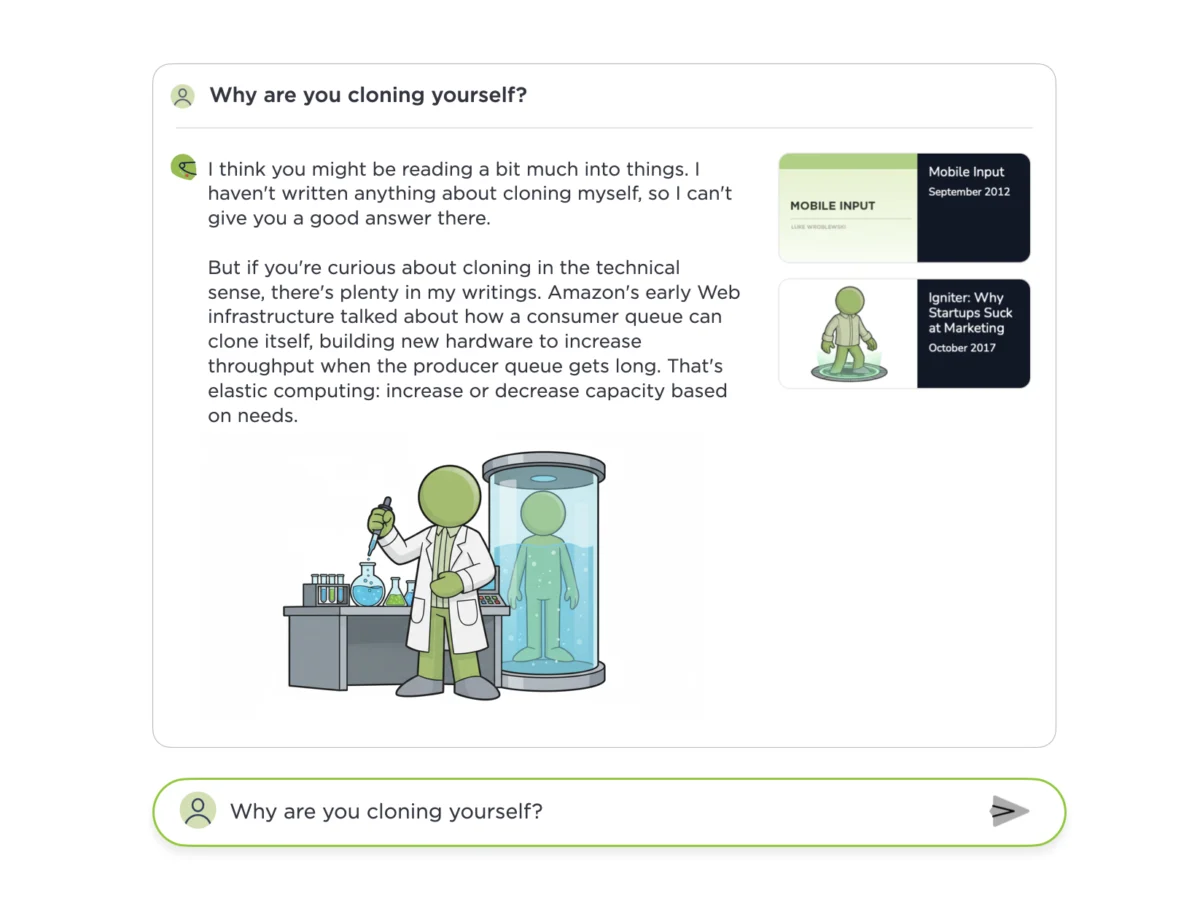
5. Casual Conversationalism
Perhaps the most human-centric update is the change in how the system handles off-topic or playful queries. Historically, these were met with a dry, automated rejection message. Now, the system recognizes the "casual" intent and responds in kind, often incorporating custom-generated "LukeW character" images to add a layer of personality and engagement.

Technical Nuance: The "Small Chunk" Strategy
Under the hood, the system has transitioned to a more granular approach. Content is now broken down into smaller "chunks"—a technical necessity for high-fidelity matching. By isolating specific sentences, the system avoids the "big blob" problem, where the core answer is lost in a sea of irrelevant text.
However, smaller chunks risk losing the surrounding context. To mitigate this, the system uses a neighbor-retrieval strategy: when a specific chunk is identified as relevant, the engine automatically fetches the surrounding text blocks to ensure the answer remains grounded in its original context.
The final response generation is governed by a carefully tuned ratio: 75% of the response is generated via the new, re-ranked system, while 25% is pulled from original embedding searches. This serves as a "sanity check," preventing the re-ranker from becoming too aggressive and biasing the final output. Furthermore, the system performs "per-result diversification," ensuring that a cluster of near-identical results doesn’t drown out unique, diverse perspectives.
The Human-in-the-Loop Reality Check
Despite the sophisticated engineering, the team encountered a sobering lesson regarding evaluation metrics. Initially, the team relied on automatic evaluation (evals) to determine success. The metrics suggested the new system was significantly better than the old one.
However, when Wroblewski personally conducted a manual "blind test" comparing 100 old results against 100 new ones, the old system actually outperformed the new one. This revealed a critical, hidden bug that the automatic evals had failed to detect.
This serves as a vital reminder for the AI development community: while automated evals are excellent at measuring directional improvement, they are often blind to the subtle, catastrophic failures that only human oversight can catch. The "bug" was subsequently fixed, but it forced a shift in the development philosophy: prioritize the human-in-the-loop audit as the ultimate arbiter of quality.
Implications for Content Creators
The evolution of "Ask LukeW" provides a roadmap for other thought leaders and organizations. As users grow accustomed to conversational interfaces, the demand for "intelligent" access to legacy archives will skyrocket.
The implications are threefold:
- The Death of Static Archives: Static blogs and documentation sites are increasingly becoming "dead" data. To remain relevant, creators must implement retrieval layers that allow users to query their archives as if they were a dynamic knowledge base.
- Granularity is Key: The shift toward smaller, contextualized chunks demonstrates that high-quality AI interaction is less about the size of the model and more about the quality of the data ingestion and indexing.
- Trust Through Citation: By prioritizing original artifacts and citing specific slides, Wroblewski’s system maintains the integrity of the source material. It acts as a bridge to the content, rather than a replacement for it.
As we move toward an era of hyper-personalized search, "Ask LukeW" stands as a testament to the fact that the best AI interfaces are not just fast—they are intentional. By blending high-speed classification with manual human verification, the team has turned a simple archive into a living, breathing extension of a design career. The project, supported by the engineering efforts of Lukas Seklir, Jerome Paulos, and Sam Breed, underscores that in the age of AI, the human touch—and the human eye—remains the most important tool in the box.


 Layla Zulfa

 Lina Hope
 Iffa Jayyana

 Basiran