
 Iffa Jayyana
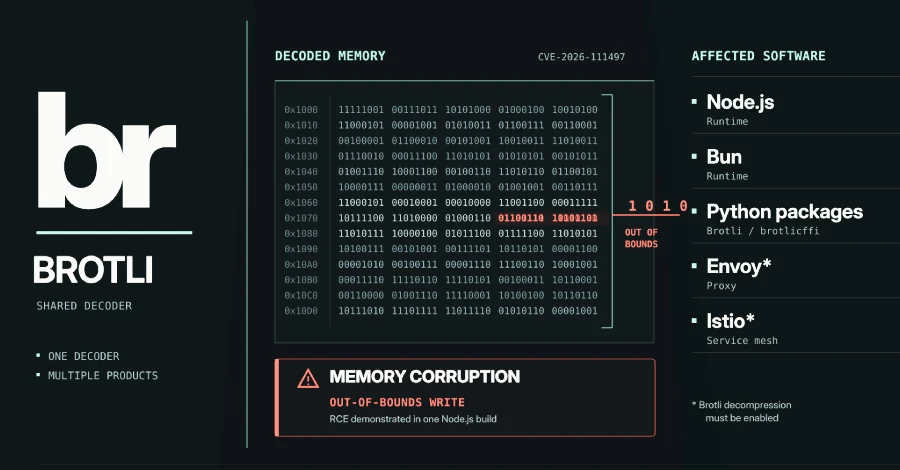
A critical security vulnerability residing within Google’s Brotli compression library has sent shockwaves through the global software development community. Tracked as CVE-2026-111497, the memory-corruption flaw affects a vast array of modern infrastructure, ranging from high-performance language runtimes like Node.js and Bun to enterprise-grade proxy servers like Envoy and Istio.
Because Brotli is the industry standard for compressing web traffic to optimize speed and bandwidth, this vulnerability effectively targets the "pipes" of the internet. By sending a maliciously crafted compressed data stream, an attacker could potentially trigger a buffer overflow, leading to application crashes, unauthorized memory access, or—in the most severe scenarios—the execution of arbitrary, attacker-controlled code.
The Nature of the Vulnerability: Understanding Memory Corruption
At its core, the issue lies in the C-based implementation of the Brotli decoder. Memory corruption occurs when a program inadvertently writes data outside the boundaries of an allocated buffer. In the context of CVE-2026-111497, a specifically engineered Brotli stream exploits weaknesses in the decoding logic, causing the library to overwrite adjacent memory addresses.
This is a classic "out-of-bounds" memory write. When a decoder processes an incoming stream, it expects the data to conform to specific compression rules. If the decoder fails to validate the boundaries of the input against the allocated memory, an attacker can supply a payload that forces the application to misbehave. Depending on the architecture of the target software, this behavior can be leveraged to hijack the application’s control flow, allowing the attacker to run commands with the privileges of the service user.
Chronology of a Silent Threat
The history of this vulnerability is particularly unusual. While the security industry was alerted to the threat on October 21, 2026, the underlying technical flaw had been identified and addressed in the Brotli source code as early as February 27, 2026.
At the time of that initial silent fix, the maintainers were unaware that the bug posed a security risk. Consequently, no new version of the library was released to propagate the fix to the thousands of downstream projects that rely on the Brotli C library.

- February 2026: The root cause is patched in the Brotli source repository, but the change remains "hidden" without a formal security release.
- October 21, 2026: OpenAI’s Codex Security team publicly discloses the vulnerability after discovering its potential for Remote Code Execution (RCE). Google and Node.js release emergency patches.
- October 22–23, 2026: A cascade of updates follows as maintainers for Bun, Envoy, Istio, and various Python ecosystem packages scramble to incorporate the latest, secure version of the Brotli library.
- Present: Organizations are in a race to audit their dependencies and update container images, as many legacy systems remain vulnerable due to the ubiquity of the affected library.
Affected Ecosystems: A Wide Attack Surface
Because the vulnerability exists in a core C library, it affects any software that binds to that code. The impact is categorized by how different environments handle Brotli decompression:
Node.js and Bun
In these JavaScript runtimes, the exposure occurs primarily during network interactions. If an application uses the native fetch() API to retrieve data from a remote server, or if it uses middleware like express or body-parser to process incoming POST requests containing Brotli-compressed bodies, it becomes susceptible to the exploit.
Python Packages
Python developers are particularly vulnerable due to the way packages like brotli and brotlicffi are integrated. Many common HTTP clients—including requests, urllib3, and aiohttp—automatically handle compression. If these packages are installed in an environment, an application might be vulnerable even if the developer never explicitly calls the Brotli library in their own source code.
Infrastructure (Envoy and Istio)
For proxy servers like Envoy and service meshes like Istio, the risk is tied to configuration. If these services are configured to perform Brotli decompression at the edge or within the mesh, they serve as a prime target for malicious actors looking to compromise the network ingress point.
Official Responses and Severity Metrics
The industry’s reaction to the vulnerability has been varied, reflecting the complexity of assessing such a low-level flaw.
- Google: As the maintainer of the Brotli library, Google assigned the vulnerability a CVSS 4.0 score of 9.2 (Critical), citing the potential for full system compromise.
- OpenAI: The researchers who reported the flaw highlighted that the attack works in both directions: an unpatched client can be compromised by a malicious server, and an unpatched server can be compromised by a malicious client.
- Red Hat: More conservative in its assessment, Red Hat rated the vulnerability an 8.1 (Important), noting that while the technical impact is severe, achieving reliable RCE in a production environment is complex and depends heavily on memory layout protections.
- CISA: The Cybersecurity and Infrastructure Security Agency (CISA) has thus far recorded no instances of in-the-wild exploitation, emphasizing that there is no "weaponized" public proof-of-concept widely available to unskilled attackers.
Implications for Modern Security
The discovery of CVE-2026-111497 serves as a stark reminder of the "Supply Chain Fragility" that plagues modern software development. Because modern applications are built on layers of dependencies, a single bug in a low-level C library can ripple upward through multiple layers of abstraction.

The "Node2Shell" Proof of Concept
Imperva’s Red Team, in their demonstration dubbed "Node2Shell," successfully executed code on an unpatched version of Node.js. This achievement proves that while the exploit requires technical sophistication—specifically the ability to manipulate memory buffers in a way that bypasses modern OS protections like ASLR (Address Space Layout Randomization)—it is well within the capabilities of motivated threat actors.
Mitigation Challenges
Traditional defenses, such as Web Application Firewalls (WAFs), are struggling to provide a comprehensive solution. While some providers like Vercel have implemented firewall rules to block suspicious traffic, these protections are incomplete. They often cannot inspect the nested, compressed traffic that functions are fetching from external third-party servers.
Consequently, the only definitive defense is to update the underlying library. This creates a significant operational burden for DevOps teams, who must not only update their dependencies but also perform a full rebuild and deployment of all containerized services to ensure the vulnerable code is completely evicted from memory.
Recommendations: What You Should Do Today
If your infrastructure relies on Brotli compression, immediate action is required. Follow these steps to secure your environment:
- Inventory Dependencies: Use software composition analysis (SCA) tools to determine if you are using affected versions of the Brotli library, Node.js, or Python packages. Note that dependency scanners may lag; perform manual checks for versions listed in the provided security table.
- Apply Patches: Prioritize updating your runtime environments. For Node.js, move to the latest patched versions (e.g., 22.23.4, 24.22.1). For Python, ensure
brotliorbrotlicffiare updated to version 1.2.1. - Restart Services: Simply updating a package is insufficient. A running process will continue to hold the vulnerable version of the library in its memory space until the service is fully restarted. Perform a rolling restart of all affected production services.
- Rebuild Container Images: Because the library is often bundled into base images, ensure your CI/CD pipeline triggers a fresh build of all container images to pull in the updated, patched base layers.
- Restrict Untrusted Input: If you cannot update immediately, disable Brotli decompression for any endpoints that accept untrusted user input. While this may result in a minor performance hit due to increased payload sizes, it effectively eliminates the primary attack vector.
The incident involving CVE-2026-111497 underscores the critical need for better "security transparency" in open-source software. The fact that a known security patch sat dormant in a source repository for eight months highlights a gap in how we maintain the foundation of the modern web. As developers, our vigilance in auditing these low-level dependencies remains our most effective defense against the next silent threat.


 Basiran

 Siti Muinah

 Nana Muazin

 Sagoh

 Ali Ikhwan

 Rifan Muazin
