Pevita Pearce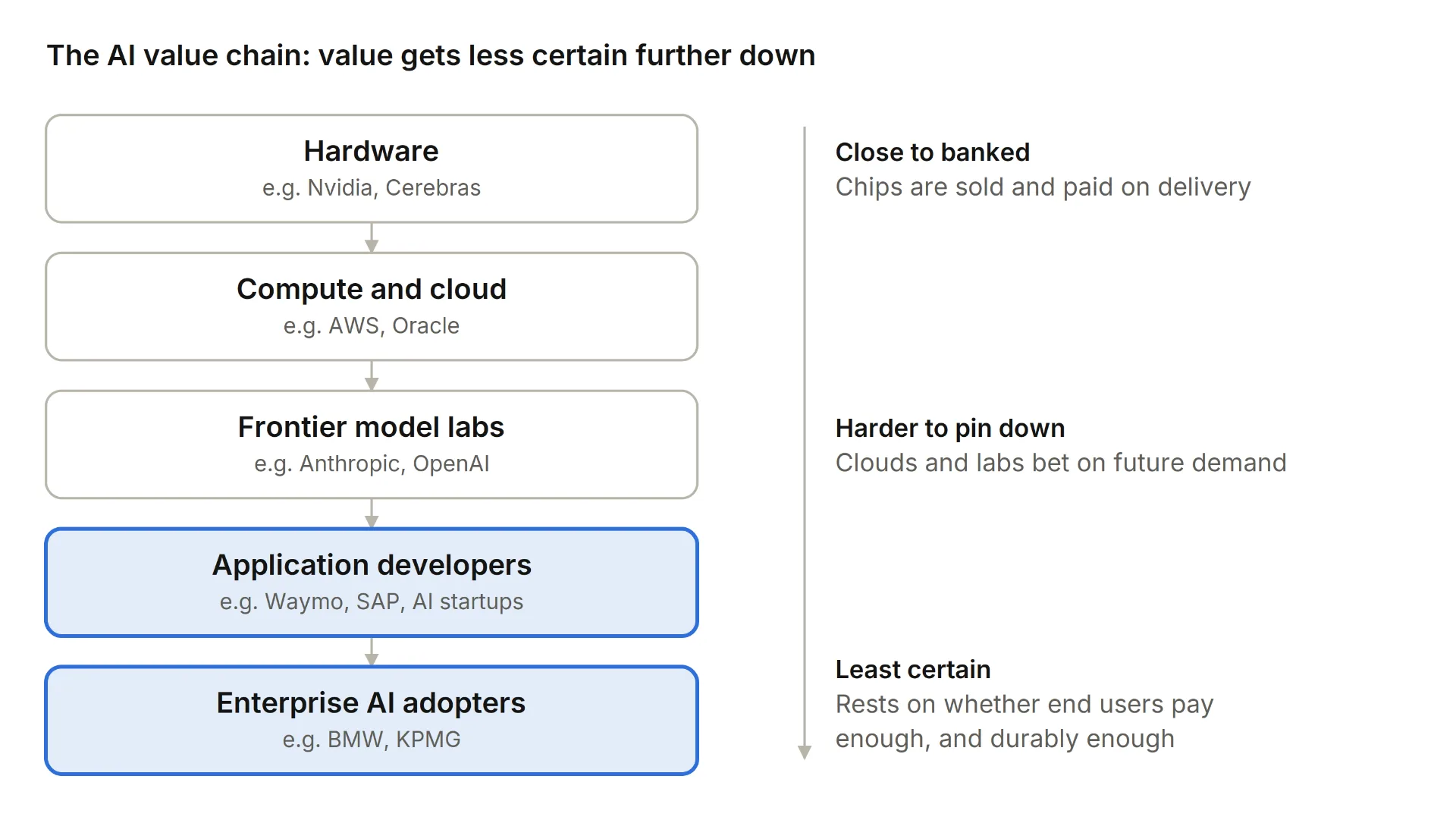
In the modern product and technology landscape, there is a recurring scene that has become a hallmark of the current corporate zeitgeist. A stakeholder bursts into a meeting, laptop in hand, eager to showcase a viral post, a glossy vendor demo, or a new "must-have" framework. Suddenly, the carefully curated product roadmap is scrapped in favor of an "agent," an "MCP app," or a complex "harness."
The demand is almost always the same: "We need an AI agent for this."
However, for those tasked with the actual delivery and maintenance of technology, this knee-jerk reaction often masks a deeper problem. After decomposing these requests from first principles, it frequently becomes clear that the client—or the stakeholder—does not need a generative AI agent at all. They might need a robust predictive model, a more efficient implementation of existing LLMs, or perhaps a simple automation script. The challenge for leaders today is to say "not so fast" without appearing like a defensive luddite.
Navigating the cacophony of AI marketing requires more than just technical skill; it requires a systematic framework for critical thinking. To stay grounded in a market driven by FOMO, we must dismantle the AI ecosystem, understand the incentives behind the noise, and adopt a rigorous filter for new technological claims.
1. The Anatomy of the AI Value Chain: Understanding the Ecosystem
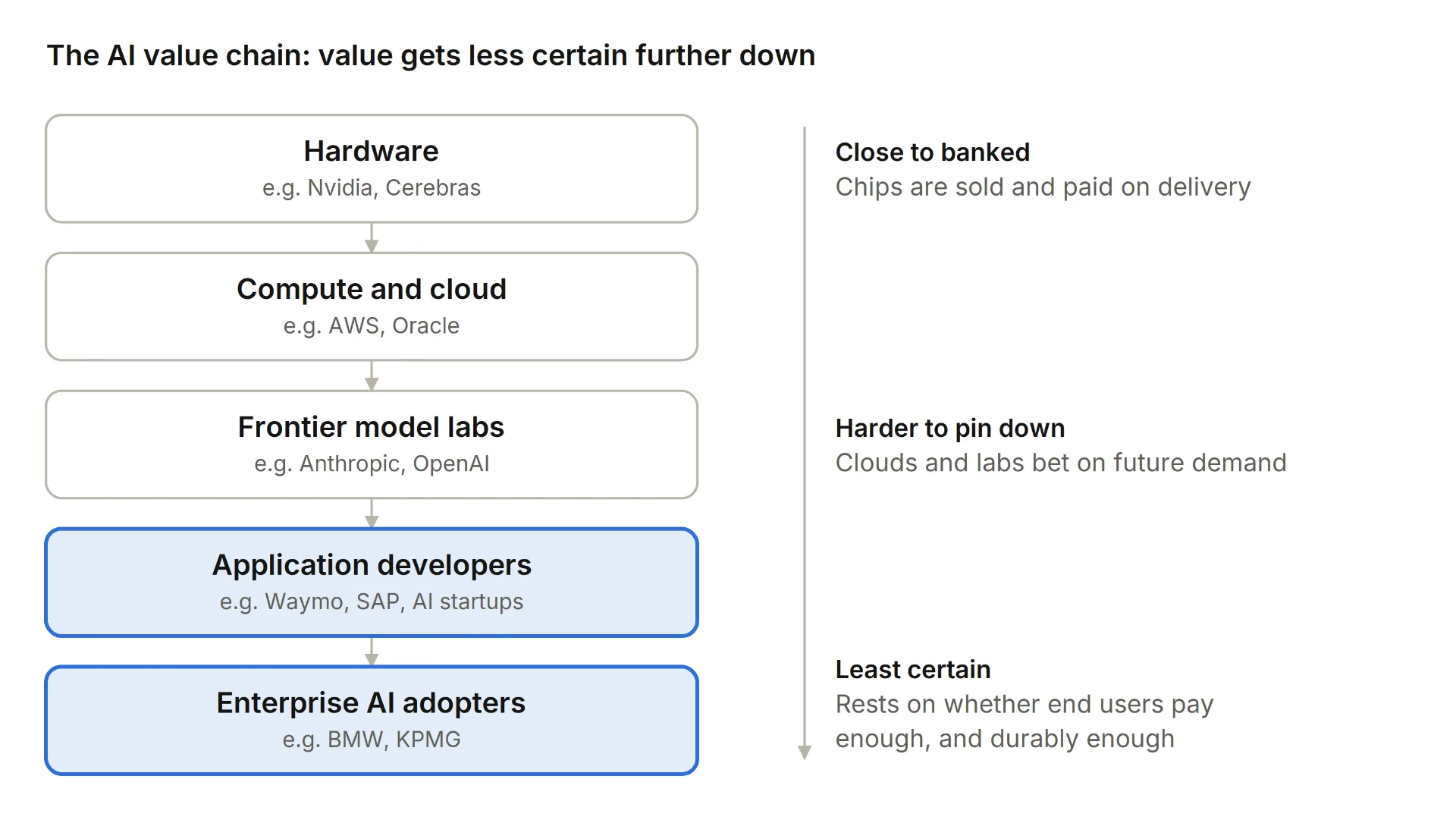
To judge an AI claim, you must first understand the architecture of the industry producing it. The AI value chain is not a neutral marketplace; it is a five-layer hierarchy that dictates how value—and risk—is distributed.
The Five Layers of AI
- The Silicon Layer: The hardware manufacturers (e.g., NVIDIA) providing the compute necessary to run models.
- The Cloud Providers: The hyperscalers providing the infrastructure to host and train these models.
- The Model Labs: The developers (e.g., OpenAI, Anthropic) creating the intelligence layer.
- The Middleware/Tools: The platforms and harness providers (e.g., LangChain, agentic frameworks).
- The Enterprise Adopters: The businesses, like yours, that consume these technologies to build end-user applications.
At the top of this chain, the money is "banked." Silicon is sold, paid for, and shipped. However, as we move down toward the end-user, value becomes increasingly nebulous. Much of the current AI "demand" is actually a circular economy: chipmakers fund model labs, labs commit to cloud providers, and cloud providers buy more chips. True, sustainable end-user demand—where a business generates actual profit from an AI implementation—is the final, and most uncertain, frontier.
The Odds Against the Enterprise Consumer
If you are an enterprise adopter, you are the target of the entire ecosystem. Your position is uniquely vulnerable because the "last mile" of AI integration remains largely unpaved. According to the McKinsey 2025 survey, over 80% of companies utilizing generative AI have yet to report a clear, measurable impact on their bottom-line profits. Furthermore, the RAND Corporation has observed failure rates exceeding 80% for AI initiatives.
The primary defense against this reality is not to ignore AI, but to develop the judgment to apply it only where it solves a genuine business problem.
2. Building a Foundation: Peeling Back the Emotional Layer
AI marketing is uniquely adept at bypassing logic by exploiting three core human blind spots: the fear of obsolescence, the desire for "magic" solutions, and the pressure of social proof.
The Mechanics of Hype
When you read an article claiming that an AI agent will "transform your workflow in 24 hours," notice the emotional cadence. It is designed to create urgency. This "house of cards" approach works because each claim is supported by another—a flashy demo, a cherry-picked statistic, or a trend-driven buzzword.
To dismantle this, you must build a foundation of knowledge consisting of two pillars:
- Technical Literacy: Understanding the limitations of probabilistic models (hallucinations, context window constraints, and latency).
- Domain Expertise: Understanding your own business processes well enough to identify where non-deterministic systems will fail.
With this foundation, a vendor promise of "zero hallucinations" changes from an exciting marketing bullet point into a critical engineering question: “How is the retrieval-augmented generation (RAG) pipeline structured, what is the source data veracity, and how is the model’s confidence threshold calibrated?”

3. Intentional Consumption: Reading Between the Lines
Information in the AI space is rarely neutral. To protect your roadmap, you must learn to invert the consumption process: read backwards from the call to action.
The "Follow the Money" Audit
Ask yourself: Who benefits if I adopt this technology? If a consulting firm releases a study claiming "90% of CIOs are failing without AI agents," look at who commissioned that study. It is often a company selling agent management software. That does not necessarily make the data false, but it highlights that the conclusion is designed to nudge you toward a specific purchase.
Recognizing the Red Flags
When reviewing content, keep a checklist of linguistic markers that indicate hype rather than substance:
- Anthropomorphism: Referring to software as having "thoughts," "intent," or "reasoning."
- Universal Claims: Using terms like "solves everything," "replaces manual labor," or "zero-shot mastery."
- Lack of Evidence: Relying on anecdotal "success stories" rather than repeatable, audited performance metrics.
Consider the contrast between successful products and hype-driven ones. Cursor, for instance, became a cornerstone of developer workflows because the product provided tangible value immediately, requiring little in the way of outbound marketing. Conversely, firms like the now-bankrupt Builder.ai relied on heavy marketing, promising "software as easy as ordering pizza," only to face accusations of "AI washing" when the product failed to deliver on its foundational claims.
4. Establishing a Decision Filter
To maintain your focus, run every new AI "innovation" through a formal filter before it touches your roadmap.
- The Relevance Test: Does this solve a problem that is currently causing a measurable drag on our KPIs?
- The Evidence Test: Can we verify the performance of this tool on our own data, in our own environment, within two weeks?
- The Complexity Test: Does the long-term maintenance cost of this AI system outweigh the short-term productivity gain?
If an idea cannot clear these three hurdles, it is relegated to the "research" bucket—not the "development" bucket.

5. Pushing Back Without Being "Against AI"
The goal of being a skeptical leader is not to obstruct progress; it is to ensure that progress is sustainable. When a team member brings you an AI proposal, your response should be a bridge to better analysis, not a wall.
Table 1: Decoding Vendor Claims
| Claim | The "Deflator" Question |
|---|---|
| "This agent will eliminate your manual work." | "What is the expected error rate, and how much manual oversight is required to audit the output?" |
| "We have zero hallucinations." | "What is the provenance of the training data, and how do you handle low-confidence scenarios?" |
| "This is a plug-and-play solution." | "How does this integrate with our legacy security protocols and existing data silos?" |
| "It’s as smart as a human." | "What specific benchmark tests were used to measure ‘intelligence’ in this context?" |
Implications for Future Strategy
As we move into the next phase of the AI cycle, the firms that survive will be those that view AI as a tool for efficiency rather than a product in itself. The "agentic" hype wave will eventually crash, leaving behind only those systems that deliver measurable, repeatable value.
By refusing to be swept up in the noise and instead demanding rigor, transparency, and objective performance metrics, you position yourself as a steward of your organization’s resources. You are not saying "no" to AI; you are saying "yes" to projects that actually work.
The next time a vendor or a colleague approaches you with the latest "must-have" AI agent, treat it as an opportunity to test your own decision logic. Break it down, verify the inputs, and measure the outcome. In the long run, your team will value the stability of your roadmap far more than the fleeting excitement of an unproven trend.

 Nana Wu
 Asro
Asro
 Jia Lissa
 Neng Nana
 Iffa Jayyana
 Evan Lee Salim
 Rifan Muazin