Asro
Asro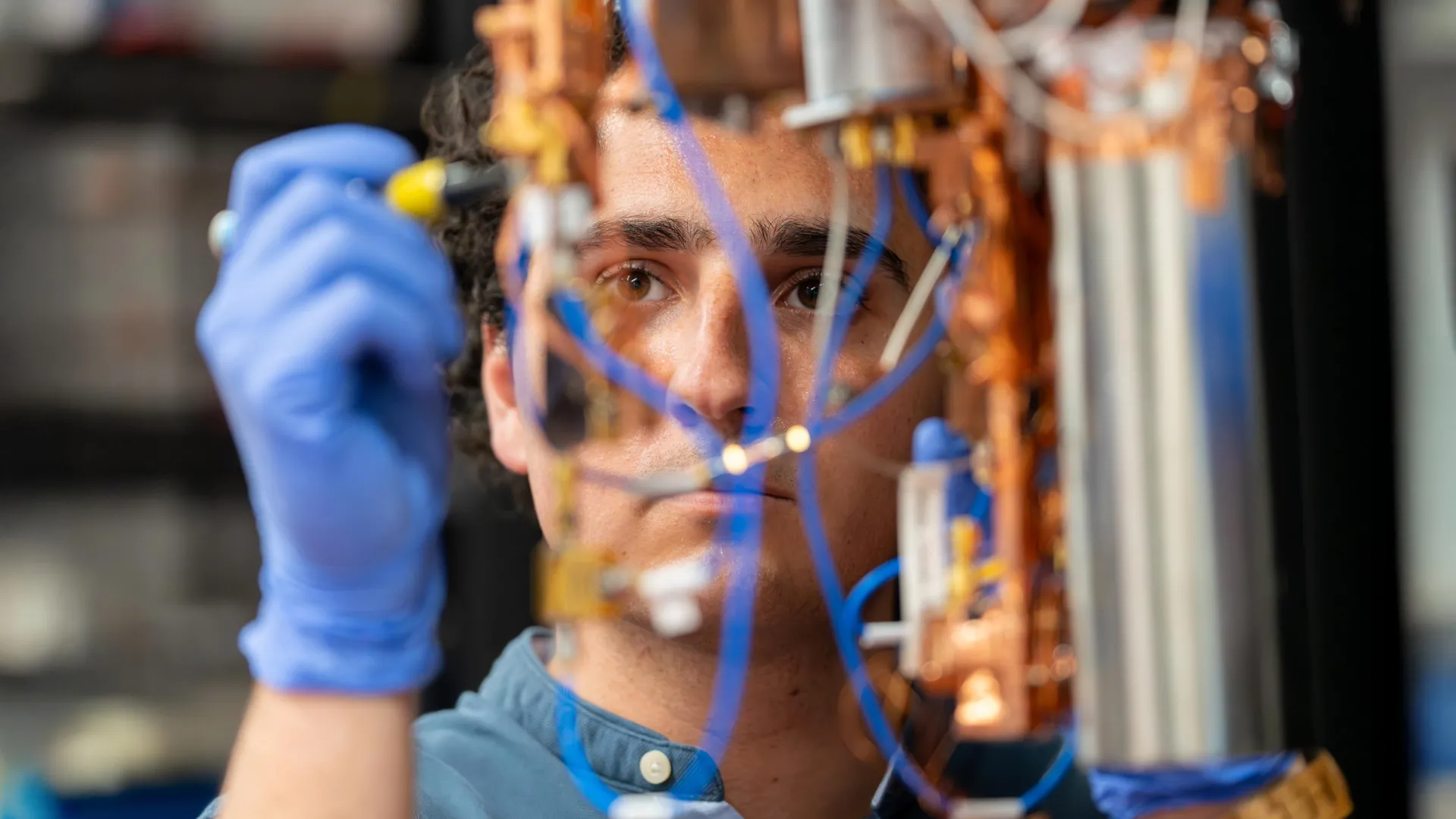
The quest to build a functional, large-scale quantum computer is, at its core, a battle against decoherence and the limitations of physical distance. For years, the scientific community has grappled with a fundamental constraint: how to link stationary qubits—the building blocks of quantum processors—across physical gaps without relying on fragile, measurement-heavy processes.
A team of physicists at the Institute of Science and Technology Austria (ISTA), led by Professor Johannes Fink and PhD student Alejandro Andrés-Juanes, has reached a significant milestone in this pursuit. As detailed in their recent publication in Physical Review X, the team has successfully demonstrated a "quantum bath" that autonomously synchronizes distant qubits using a stream of correlated light particles. This achievement moves quantum networking away from the hit-or-miss, active-control methodologies of the past and toward a robust, passive architecture that could redefine the scalability of quantum systems.
Main Facts: The Autonomous Paradigm Shift
At the heart of the ISTA breakthrough is the concept of a "quantum bath." Traditionally, entangling two distant qubits required a series of complex, active steps: sending a photon, performing a measurement, and "post-selecting" successful events—a process that is inherently probabilistic and prone to failure.
The ISTA team’s innovation replaces this active intervention with a continuous, steady-state environment. By bathing two spatially separated qubits in a stream of correlated microwave photons, the researchers forced the qubits into an entangled state without the need for external feedback loops.
Key Technical Innovations:
- Continuous Entanglement: Unlike previous methods that created fleeting, temporary entanglement, this system maintains a constant state of correlation. The qubits are "always on" and available for quantum processing.
- The Quantum Bath: The environment surrounding the qubits acts as a stabilizing force, effectively "pumping" the entangled state into existence through a shared source of correlated light.
- Microwave Architecture: Utilizing low-energy microwave photons, the system integrates seamlessly with existing superconducting-qubit technology, the current industry standard for quantum computing.
Chronology: A Two-Decade Quest
The journey to this discovery is a testament to the persistence of theoretical physics. The concept of using a "bath" of correlated particles to induce entanglement was first proposed in theoretical papers over 20 years ago. However, the gap between the idealized mathematical models of the early 2000s and the messy, noise-prone reality of a laboratory environment was profound.
The Timeline of Discovery:
- Early 2000s: Theoretical physicists formulate the concept of "dissipative state engineering," suggesting that a quantum system could be driven into a desired entangled state by interacting with a specifically engineered reservoir or "bath."
- The Middle Years: Numerous attempts to replicate this in the lab failed due to the difficulty of creating a high-fidelity, persistent stream of correlated particles that could overcome the qubits’ natural tendency toward decoherence.
- Recent Years (The ISTA Effort): Professor Johannes Fink and his team began systematically analyzing why the theory had not been translated into practice. They identified that earlier efforts often lacked the necessary stability in the photon source.
- The Breakthrough (2024): By refining the correlation of the microwave photon source and carefully managing the coupling between the qubits and their environment, the ISTA team successfully realized the long-standing prediction. The experiment confirmed that the theoretical model, when adapted for experimental constraints, could indeed function as a reliable source of distributed entanglement.
Supporting Data: Peering into the Quantum State
Validating that the qubits were, in fact, entangled required extraordinary precision. Because the act of measuring a quantum state causes it to "collapse," the researchers utilized a technique known as quantum tomography.
Measurement Methodology:
- The 20-80 Nanosecond Window: Using high-speed measurement electronics, the team performed quantum state tomography in intervals of 20 to 80 nanoseconds. This allowed them to capture "slices" of the qubits’ behavior before decoherence could set in, enabling the reconstruction of the underlying entangled state.
- Efficiency Metrics: The current prototype demonstrates a 10% efficiency in transferring the bath’s available entanglement to the qubits. While this represents a proof-of-concept, the researchers note that this figure is sufficient to confirm the mechanism’s viability.
- Scalability Potential: The ISTA team emphasizes that the simplicity of the method—which relies on a single source of correlated light—offers a clear path toward scaling. Instead of managing pairs of qubits individually, future designs could potentially link entire arrays of qubits to a single, shared quantum bath.
Official Responses: Insights from the ISTA Team
The significance of the experiment lies not just in its success, but in its conceptual departure from traditional quantum networking.
"In this work, we aimed to overcome this mismatch between the readily available and the practically useful forms of entanglement," explains Alejandro Andrés-Juanes, the lead researcher on the project. "By stabilizing the entangled states remotely, our approach is fully autonomous and requires no active control or measurement."
Professor Johannes Fink adds that the beauty of the system is its ability to defy the short lifetimes of individual qubits. "In our method, the quantum bath is the source of entanglement. It creates a new ground state through a continuous stream of correlated photons. This way, the entangled qubit state is stabilized, even beyond the qubits’ own ‘lifetime’, and remains always available as a resource for further quantum processing."
The team acknowledges that the transition from theory to practice was hindered for decades by the "idealized conditions" assumed in early models. By revealing the practical factors—such as precise coupling and photon synchronization—that previously prevented functional realizations, the ISTA team has provided a blueprint for future experiments in the field.
Implications: Building the Quantum Internet
The implications of this research extend far beyond the laboratory bench. As quantum computing moves from experimental curiosity to industrial application, the ability to create robust, distributed quantum networks will be the deciding factor in feasibility.
1. Toward Fault-Tolerant Computing
One of the primary goals of the quantum industry is "fault tolerance"—the ability of a computer to correct its own errors. A system that can autonomously maintain entanglement between modules is inherently more resilient than one that requires manual, error-prone active intervention.
2. The Future of Quantum Communication
While the ISTA team utilized microwave photons (ideal for local superconducting circuits), the underlying principle of a quantum bath could theoretically be adapted for optical photons. Optical photons are the gold standard for long-distance communication via fiber optics. If researchers can create an "optical quantum bath," it could lead to the development of quantum repeaters, which are essential for a long-distance, secure quantum internet.
3. Bridging the Gap
The ISTA experiment acts as a bridge between "continuous-variable" entanglement (which is relatively easy to generate) and "discrete-variable" systems (which are necessary for the logical operations performed by quantum computers). By solving this "mismatch," the researchers have cleared a significant hurdle for modular quantum architecture.
Conclusion
The work performed at the Institute of Science and Technology Austria is more than a technical success; it is a validation of the power of theoretical foresight. By proving that a quantum bath can autonomously stabilize entanglement, Fink and Andrés-Juanes have provided a new foundation for modular quantum computing. While current efficiencies remain at 10%, the scalability and simplicity of this approach suggest that it will likely become a cornerstone technique for the quantum networks of tomorrow. As the team continues to refine their prototype, the path toward stable, distributed quantum processors looks clearer than it has in the last two decades.


 Nana Wu
 Lina Irawan
 Laily UPN
 Iffa Jayyana
 Rifan Muazin
 Suro Senen
 Lina Hope