
 Lina Hope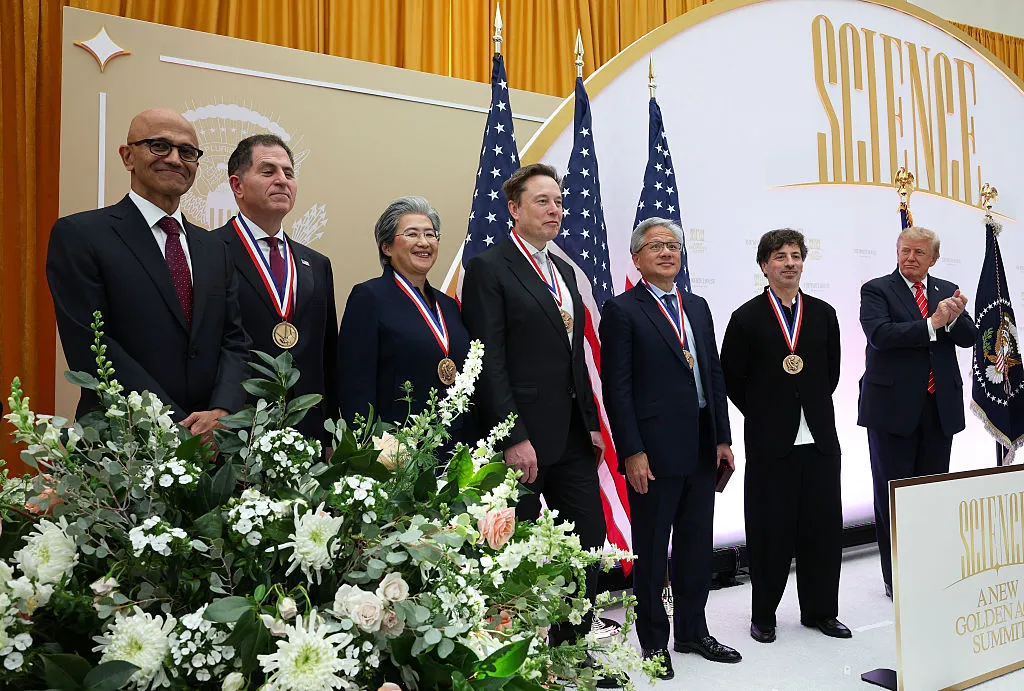
By [Your Name/Agency]
Updated: October 8, 2026 | 3:33 PM PDT
Introduction: A Gathering of Industry Giants
In a high-profile ceremony held at the White House on Thursday, President Donald Trump presided over the "Golden Age of American Innovation Summit." The event served as the backdrop for the presentation of the United States’ highest honors in scientific and technological achievement: the National Medal of Science and the National Medal of Technology and Innovation.
The roster of recipients was a veritable "who’s who" of the modern Silicon Valley elite. Among those honored with the National Medal of Science were Tesla and SpaceX CEO Elon Musk, Nvidia CEO Jensen Huang, Alphabet co-founder Sergey Brin, and AMD CEO Lisa Su. Simultaneously, the National Medal of Technology and Innovation was presented to Dell Technologies CEO Michael Dell and Microsoft CEO Satya Nadella.
The ceremony was framed by the administration as a celebration of American ingenuity and a reaffirmation of the country’s dominance in global markets. However, the event has sparked significant controversy, as critics and political observers point to the deep financial ties between these honorees and the current administration.
Chronology of the 2026 Innovation Summit
The events of October 8 were the culmination of a weeks-long initiative by the White House to rebrand its economic policy as a catalyst for a new "Golden Age."
- September 15, 2026: The White House announces the "Golden Age of American Innovation Summit," promising to highlight leaders who have "secured American competitiveness."
- October 1, 2026: Reports begin to circulate regarding the list of potential honorees, sparking initial speculation about the intersection of political donations and government recognition.
- October 8, 2026, 9:00 AM: The Summit begins with a series of closed-door policy discussions regarding AI infrastructure and domestic semiconductor manufacturing.
- October 8, 2026, 2:00 PM: President Trump formally presents the medals in the East Room. The ceremony is marked by speeches emphasizing the "America First" approach to technological development.
- October 8, 2026, 4:00 PM: News breaks regarding the irony of Microsoft CEO Satya Nadella’s award, coming on the heels of the administration’s decision to indefinitely suspend Microsoft from the H-1B visa program.
Supporting Data: The Cost of Recognition
The legitimacy of these awards has been challenged by recent investigative reporting, most notably by The New Republic, which cataloged a staggering nearly $6 billion in combined donations from the honorees to causes and initiatives tied to the Trump administration.
Breakdown of Financial Contributions:
- The Trump Accounts: Perhaps the most significant contribution came from Michael and Susan Dell, who pledged $6.25 billion to the "Trump Accounts," a federal savings program designed for children.
- Corporate Political Giving: Records indicate that both Alphabet (Google) and Microsoft contributed substantial sums to the President’s inauguration fund and were instrumental in financing the renovation of the White House ballroom.
- Super PAC Funding: AMD, led by Lisa Su, was noted for its contributions to pro-Trump Super PACs, signaling a alignment between the firm’s lobbying interests and the administration’s electoral efforts.
While corporate contributions to political causes are a standard feature of the American lobbying landscape, the sheer scale of the funds involved—and the direct correlation between major donors and the recipients of the nation’s highest scientific honors—has ignited a debate about the integrity of the selection process for the National Medals.
Official Responses and the "America First" Narrative
During his keynote address, President Trump framed the honorees as essential pillars of national strength. "These individuals have pioneered an incredible future for America," the President stated. "Because of their work, we will always be on top. No one else can compete with us."
The White House press office maintained that the awards were based solely on merit, citing the immense economic impact of the recipients’ companies. Spokespeople emphasized that the administration’s focus is on incentivizing domestic production and that the donations mentioned in the press were separate from the selection process.
However, the awards were met with a mixed reception in the scientific community. While few would dispute the technical contributions of figures like Jensen Huang—whose GPUs have become the bedrock of the global artificial intelligence boom—or the aerospace advancements of Elon Musk, the timing and the perceived transactional nature of the awards have cast a long shadow over the proceedings.

The Microsoft Paradox: H-1B Suspension
Perhaps the most jarring element of the day was the timing of Satya Nadella’s award. The ceremony occurred shortly after the Department of Labor announced the indefinite suspension of Microsoft from the H-1B visa program.
The H-1B program is a critical component of the tech industry, allowing companies to recruit highly skilled foreign nationals to work in specialized roles within the United States. For a company like Microsoft, which relies heavily on global talent to maintain its cloud computing and software leadership, the suspension is a significant blow.
Industry analysts are puzzled by this move. "You have the President giving the highest technology award in the country to the CEO of a company he is simultaneously cutting off from the labor pool it needs to function," said one policy analyst. "It highlights a major disconnect within the administration’s own policy framework—an attempt to appease tech leadership with honors while aggressively pursuing an isolationist labor policy."
Implications: The Future of Tech-Policy Relations
The 2026 Summit signals a new era in the relationship between the federal government and the private sector. By tying state-level honors to significant financial contributions, the administration has effectively signaled that "innovation" is now inseparable from political alignment.
1. The Politicization of Scientific Merit
The National Medal of Science was historically viewed as a non-partisan recognition of research excellence. By awarding it to industry leaders during a time of intense political polarization, the administration risks devaluing the medal itself. Future recipients may face scrutiny regarding their political affiliations, which could deter academic researchers from accepting the honor.
2. The Shift Toward Corporate Protectionism
The tension between the H-1B suspension and the award given to Microsoft suggests a "carrot and stick" approach. The administration is signaling that it expects major tech firms to invest heavily in American infrastructure and domestic political causes, while simultaneously using immigration policy as a lever to enforce strict domestic labor standards.
3. Industry Consolidation
The selection of these specific CEOs reinforces the current trend toward corporate consolidation. By honoring the heads of the largest, most influential firms, the administration is effectively choosing winners in the tech sector. This may lead to an environment where smaller, emerging companies find it increasingly difficult to compete, as they lack the capital to participate in the "donations-for-access" loop that the 2026 Summit has highlighted.
Conclusion: A Legacy in Question
The "Golden Age of American Innovation Summit" will likely be remembered not just for the individuals it honored, but for the questions it raised about the health of American institutions. As the dust settles on the ceremony, the tech industry is left to grapple with a new reality: one where the line between private sector innovation and federal political maneuvering has all but vanished.
Whether this new dynamic will lead to the "incredible future" promised by the President or merely accelerate the erosion of trust in public-private partnerships remains to be seen. For now, the recipients of the medals have received their accolades, but the broader industry—and the public—are left to wonder what the true cost of these awards has been to the integrity of American science and technology.

 Evan Lee Salim
 Suro Senen
 Sagoh
Sagoh
 Ali Ikhwan
 Laily UPN
 Jia Lissa
 Neng Nana
 Iffa Jayyana