
 Nana Muazin
In the race to achieve fault-tolerant quantum computing, the industry has hit a formidable wall: the "noise floor." As engineers attempt to scale systems from a few dozen qubits to thousands or millions, the delicate quantum states required for computation are increasingly besieged by environmental interference. Now, a team of researchers at the University of Surrey has proposed a radical departure from conventional hardware, introducing a new qubit design centered on the exotic properties of superfluid helium-3. This development, published in the journal npj Quantum Information, offers a potential pathway to error rates up to 100 times lower than those currently achievable by leading superconducting systems.
The Quantum Scaling Bottleneck: Why Current Systems Struggle
To understand the significance of the University of Surrey’s proposal, one must first understand the fragility of the status quo. Most contemporary quantum computers, such as those developed by tech giants like IBM and Google, utilize superconducting circuits—tiny loops of metal that, when cooled to near absolute zero, allow electricity to flow without resistance. These circuits rely on the Josephson junction to create a quantum state, forming what is known as a transmon qubit.
While effective at small scales, these superconducting qubits are notoriously temperamental. They are essentially microscopic antennas, highly susceptible to electromagnetic interference and stray electrical charges. Much like the static electricity that causes hair to cling to a balloon, ambient electromagnetic noise in a laboratory setting can cause "decoherence"—the process by which a qubit loses its quantum information, leading to calculation errors.
As designers add more qubits to a processor, the complexity of shielding these sensitive components from one another, and from the outside world, grows exponentially. This "scaling crisis" has led many researchers to search for materials that are inherently less sensitive to electromagnetic "chatter."
A New Paradigm: The SHOQ Device
The Surrey team, led by the Quantum Sciences Group, has pivoted toward a state of matter that is as mysterious as it is promising: superfluid helium-3. Unlike standard fluids, helium-3, when cooled to temperatures just a fraction of a degree above absolute zero, enters a superfluid state. In this state, the liquid exhibits zero viscosity, effectively flowing without friction.
The researchers have conceptualized the "Superfluid Helium Oscillator Quantum" (SHOQ) device. The genius of the design lies in its charge-neutrality. Because the superfluid helium itself carries no electric charge, it is naturally shielded from the electromagnetic noise that plagues superconducting circuits. By confining this superfluid within a microfluidic architecture, the team believes they can manipulate quantum states in a medium that is essentially "deaf" to the electrical interference that causes errors in current-generation machines.
Chronology of the Research
The path to the SHOQ device was not an overnight breakthrough, but a calculated evolution in quantum materials science:
- Early Conceptualization: The researchers began by examining the theoretical limits of superfluid helium-3 in quantum information storage, drawing on decades of low-temperature physics research.
- The Collaboration: The project was spearheaded by the University of Surrey, featuring a strategic partnership with Professor Jens Koch of Northwestern University. Professor Koch’s previous contribution to the development of the "transmon"—the gold standard for superconducting qubits today—provided the team with a unique perspective on the limitations of current architectures.
- Theoretical Modeling (2023-2024): The team performed rigorous mathematical modeling to determine whether a microfluidic device could realistically host a qubit. These calculations validated the parameters required to maintain quantum coherence.
- Publication and Recognition: The findings were formally published in npj Quantum Information, validating the mathematical feasibility of the design.
- Current Phase: With the support of an IAA Commercialisation Fellowship awarded to lead author Dr. Priya Sharma, the team has moved into the prototype development phase.
Supporting Data and Technical Specifications
The core of the SHOQ device’s promise is its predicted performance. Theoretical modeling indicates that the SHOQ qubit could achieve an error rate approximately two orders of magnitude lower than current superconducting standards.
The device functions by utilizing the quantized vortices within the superfluid. In the superfluid state, any rotation of the liquid is restricted to quantized units. These quantized states provide the two-level system necessary to define a qubit—the 0 and the 1 of quantum information. Because these states are defined by the physical movement of the superfluid rather than the oscillation of electrons, the qubit is decoupled from the electromagnetic noise environment.
The system operates at "millikelvin" temperatures. While this requires advanced dilution refrigeration, the infrastructure for reaching such extreme cold is already well-established in the quantum computing community, making the integration of a SHOQ-based component technically feasible within existing laboratory setups.
Official Responses and Expert Perspectives
The reaction from the research community has been one of cautious, yet profound, optimism. Dr. Priya Sharma, the lead author of the study and Daphne Jackson Fellow at Surrey, emphasizes that this is not merely a theoretical exercise.
"We are not the first to think about the individual components behind this idea, but what we have done for the first time is bring them together in a microfluidic device and work out the specific details that could enable the device to function as a qubit," Dr. Sharma noted. "The maths tells us that it should work. We have taken what we already know about superfluid helium and quantum technologies and turned that into an educated design."
Dr. Eran Ginossar, Associate Professor at the University of Surrey and co-author, highlights the importance of hybrid architectures. "We don’t necessarily need one type of qubit to do everything," Dr. Ginossar stated. "Combining different quantum technologies could allow us to take advantage of the strengths of each. Superfluid helium gives us a fundamentally different type of quantum hardware to explore."
Implications: The Future of Quantum Architecture
The emergence of the SHOQ device suggests a shift in how we perceive the "ideal" quantum computer. Instead of a monolithic architecture composed of a single type of qubit, the future may look more like a heterogeneous landscape.
A Role for Quantum Memory
One of the most compelling long-term applications for the SHOQ device is as "quantum memory." In current systems, qubits must perform two roles simultaneously: processing data and storing it. This dual burden increases the likelihood of errors. By utilizing a superfluid-based qubit as a static storage medium—due to its inherent stability and lower noise sensitivity—engineers could offload the storage requirements from the processors. The SHOQ device would effectively act as a high-fidelity "buffer," allowing the superconducting processors to focus on high-speed calculations.
Bridging the Gap
The researchers emphasize that their goal is not to render existing hardware obsolete. Rather, the SHOQ device is designed to be integrated into existing superconducting systems. This modular approach could be the key to overcoming the "scaling wall." If a quantum processor can delegate tasks based on the specific strengths of the qubit—using transmon qubits for fast gate operations and SHOQ qubits for stable, long-term memory—the error rates of the entire system could drop precipitously.
The Prototype Challenge
The next 18 to 24 months will be critical for the Surrey team. Building a prototype involves complex nanofabrication, specifically the creation of the microfluidic channels required to house the superfluid helium-3, and the integration of superconducting sensors to read out the quantum states of the superfluid.
While the team acknowledges the technical hurdles, they are bolstered by the fact that the underlying physics of superfluid helium-3 is well-understood. The challenge is no longer one of fundamental discovery, but of engineering—the transition from mathematical certainty to tangible hardware.
Conclusion
The University of Surrey’s proposal for a superfluid helium qubit marks a turning point in the field of quantum computing. By stepping outside the established reliance on purely electronic, charge-based qubits, the team has opened a new frontier in materials science. Should the experimental prototype mirror the results of the theoretical models, the SHOQ device could prove to be the "missing link" needed to stabilize large-scale quantum computers.
In the high-stakes, multi-billion-dollar race to achieve quantum supremacy, the most effective solution may not be to build a better superconducting qubit, but to change the medium of the information itself. As the team moves toward the laboratory phase, the physics community watches with bated breath, hopeful that this exotic fluid might finally bring order to the chaotic world of quantum information.


 Nana Wu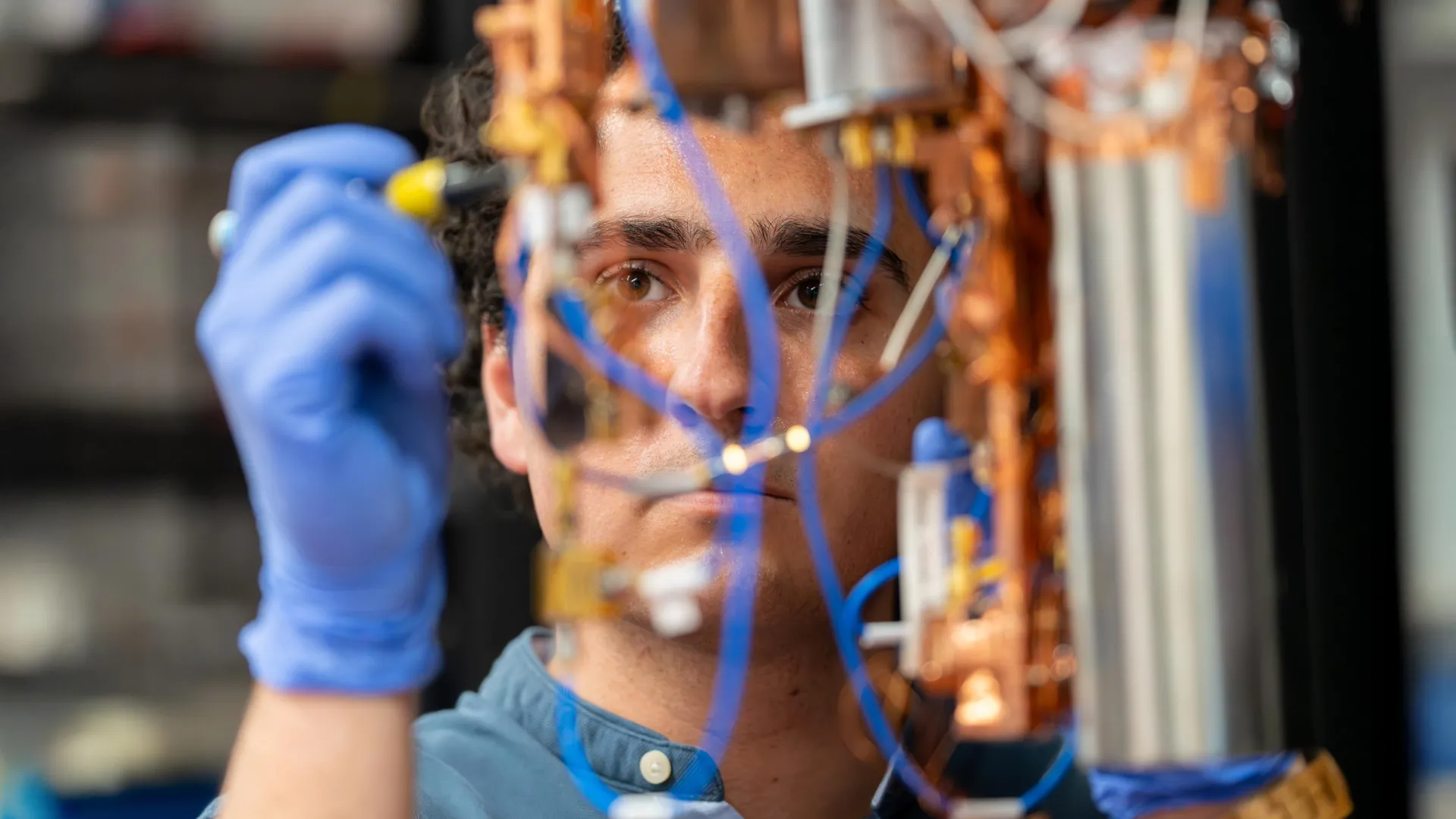
 Asro
Asro
 Laily UPN
 Jia Lissa
 Neng Nana
 Iffa Jayyana
 Evan Lee Salim
 Rifan Muazin