
 Rifan Muazin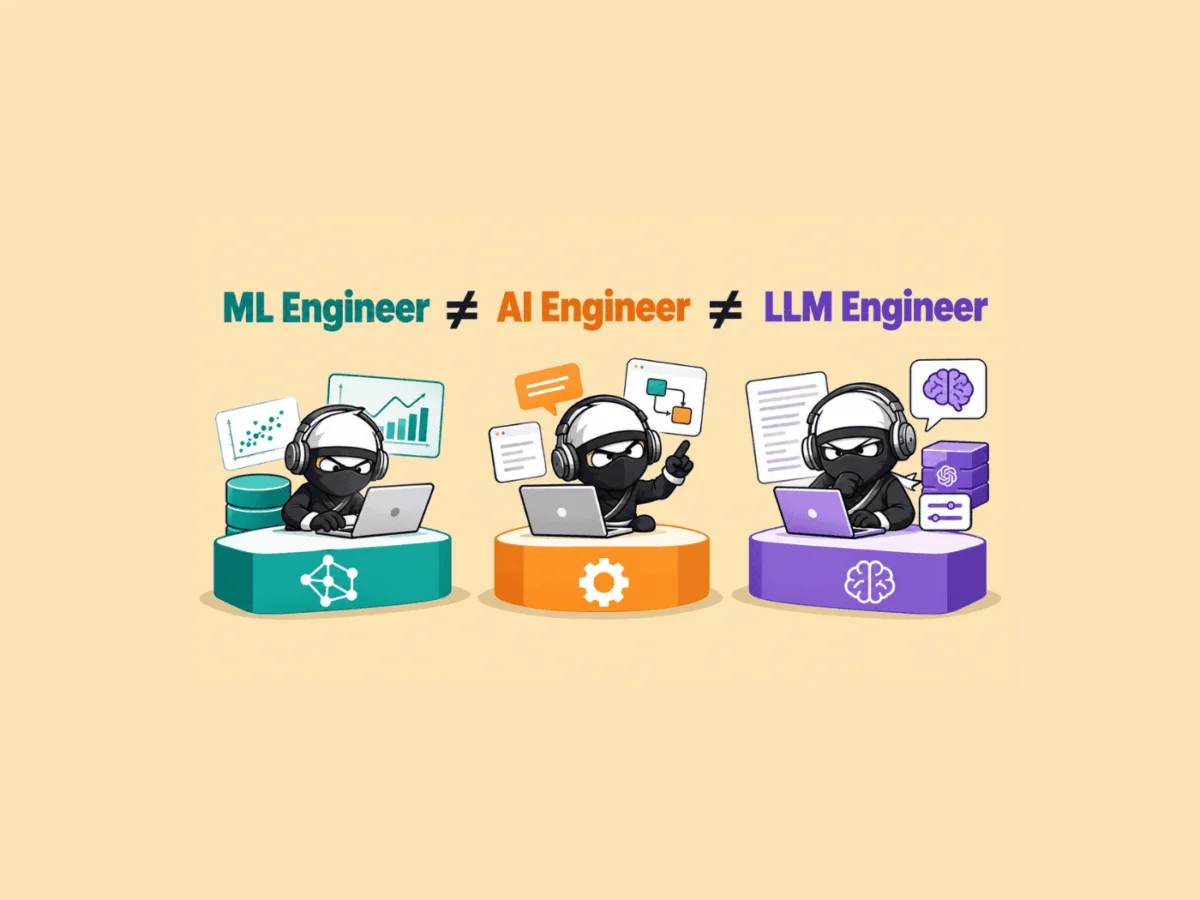
In the modern job market, searching for a position in the artificial intelligence sector is akin to navigating a labyrinth without a map. A candidate might open three different job portals and search for "AI," only to find three distinct companies offering positions titled "AI Engineer," "Applied AI Engineer," and "LLM Engineer." Despite the varying nomenclature, the listed responsibilities often read like a copy-paste job: proficiency in Python, the ability to manage API keys for large language models (LLMs), a vague reference to "retrieval systems," and a standard line regarding "production reliability."
However, beneath this superficial homogeneity lies a complex web of varying expectations. One posting may prioritize hands-on experience with LangChain, while another demands deep expertise in fine-tuning weights via LoRA. A third might simply require the ability to interface with an API and write clean evaluation scripts. The divergence is not merely semantic; it represents a fundamental lack of industry consensus on what these roles entail, leading to significant confusion among job seekers and recruiters alike.
The Evolution of AI Roles: A Brief Chronology
To understand the current state of industry confusion, one must look at the rapid evolution of the field. Initially, the role of the Machine Learning (ML) Engineer emerged as a specialized offshoot of data science. As organizations moved from the experimentation phase of data analysis to the need for persistent, scalable model deployment, the requirement for a professional who could bridge the gap between research prototypes and production environments became critical.
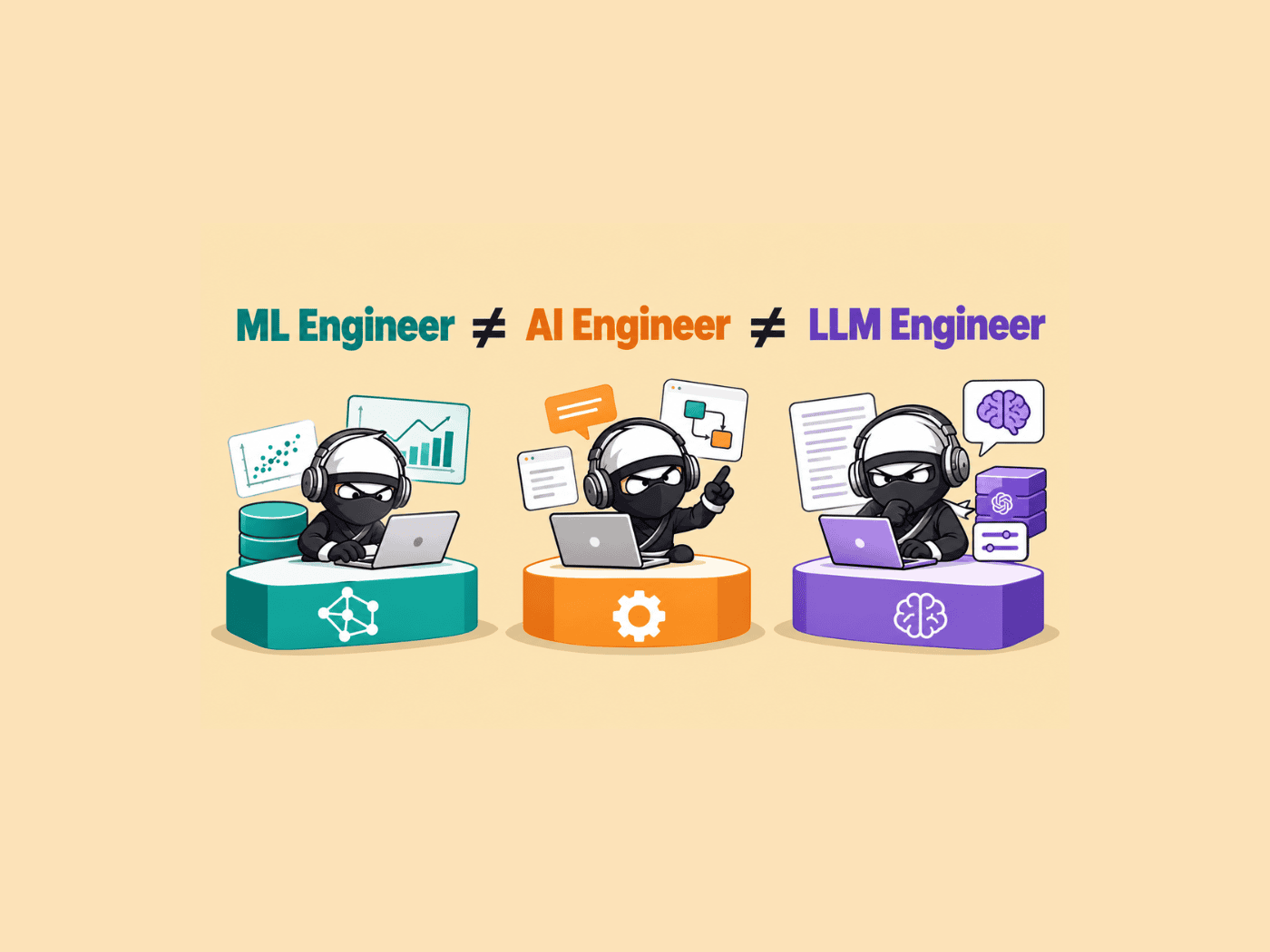
Following the massive shift toward generative AI around 2022, a new category was born: the AI Engineer. This role materialized almost overnight, driven by the accessibility of powerful, pre-trained models. Because the field matured so quickly, the industry did not have time to standardize a taxonomy. Consequently, companies adopted a grab bag of titles—GenAI Engineer, RAG Engineer, and Prompt Engineer—to attract talent, often using these titles interchangeably despite the vastly different technical requirements they imply.
The Technical Taxonomy: Defining the Roles
Distinguishing between these roles requires looking past the title to the core outputs. What is the engineer actually shipping?
1. The Machine Learning Engineer
The Machine Learning Engineer sits at the intersection of traditional software engineering and data science. Their primary mandate is to build and train models from raw data. While a data scientist focuses on exploration and prototyping, the ML Engineer focuses on reliability and scale. Their daily loop involves collecting and cleaning massive datasets, selecting algorithms, training models, and validating them against rigorous metrics like RMSE or confusion matrices.
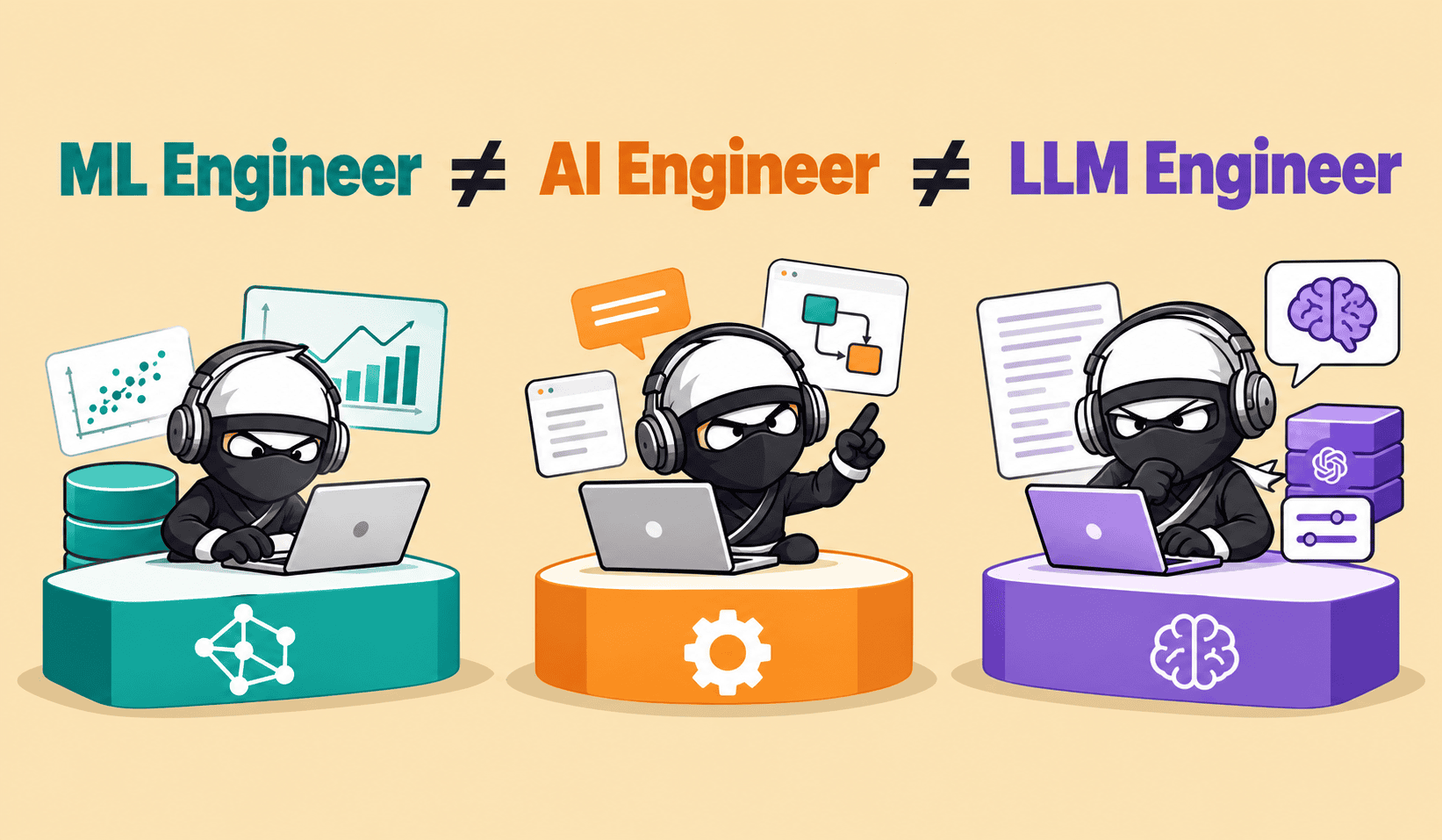
The core tools for this role—PyTorch, TensorFlow, and scikit-learn—are designed for structural model development. The final output is usually a highly specialized product, such as a fraud detection score, a demand forecasting engine, or a recommendation system that must perform under load.
2. The AI Engineer
The AI Engineer operates at a different layer of the stack. They rarely "train" a model from scratch. Instead, they act as the connective tissue between a pre-existing, powerful model (often accessed via API) and a real-world product. An AI Engineer’s day is dominated by prompt design, retrieval-augmented generation (RAG) pipelines, and integrating models into backend infrastructure.
They are the architects of the "agentic" experience—creating systems that can perform multi-step tasks. Their success is measured not by the accuracy of a model’s weights, but by the reliability of the system as a whole, specifically monitoring for hallucinations, latency, and quality drops.

3. The LLM Engineer
The LLM Engineer is a specialized subset of the AI Engineering role. While they share the AI Engineer’s stack, their differentiator is the expertise in model fine-tuning. When a general-purpose model is insufficient for a domain-specific task, the LLM Engineer applies techniques like LoRA (Low-Rank Adaptation) or QLoRA to adjust the model’s weights. A hallmark of a senior LLM Engineer is the wisdom to avoid fine-tuning unless absolutely necessary, as they recognize that superior retrieval systems or prompt engineering are often more cost-effective and easier to maintain.
Supporting Data: Why Titles and Pay Diverge
The lack of standardization has direct economic consequences. Research into current job postings indicates that two roles with identical technical requirements can carry significantly different salary bands simply because one is labeled "LLM Engineer" and the other "AI Engineer."
This "title inflation" is compounded by company size. In a lean startup, an individual may be forced to play the role of all three: training a model, building the retrieval infrastructure, and deploying the application. Conversely, in a large enterprise, these responsibilities are siloed into distinct departments: applied AI product engineering, infrastructure engineering, and model quality assurance.

Candidates who prioritize the title over the job description often find themselves in a "bait-and-switch" scenario. A candidate chasing the "AI Engineer" title for its perceived growth potential may find themselves relegated to basic prompt testing, while someone expecting to be an "ML Engineer" might be surprised to find their role is purely data-wrangling rather than architecture design.
The Implications for Career Development
For professionals entering the space, the implications are clear: the interview process is far more standardized than the job titles themselves. Regardless of the title on the business card, the core competencies required to succeed in all three roles remain remarkably consistent.
- Foundational Rigor: Every top-tier organization—from Meta to Uber—continues to prioritize fundamental skills. Proficiency in SQL, data shaping, and the ability to articulate clear, logical solutions to ambiguous problems are the true indicators of success.
- Problem Framing: The most critical skill for any of these roles is not memorizing the latest library, but rather understanding how to frame a business problem as a technical solution. Avoiding data leakage, selecting the right signals, and managing trade-offs are the "hidden" skills that distinguish senior engineers from juniors.
- The 90-Day Audit: Before accepting an offer, candidates should ignore the title and ask three specific questions: "What will I build in my first 90 days?" "What infrastructure will I be responsible for maintaining?" and "Who else is on the team, and what is their specific technical focus?"
Official Perspectives: The Path Forward
Industry leaders suggest that the naming chaos will eventually settle, but not in the immediate future. As organizations continue to iterate on their AI strategies, the roles will likely bifurcate further. We are already seeing the emergence of "AI Infrastructure Engineers"—those who build the platforms on which AI Engineers work—and "Forward-Deployed AI Engineers," who work directly with customers to implement bespoke solutions.

The best defense for a job seeker is to treat the job description as the only source of truth. If a posting mentions "training from scratch," you are looking at an ML Engineering role. If it mentions "RAG," "LangChain," and "APIs," you are looking at an AI Engineer. If it explicitly mentions "fine-tuning," "LoRA," and "weight adjustment," you are looking at an LLM Engineer.
Conclusion
The rapid growth of the AI sector has left the labor market in a state of flux, with titles evolving faster than the definitions behind them. While the "Great Title Inflation" may cause short-term confusion, it ultimately rewards those who look past the surface-level marketing of a job posting.
Whether you are a seasoned ML Engineer or a newcomer looking to enter the LLM space, the advice remains the same: focus on the craft of building, the rigor of your data pipelines, and the clarity of your logic. Companies may rename these roles every six months, but the ability to solve complex, real-world problems using machine intelligence will remain the most valuable skill in the modern economy. Do not let the title dictate your career trajectory; let the work you own define your professional identity.

 Nana Wu
 Asro
Asro
 Laily UPN
 Iffa Jayyana

 Suro Senen
 Lina Hope
 Lina Irawan