
 Nila Kartika Wati
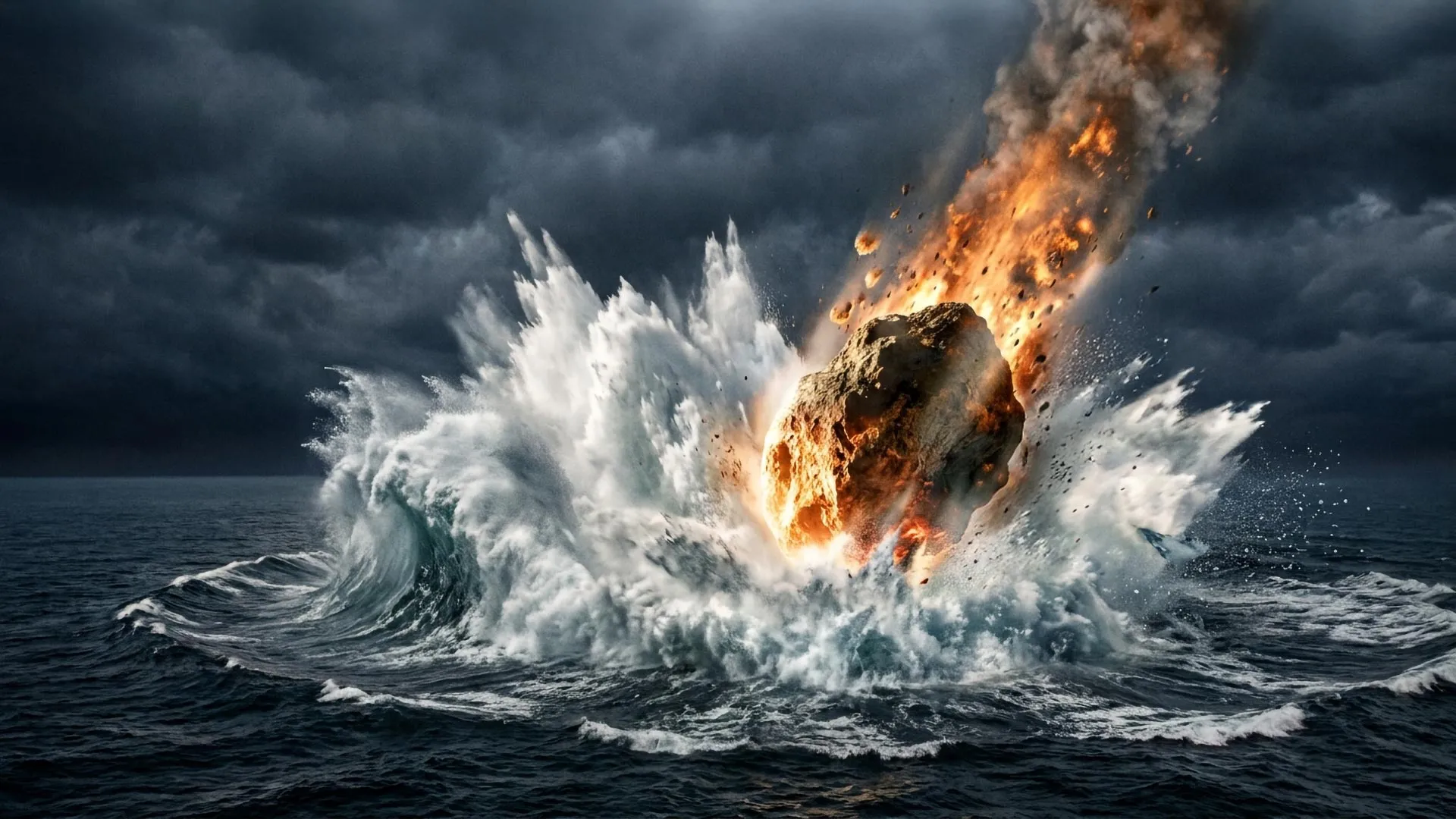
For more than two decades, a deep-seated geological mystery has lingered 80 miles off the coast of Yorkshire, England. Buried 700 meters beneath the sediment of the North Sea floor, a bizarre, circular structure known as the "Silverpit Crater" has long challenged the scientific community. Was it the scar of a violent cosmic collision, or merely the result of mundane terrestrial processes like shifting salt deposits or volcanic collapse?
Today, that debate has been emphatically settled. A research team led by Dr. Uisdean Nicholson of Heriot-Watt University in Edinburgh has provided the "smoking gun" needed to close the case. By synthesizing high-resolution seismic imaging with the discovery of rare mineral evidence, scientists have confirmed that approximately 43 to 46 million years ago, a 160-meter-wide asteroid slammed into the prehistoric North Sea, triggering a cataclysmic tsunami that would have towered over 100 meters high.
A Legacy of Scientific Discord
The discovery of the Silverpit Crater in 2002 initially sent shockwaves through the geological community. Its structural appearance—a central peak surrounded by concentric rings—bore a striking resemblance to recognized impact craters on Earth and across the solar system. In planetary science, central peaks typically form when rock, momentarily liquefied by the immense pressure of an impact, rebounds upward like a splash in a pond.
However, the scientific method demands rigorous skepticism. In the years following its discovery, many geologists pushed back against the "impact hypothesis." The North Sea is a complex geological theater; some experts argued that the Silverpit structure was merely a "salt diapir"—a formation caused by the upward movement of subterranean salt deposits—or the result of localized seafloor subsidence related to volcanic activity.
The disagreement reached a fever pitch in 2009, when a vote conducted during a symposium and documented in Geoscientist magazine saw the majority of participants reject the idea that Silverpit was an impact crater. For years, the feature remained an enigma, a "maybe" in the annals of planetary geology.
Chronology of a Cosmic Collision
With the confirmation of the impact, researchers have been able to reconstruct the timeline of the event with chilling clarity. Roughly 45 million years ago, the region was a vastly different environment, submerged under a shallow sea. The asteroid, measuring roughly 160 meters in diameter, approached from the west at a shallow, oblique angle.
Traveling at hypervelocity—several kilometers per second—the object struck the seafloor with enough energy to shatter the bedrock and displace millions of tons of water and sediment. According to computer simulations developed by Professor Gareth Collins of Imperial College London, the impact generated a 1.5-kilometer-high curtain of debris. As this massive volume of displaced rock and water collapsed back into the ocean, it unleashed a colossal tsunami.
Estimates suggest this wave would have stood over 100 meters high—dwarfing any modern storm-driven surge and standing taller than a 30-story building. The sheer scale of this displacement highlights the immense energy transfer inherent in cosmic impacts, even those caused by asteroids significantly smaller than the "dinosaur-killer" that struck the Yucatán Peninsula 66 million years ago.
The Smoking Gun: Seismic Imaging and Mineralogy
The resolution of the Silverpit mystery relied on a dual approach: advanced technology and old-fashioned "needle-in-a-haystack" field work. Dr. Nicholson’s team utilized cutting-edge seismic imaging to peer through the layers of sediment that have accumulated over the crater since the Eocene epoch. Seismic imaging works by analyzing how sound waves reflect off subsurface rock layers, allowing geologists to map hidden faults and deformations with startling precision.
However, visual data alone was not enough to silence critics. The definitive proof came from rock cuttings recovered from an oil well drilled in the vicinity of the crater.
"Samples from an oil well in the area revealed rare ‘shocked’ quartz and feldspar crystals at the same depth as the crater floor," Dr. Nicholson explained. "We were exceptionally lucky to find these. These prove the impact crater hypothesis beyond doubt, because they have a fabric that can only be created by extreme shock pressures."
"Shocked minerals" are a hallmark of high-velocity impacts. When an asteroid strikes, the instantaneous pressure is so extreme that it alters the internal crystal structure of the surrounding rock—a process that no volcanic activity or salt movement can replicate. The presence of these altered crystals at the precise depth of the crater floor serves as the physical signature of a cosmic event.
Official Perspectives: Closing the Chapter
The confirmation of the Silverpit Crater is being hailed as a triumph of persistence and interdisciplinary cooperation. Professor Gareth Collins, who was a vocal participant in the 2009 debate, expressed relief at the conclusion of the long-standing controversy.
"I always thought that the impact hypothesis was the simplest explanation and most consistent with the observations," Collins stated. "It is very rewarding to have finally found the silver bullet. We can now get on with the exciting job of using the amazing new data to learn more about how impacts shape planets below the surface, which is really hard to do on other planets."
For the team at Heriot-Watt University, the findings published in Nature Communications are not just about winning an argument; they are about opening a new window into planetary science. By studying how the impact fractured and displaced the subsurface layers, scientists can gain insights into the mechanics of crater formation that are applicable to other worlds where erosion and plate tectonics are absent.
Broader Implications: Earth’s Dynamic History
The rarity of the Silverpit Crater cannot be overstated. Earth is a geologically "alive" planet, characterized by active plate tectonics, persistent erosion, and sediment deposition. These processes act as a cosmic eraser, constantly wiping away the scars of ancient impacts.
"Silverpit is a rare and exceptionally preserved hypervelocity impact crater," noted Dr. Nicholson. "Around 200 confirmed impact craters exist on land, and only about 33 have been identified beneath the ocean."
Because so few marine impact sites have been identified, Silverpit offers a unique laboratory for studying the effects of impacts on the seafloor. It now joins an elite, albeit small, list of confirmed underwater impact sites, including the massive Chicxulub Crater and the recently identified Nadir Crater off the coast of West Africa.
The study of these sites is crucial for understanding the frequency and severity of asteroid impacts throughout Earth’s history. As humanity looks toward the stars and considers the risks posed by Near-Earth Objects (NEOs), the Silverpit data provides a vital reference point. By understanding how an asteroid of this size affects the ocean, the atmosphere, and the underlying geology, scientists can build more accurate models for predicting the consequences of future collisions.
Furthermore, the research highlights the importance of industrial data—such as oil well cuttings—in the pursuit of basic science. The collaboration between academia and the energy sector provided the necessary samples that finally allowed the team to distinguish between terrestrial geological confusion and a true extraterrestrial impact.
Conclusion: A New Understanding of Our Past
The confirmation of the Silverpit Crater serves as a poignant reminder that the Earth is a target in a crowded solar system. For millions of years, the North Sea has kept this secret, buried beneath hundreds of meters of mud and sand. Today, thanks to the combination of modern seismic technology and microscopic analysis, we have reclaimed this chapter of our planet’s violent history.
As the scientific community turns its attention to the implications of this finding, one thing is clear: the study of Silverpit will continue to yield secrets. Whether it is helping us understand the subsurface dynamics of impact craters or refining our ability to monitor the skies for future threats, the "needle in the haystack" discovered by Dr. Nicholson and his team has proven to be one of the most significant geological finds of the decade. The debate is over; the evidence is irrefutable. The North Sea, once a quiet basin, was once the stage for a dramatic, world-shaking collision.


 Laily UPN

 Nana Muazin

 Lina Hope

 Rifan Muazin

 Asep Darmawan


 Basiran
