
 Jia Lissa
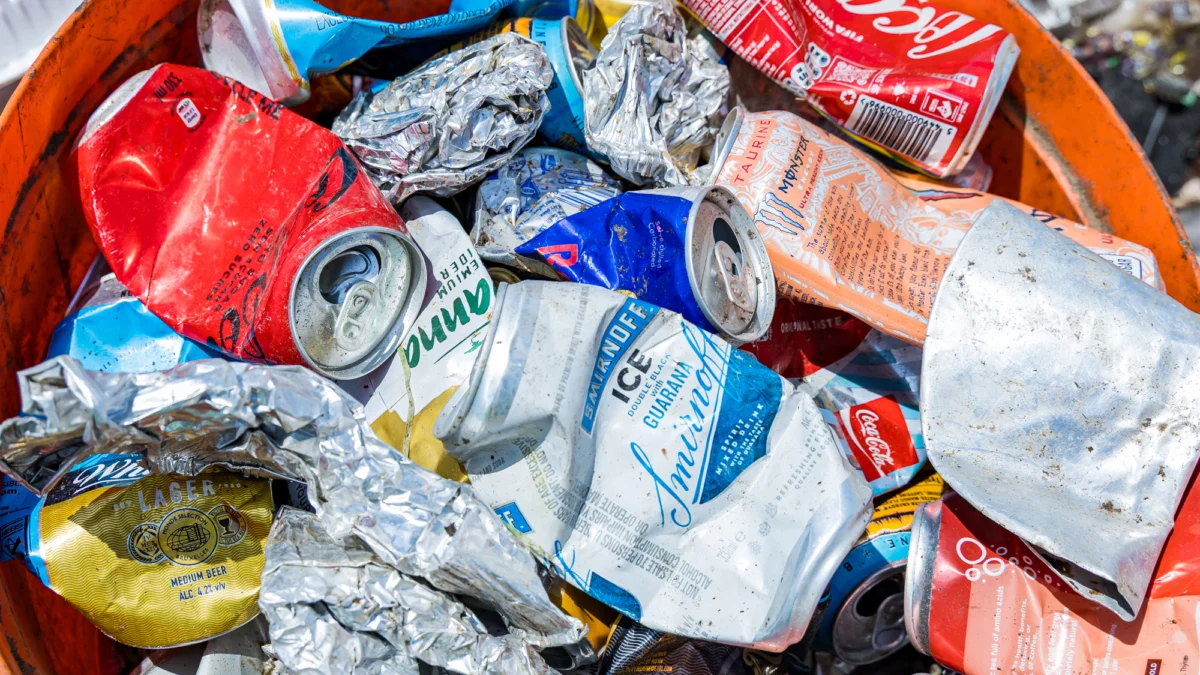
In the high-stakes arena of modern industrial manufacturing, aluminum has emerged as the "green steel" of the 21st century. Essential to the production of lightweight electric vehicles, high-capacity power lines, cutting-edge data centers, and the aerospace industry, the metal is a cornerstone of the global energy transition. Yet, as the United States faces a mounting supply shortage and increasingly volatile global trade tariffs, the country is currently discarding billions of dollars in high-value aluminum into landfills annually.
As the nation scrambles to reopen gargantuan smelters to bolster domestic production, it faces a harsh reality: these energy-intensive facilities require massive, consistent power inputs at a time when the grid is already strained by the exploding energy demands of artificial intelligence and digital infrastructure. Meanwhile, a solution sits right under our feet—or, more accurately, in our trash bins. Recycling aluminum requires only 5 percent of the energy needed to produce virgin metal. Despite this massive efficiency advantage, the U.S. remains trapped in a cycle of waste, hampered by fragmented policy, aging infrastructure, and a lack of investment in modern recovery technologies.
The Strategic Supply Chain Crisis
The aluminum deficit is not merely an environmental concern; it is a profound national security and economic issue. Joe Quinn, executive director of the Center for Strategic Industrial Materials at SAFE, a prominent Washington-based think tank, describes the situation as a critical vulnerability.
"It’s a secure supply chain issue," Quinn explains. "There are environmental benefits all day long, but I need the metal back in the market."
The reliance on imported aluminum—or the costly, carbon-heavy process of smelting virgin ore—creates a dependency on global supply chains that have become increasingly unstable. For sectors such as military defense and advanced aerospace, high-purity aluminum is non-negotiable. When the civilian market cannot efficiently recycle its own waste, it forces the entire economy to compete for a limited pool of primary aluminum, driving up costs for the very industries that are supposed to lead the transition to a sustainable future.
Chronology of a Recycling Failure
To understand why the U.S. is failing to capitalize on this resource, one must look at the historical trajectory of waste management in the country:
- The 1980s Era of Innovation: States began implementing "bottle bills," a series of deposit-return schemes designed to incentivize recycling. At the time, these programs were revolutionary, successfully capturing a significant percentage of beverage containers.
- The Era of Stagnation: In states like New York, the 5-cent deposit fee established in the 1980s has remained untouched for over four decades. Inflation has eroded the value of that nickel, and the administrative costs of running redemption centers have soared, leading to a steady decline in the number of collection points.
- The Global Sorting Crisis: As domestic recycling infrastructure failed to keep pace with the complexity of modern materials, the U.S. began relying on international markets. Much of the nation’s "recycled" scrap was baled and shipped overseas, where it was sorted by hand—a practice that is both logistically fragile and ethically fraught.
- 2024–2025: The Regulatory Wake-up Call: States like Connecticut attempted to break the cycle by doubling deposit fees to 10 cents. While this led to a spike in redemption rates, it triggered a "cross-border arbitrage" problem, where cans from out-of-state are being brought in to claim higher returns, creating a fiscal nightmare for local distributors.
The High-Tech Renaissance: AI and Lasers
The primary barrier to aluminum recovery has always been the "mixed bag" problem. Aluminum is rarely discarded in its pure form; it is often alloyed with other elements—such as copper or titanium—to suit specific industrial needs. Traditional mechanical shredders often fail to differentiate between these alloys, resulting in a low-value, contaminated mixture that is often only fit for "downcycling" into lower-grade products.
A new wave of technology is attempting to bridge this gap. Companies like Sortera Technologies are moving beyond the magnet-and-conveyor-belt era. Using advanced sensors, high-speed lasers, and artificial intelligence, Sortera’s facilities can identify and pluck specific, high-value aluminum alloys out of a stream of mixed scrap metal with surgical precision.
Similarly, the UK-based firm Greyparrot is revolutionizing the sorting floor. By installing AI-powered camera systems over conveyor belts in municipal recycling facilities, Greyparrot can track, count, and identify materials in real-time. In a recent installation at a massive facility in Brooklyn, New York, the AI revealed that 89 percent of the aluminum passing through the plant was technically recyclable—nearly double the historical extraction rate for such facilities.
"A substantial amount of money is left on the table," says Ambarish Mitra, cofounder of Greyparrot. "In every plant we have gone in, the yield has gone up, and the residue line—which is everything that will go into the landfill—has become leaner, because more and more extraction is going on."
Data and the Economics of Waste
The economic scale of this failure is staggering. According to data from the Aluminum Association and the Can Manufacturers Institute, Americans discarded approximately 61 billion aluminum beverage cans in 2023 alone. This represents an estimated $1.2 billion worth of raw material that was effectively buried in landfills.
The loss is not just monetary; it is structural. Benjamin Carlson, director of the Center for Strategic Industrial Materials, emphasizes that the lack of sorting tools is only half the battle. "The real challenge in the United States is just getting people to recycle it, period," Carlson notes.
The decline in beverage can recycling is a direct byproduct of a "passive approach to recycling policy." When consumers are not incentivized to return containers, and when the infrastructure to collect them is disappearing, the material is lost to the landfill. The result is a systemic inefficiency where energy-intensive virgin aluminum production is subsidized by the failure to capture and reuse existing, high-quality scrap.
Official Responses and Policy Implications
The push for a federal solution is gaining momentum, though it faces significant legislative hurdles. Senator Jeff Merkley (D-Ore.) has emerged as a key voice in Congress, advocating for a nationalized bottle bill. Such legislation would aim to harmonize the current, chaotic patchwork of state policies, creating a unified market for recycled materials.
"Aluminum is infinitely recyclable, and keeping that material in circulation is essential to cutting down on plastic waste and enhancing domestic manufacturing," Merkley said in a recent statement.
However, proponents of such legislation acknowledge that a federal program remains "vanishingly unlikely" in the current political climate. Instead, experts are calling for a tiered approach:
- Federal R&D Funding: Increased government grants for the scaling of AI and sensor-based sorting technologies to reduce the reliance on manual labor and international shipping.
- Regional Coordination: As suggested by Janet Domenitz of the Massachusetts Public Interest Research Group, a regional "New England bottle-bill network" could serve as a pilot for larger, multi-state cooperation, preventing the cross-border fraud that currently plagues states like Connecticut.
- Modernizing Deposit Fees: Bringing state-level deposit fees into the 21st century to reflect modern inflation, thereby ensuring that redemption remains a viable economic activity for both consumers and collection centers.
Conclusion: Closing the Loop
The path forward for American aluminum is clear, though the implementation remains complex. The goal is to move from a "take-make-waste" model to a circular economy where every aluminum atom is accounted for. As the demand for clean energy infrastructure grows, the country cannot afford to let its most valuable metal end up in the trash.
The technology to solve this problem exists. The economic incentive—billions of dollars in lost material—is already there. What remains is the political will to modernize the systems that handle our waste. If the U.S. is to succeed in its industrial comeback, it must stop looking for new sources of metal and start looking at the treasure currently hidden in the recycling stream. Only by embracing automation, updating archaic policies, and securing the domestic supply chain can the U.S. turn its "aluminum paradox" into a competitive advantage.


 Raul Delapena Setiawan

 Laily UPN

 Reynand Wu

 Sagoh


 Azzam Bilal Chamdy

 Ali Ikhwan
