
 Nana Muazin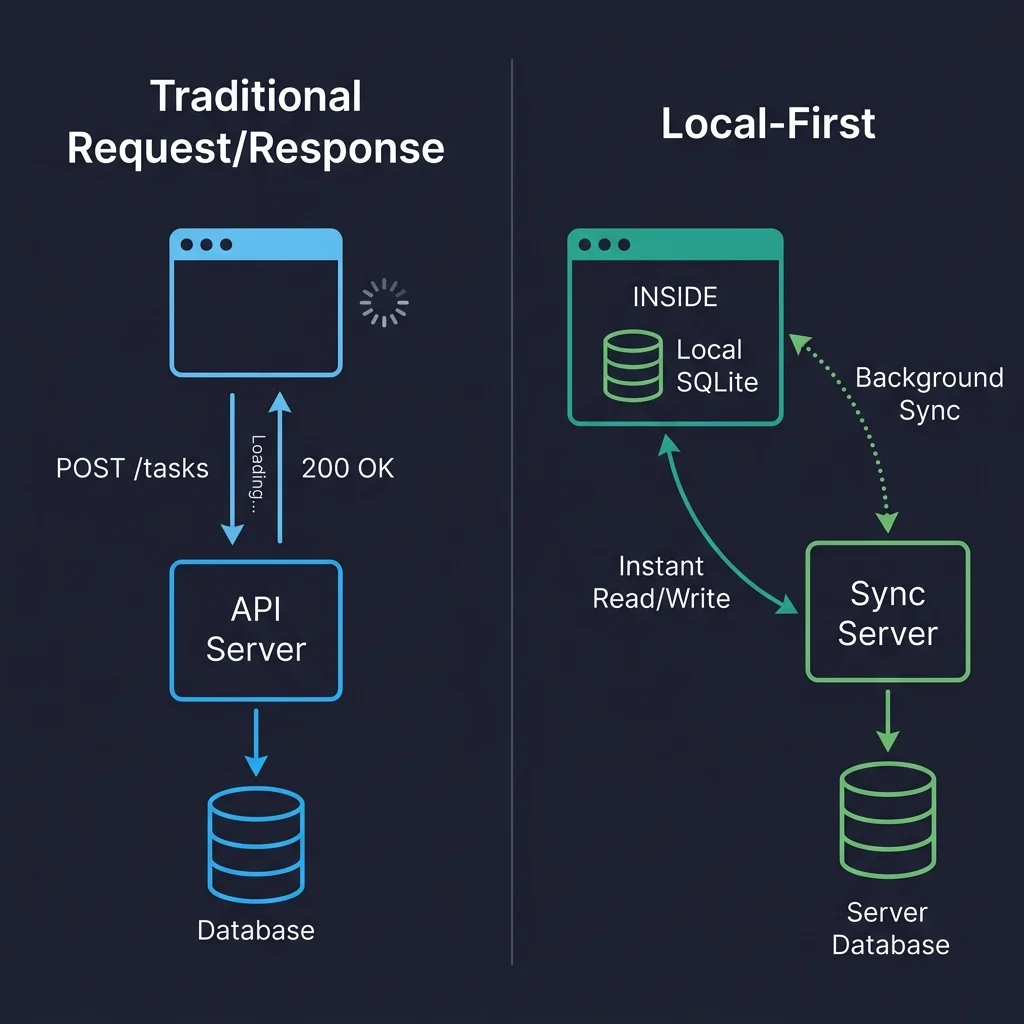
In the landscape of modern web development, the "local-first" paradigm has shifted from an academic curiosity to a pragmatic architectural choice. For developers who have spent the last decade wrestling with the fragility of client-server request/response cycles, the promise of an application that remains functional, instantaneous, and resilient—regardless of network conditions—is alluring. However, as of 2026, the transition to local-first is not merely a technical upgrade; it is a fundamental shift in how we conceive of data ownership and distributed systems.
The Genesis of the Local-First Shift: A Reality Check
The shift toward local-first architecture is rarely driven by theoretical purity; it is usually driven by the frustration of the "spinner." Last October, while testing a project management tool in a hotel in Lisbon, a developer experienced the classic failure of traditional architecture: a unstable network connection rendered a sophisticated React/Node/Postgres stack effectively useless. Despite a robust backend, the inability to access local data without a 3,000-mile round-trip to a server underscored a glaring inefficiency in modern web design.
This frustration mirrors the sentiments expressed in the seminal 2019 Ink & Switch paper, which established the core ideals of the movement: speed, multi-device support, offline capabilities, collaboration, longevity, privacy, and user ownership. While initially dismissed by many as "academic," these ideals have become the benchmark for high-performance applications in 2026.
Chronology of a Paradigm Shift
The journey to local-first maturity has been marked by three distinct phases:
- 2019–2021: The Theoretical Phase. The introduction of the Ink & Switch ideals, followed by early experimentation with CRDTs (Conflict-free Replicated Data Types) like Yjs and Automerge.
- 2022–2024: The Tooling Gap. Developers attempted to force-fit local-first into traditional stacks using IndexedDB. This was marked by "brittle" implementations, significant performance bottlenecks, and a lack of reliable sync protocols.
- 2025–2026: The Maturity Phase. The emergence of robust WASM-based SQLite, the maturation of the Origin Private File System (OPFS), and the rise of production-grade sync engines like PowerSync and the continued evolution of CRDT-based frameworks.
Data Architecture: Replicas, Not Requests
The most critical distinction for developers to grasp is that local-first is not synonymous with "offline-first" or "PWA." Offline-first often maintains the server as the sole source of truth; local-first makes the client a node in a distributed system.
In a traditional request-response model, every user interaction triggers a round-trip to the server. In a local-first architecture, the user’s device holds a primary replica of the data. Interaction is near-instantaneous because the UI reads from and writes to a local database—typically SQLite running via WebAssembly. The server acts as a sync peer—a facilitator of reconciliation rather than a gatekeeper of every action.
Where Data Lives: The Rise of WASM-SQLite
For years, localStorage was the crutch of web developers, despite its severe limitations (synchronous blocking, 5–10 MB caps, and string-only storage). The industry has now moved toward SQLite in the browser via WASM, persisted to the Origin Private File System (OPFS). This setup allows for true relational data, transactions, and indexing within the browser.
While IndexedDB remains the fallback for compatibility, the performance gains offered by OPFS-backed SQLite are significant, enabling complex local queries that would have been unthinkable five years ago.
Conflict Resolution: The "Manageable" Problem
Perhaps the greatest fear for developers new to local-first is the specter of "merge conflicts." However, experience suggests that the problem is vastly over-analyzed.
Most production-level conflicts are resolved through Last-Write-Wins (LWW) applied at the field level, not the record level. By using high-precision timestamps and deterministic tie-breakers (such as Client IDs), developers can resolve the vast majority of collisions without user intervention.

For complex scenarios—such as double-booking a calendar slot—the industry standard is shifting toward Server-Side Validation. The server accepts the mutation but flags it as a "violation," which is then synced back to the client as a non-blocking notification. This approach prevents state divergence while maintaining a superior user experience, avoiding the "nightmare" of rejecting writes and creating ghost records.
Supporting Data: When to Avoid Local-First
Despite the excitement, local-first is not a silver bullet. Data from practical experience suggests several "no-go" zones:
- Server-Generated Data: If the data is primarily produced by the server (e.g., analytics dashboards, search results), the complexity of a sync engine is unnecessary.
- Strong Transactional Consistency: Systems involving banking or inventory management require ACID guarantees that are difficult to achieve in an eventually consistent distributed system.
- Massive Datasets: If the data exceeds the physical storage or memory capacity of a client device, a traditional API approach remains the only viable path.
Implications for Future Development
As we look toward 2027 and beyond, the implications for developers are profound:
- Auth and Security: The client is not a trust boundary. Authorization must be strictly enforced at the sync layer, ensuring the server only pushes data a user is permitted to see.
- The Migration Challenge: Because every client is a node, schema migrations must be additive. Dropping or renaming columns can cause catastrophic sync failures for users running older versions of an application.
- The "Standardization" Deficit: The web has standards for almost everything, yet sync protocols remain fragmented. The industry is currently reliant on proprietary sync engines, which introduces a "novelty risk." Developers are advised to keep their sync layer abstracted to ensure that, should a tool be deprecated, the architecture can pivot.
Conclusion: The Path Forward
Building local-first applications requires a "complexity budget." The overhead of sync engines, client-side migrations, and conflict resolution is high. However, for collaborative, data-intensive applications, this complexity pays for itself in user retention, speed, and reliability.
For those looking to start, the consensus is clear: do not re-architect your entire stack overnight. Identify a single feature—an offline draft mode or a collaborative workspace—and build it using a local-first approach. Once you experience the fluidity of a local database reacting to user input without a network spinner, the "traditional" request-response cycle will feel obsolete. As the ecosystem matures, the focus will likely shift toward standardizing sync protocols and further blurring the line between client-side and server-side data, bringing us closer to a future where the network is an enhancement, not a requirement.


 Sagoh
Sagoh

 Nila Kartika Wati
 Jia Lissa
 Basiran


 Lina Hope