
 Iffa Jayyana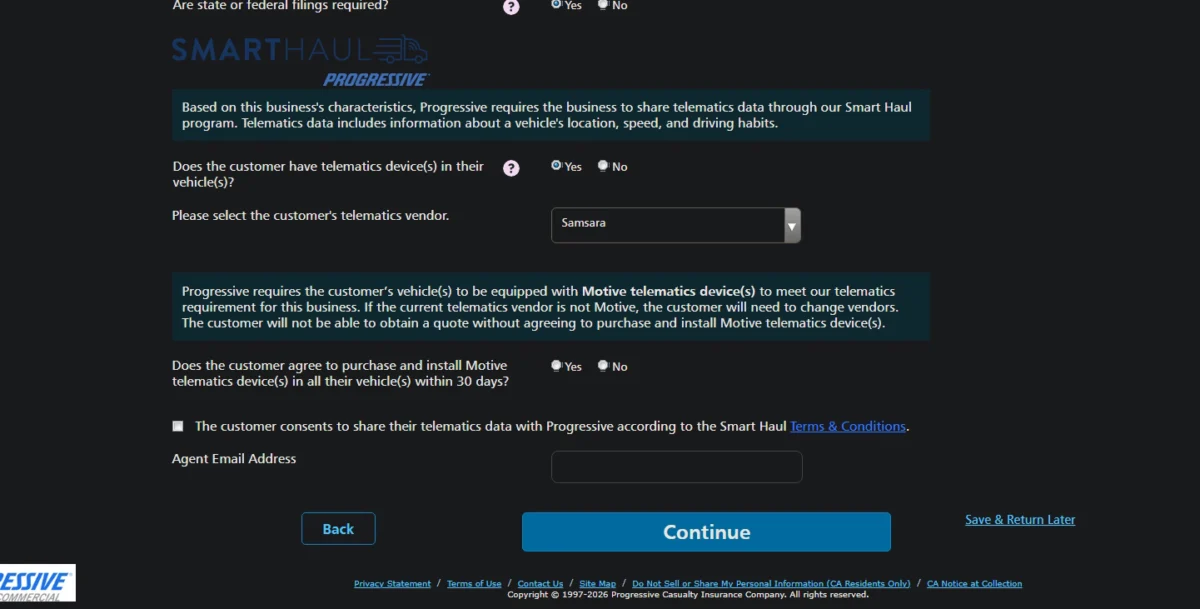
For over a decade, the commercial trucking insurance sector has dangled a carrot in front of fleet operators: participate in telematics programs, share your electronic driving data, and receive a premium discount. What began as a voluntary "safety initiative" has, however, undergone a subtle but profound transformation. No longer just a path to savings, telematics is increasingly becoming a core component of the underwriting process itself.
Recent revelations concerning Progressive Commercial’s "Smart Haul" program highlight a significant shift in how insurers interact with motor carriers. For a subset of applicants, the choice of telematics provider has transitioned from an operational preference to a mandatory condition of obtaining coverage, forcing a collision between insurance requirements and fleet management strategy.
The Trigger: Mandatory Hardware and Underwriting Hurdles
The issue surfaced following the discovery of screenshots from Progressive’s commercial quoting platform. These images revealed a specific workflow: as an applicant navigated the digital quote process, they were prompted to disclose their current Electronic Logging Device (ELD) provider.
In the specific case reviewed, the applicant selected Samsara—a major, industry-standard telematics provider. Instead of proceeding to a quote, the system halted. A mandatory notification appeared, informing the user that to secure insurance, the fleet would be required to purchase and install Motive telematics devices. The system explicitly stated that no quote would be generated unless the applicant agreed to this hardware migration within 30 days.
This mandate represents a significant departure from the historical voluntary nature of telematics. For trucking firms, this is not merely a request to toggle a data-sharing setting; it is a directive to overhaul their entire internal technology ecosystem.
Chronology of a Shifting Landscape
The integration of telematics into the insurance lifecycle has evolved through three distinct phases:
- Phase I: Compliance and Regulation (2017–2019): Following the federal mandate for ELDs, fleets adopted tracking technology primarily for regulatory compliance. Insurers took notice, recognizing that these devices could provide objective evidence of safety.
- Phase II: The Discount Era (2020–2025): Progressive and other major carriers launched initiatives like Smart Haul. These were marketed as "win-win" scenarios: insurers gained better risk visibility, and safe fleets received tangible premium reductions.
- Phase III: The Mandatory Underwriting Era (2026–Present): As seen in recent quoting platform data, the industry has entered a phase where telematics data is no longer optional for high-risk or specific-profile accounts. The technology has shifted from a "value-add" to a "barrier to entry."
Supporting Data: Why Insurers are Turning to Telematics
The move toward mandatory telematics is not arbitrary. It is a calculated response to a deteriorating macroeconomic environment for the insurance industry. According to industry reports, commercial auto insurers have been grappling with a "hard market" for several years, driven by several key factors:
- Nuclear Verdicts: The rise in massive jury awards for trucking accidents has forced insurers to be more cautious about which risks they underwrite.
- Rising Repair and Medical Costs: The cost of fixing modern, sensor-laden vehicles and the inflation of medical expenses have drastically increased the severity of claims.
- Data Precision: Traditional underwriting—which relies on static data like "years in business" or "driver age"—is increasingly viewed as insufficient. Insurers now favor "behavioral data," which includes harsh braking, rapid acceleration, speeding, and cornering.
By requiring specific devices like Motive, insurers can ensure that the data they receive is consistent, standardized, and arrives in a format that their proprietary algorithms can ingest instantly, allowing for more precise risk modeling.
Official Responses and Clarifications
When approached for clarification, Progressive confirmed the existence of this underwriting requirement. In official documentation, the company stated that a "small subset of trucking risks" is now required to participate in the Smart Haul program as a condition of underwriting.
The insurer noted that this requirement is not applied to every customer. For most, the program remains voluntary and tied to potential discounts. However, for those deemed "higher risk" or those who fall within specific underwriting profiles, the mandate is absolute.
Furthermore, the insurer clarified that while some applicants are steered specifically toward Motive devices, others may be permitted to use different approved providers depending on the complexity of their fleet profile. Crucially, the company confirmed that for these mandatory participants, the "standard participation discount" typically offered to voluntary users does not apply. In this context, the device is not a tool for a discount—it is a requirement for eligibility. Failure to install the specified hardware within the 30-day window can lead to policy cancellation.

The Operational Implications for Fleet Managers
For a trucking company, replacing an ELD system is rarely a simple "plug-and-play" operation. Modern telematics platforms have become the "operating systems" of the trucking industry.
The Ecosystem Problem
An ELD is no longer just a logbook. It is the central nervous system of a fleet, integrating:
- Dispatch and Routing: Real-time location data that feeds into customer-facing tracking portals.
- Maintenance Scheduling: Predictive alerts that notify shops when a truck needs service, preventing costly breakdowns.
- Payroll and Compliance: Automated systems that calculate driver pay based on hours of service (HOS) and ensure strict adherence to federal safety regulations.
- Driver Scorecards: Gamified performance metrics that companies use to coach drivers and reduce turnover.
The Cost of Migration
When an insurer mandates a switch to a specific provider, the costs are not limited to the price of the new hardware. They include:
- Hidden Labor Costs: Time spent by maintenance teams removing old hardware and installing new units.
- Software Integration Costs: Reconnecting third-party dispatch and fuel management software to the new API.
- Training and Downtime: The lost productivity of drivers and office staff who must learn an entirely new interface while maintaining their current workload.
- Data Migration Risks: The potential loss of years of historical data that the company relies on for historical reporting and audit purposes.
For small carriers or owner-operators, these costs can represent a significant portion of their annual margin, potentially outweighing any insurance savings they might have hoped to achieve.
Broader Industry Consequences
The implications of this shift extend far beyond the relationship between one insurer and its policyholders.
The Question of Data Governance
As insurers move from "occasional data requests" to "constant, mandatory monitoring," concerns regarding data privacy and governance increase. Who owns the data? How long is it stored? If a driver’s behavior is recorded and later used to justify a massive rate hike or a claim denial, what rights does the carrier have to challenge that data? These questions are currently being navigated in real-time, often without clear regulatory guidance.
Competition and Market Influence
If major insurers begin to standardize their preferred telematics vendors, the market could shift toward a few dominant players. This creates a "kingmaker" dynamic where telematics companies that secure partnerships with major insurers gain an unfair advantage, potentially stifling innovation among smaller or niche fleet management providers.
The Future of Underwriting
This trend is part of a larger, global shift toward "algorithmic underwriting." As artificial intelligence and machine learning become more sophisticated, insurers are moving away from manual assessment and toward automated, data-driven decision-making. In this future, your "insurability" may be determined in seconds by an AI that monitors your fleet’s real-time performance.
Conclusion: A New Reality for Trucking
The message for the industry is clear: the era of "set it and forget it" for fleet technology is over. As telematics becomes deeply intertwined with the underwriting process, trucking companies must treat their choice of technology provider with the same level of due diligence as they treat their choice of insurance carrier.
Fleet managers and owners are advised to:
- Engage Early: Discuss telematics requirements with brokers and insurers before finalizing an insurance policy or selecting a new fleet management platform.
- Evaluate Compatibility: When choosing a telematics provider, ask if they are "insurance-ready" and compatible with the platforms required by major carriers.
- Prepare for Transparency: Expect that your driving behavior will be the primary driver of your insurance cost. Treat your telematics data as a living document of your company’s safety culture.
As the industry continues to evolve, the distinction between a "technology decision" and an "insurance decision" will continue to blur. For the modern fleet, success now requires a delicate balance of operational efficiency, regulatory compliance, and a proactive approach to the data-driven expectations of the insurance market.

 Sagoh
Sagoh
 Ali Ikhwan
 Raul Delapena Setiawan
 Reynand Wu


 Azzam Bilal Chamdy
