
 Pevita Pearce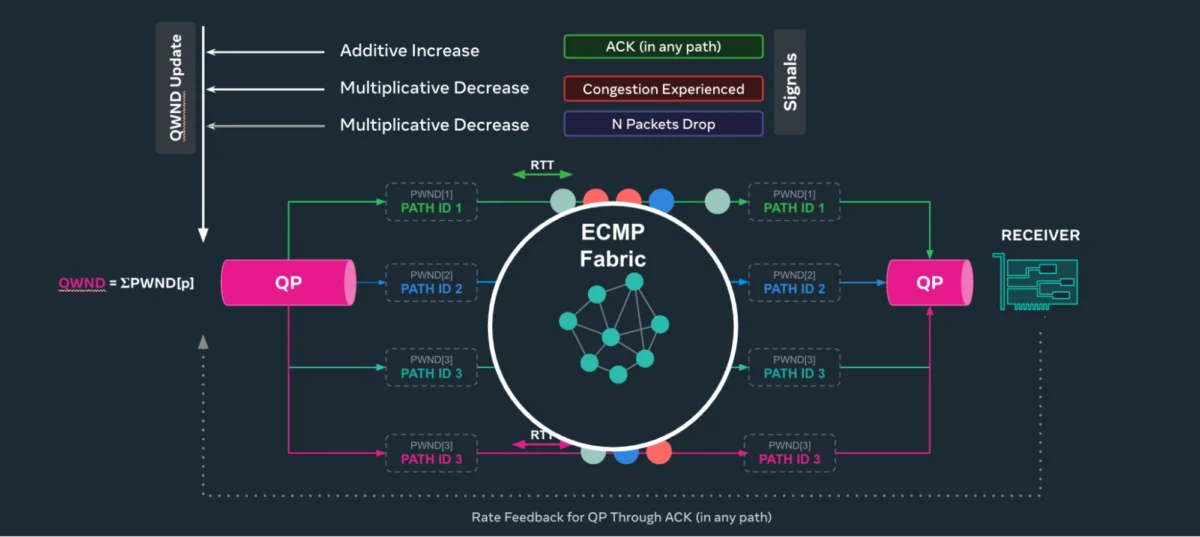
In a move that promises to reshape the landscape of high-performance computing, Meta has officially announced the development of MetaRoCE, a groundbreaking network transport protocol designed specifically to handle the immense communication demands of million-GPU AI clusters. By fundamentally re-engineering how data travels across Ethernet fabrics, Meta aims to move beyond the limitations of legacy RDMA over Converged Ethernet (RoCE), offering a scalable, resilient, and vendor-neutral solution for the artificial intelligence era.
The Core Challenge: Networking as the AI Bottleneck
As AI models grow in complexity—transitioning from billion-parameter experiments to multi-trillion-parameter frontier models—the physical infrastructure required to train them has scaled in tandem. Meta has successfully deployed clusters spanning hundreds of thousands of GPUs across multiple data centers and geographic regions. However, as these clusters grow, the network fabric has become the single most critical point of failure.
In distributed AI training, operations such as all-reduce and all-to-all require thousands of accelerators to synchronize state constantly. If even a single network link experiences friction or congestion, the entire training job stalls, effectively "stranding" expensive compute capacity. Furthermore, in inference workloads, the latency between distributed model shards dictates the response times for hundreds of millions of users globally. To solve this, Meta has reached a consensus that Ethernet—the world’s most ubiquitous networking standard—must become the primary fabric for AI. MetaRoCE is the realization of that vision.
Chronology of an Infrastructure Evolution
The development of MetaRoCE is not an isolated event but the culmination of a multi-year effort to modernize Meta’s data center architecture.
- August 2024: Meta published foundational research proving that RoCE could power distributed AI training at scale, setting the stage for a shift away from proprietary interconnects.
- September 2025: Meta provided a comprehensive overview of its infrastructure evolution, highlighting the massive scale-up of GPU clusters and the inherent bottlenecks in standard network protocols that relied on legacy "lossless" assumptions.
- August 2026: The official unveiling of MetaRoCE. This phase marked the transition from theoretical research to hardware implementation, specifically through a collaboration with AMD using their Pensando programmable NICs.
- October 2026 (Forthcoming): Meta is scheduled to release the full protocol specification, software reference implementations, and compliance frameworks at the 2026 OCP Global Summit.
How MetaRoCE Works: Intelligence at the Edge
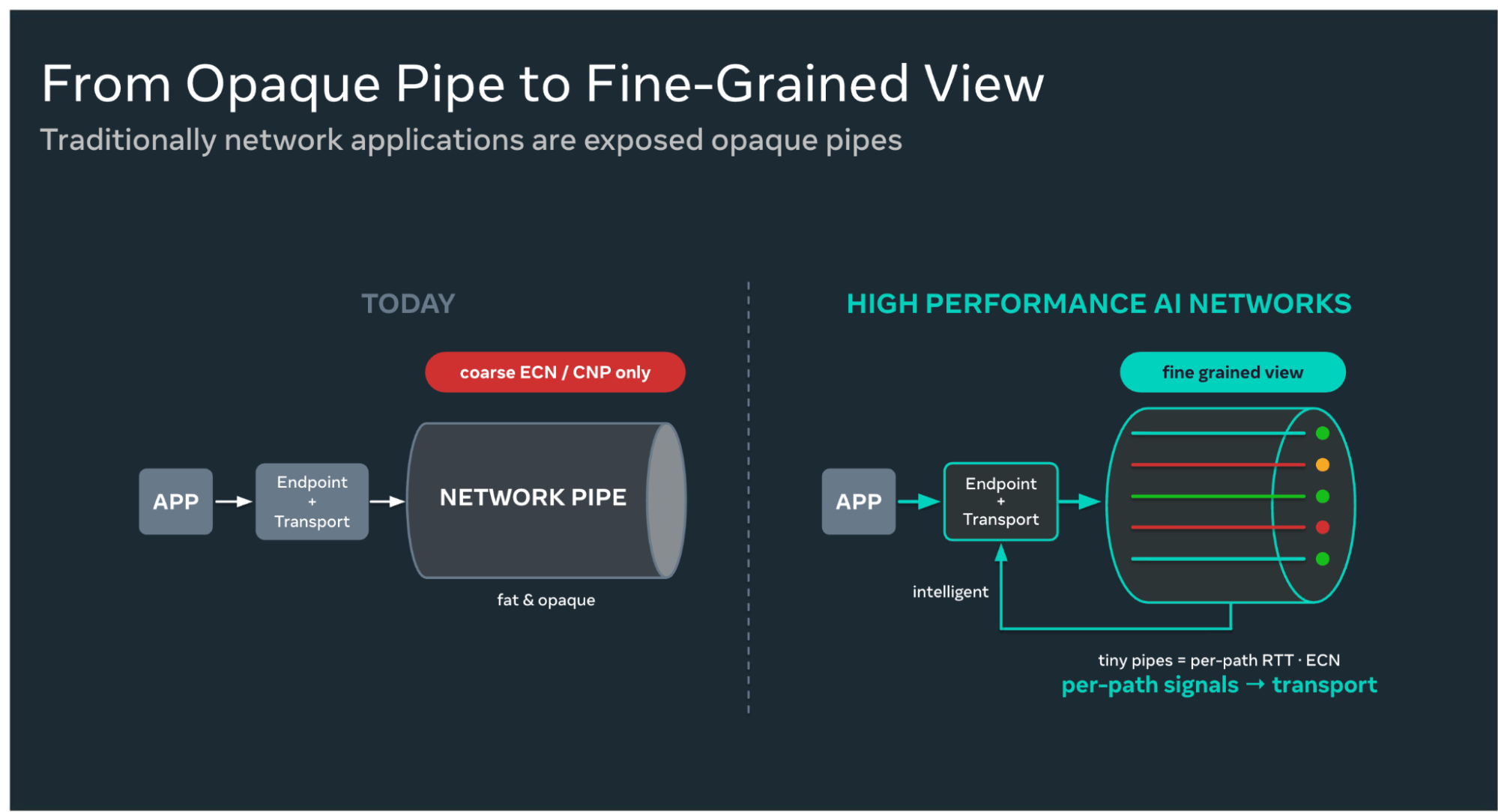
The philosophy behind MetaRoCE is defined by a single, transformative insight: The fabric sees packets, but the NIC sees intent.
Traditional network architectures have historically centralized intelligence within the fabric switches, forcing them to enforce "lossless" behavior through Priority Flow Control (PFC). This approach is brittle; it limits the network’s ability to utilize multiple paths and creates head-of-line blocking.
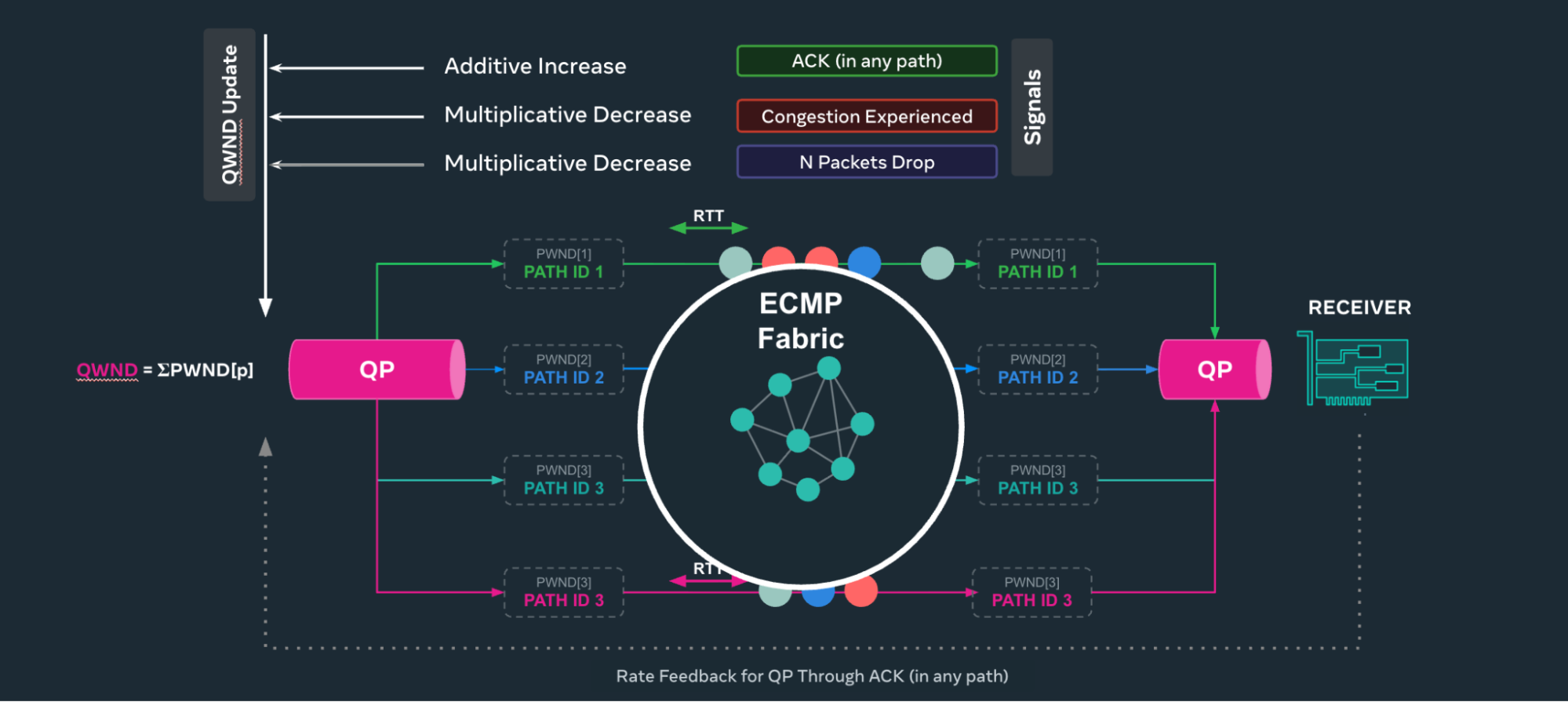
MetaRoCE shifts this burden to the network interface card (NIC). By treating the network as a collection of fine-grained logical paths, the NIC gains real-time telemetry—including round-trip time (RTT), Explicit Congestion Notification (ECN) state, and utilization metrics—for every path. This allows for several key innovations:
1. Native Out-of-Order Delivery
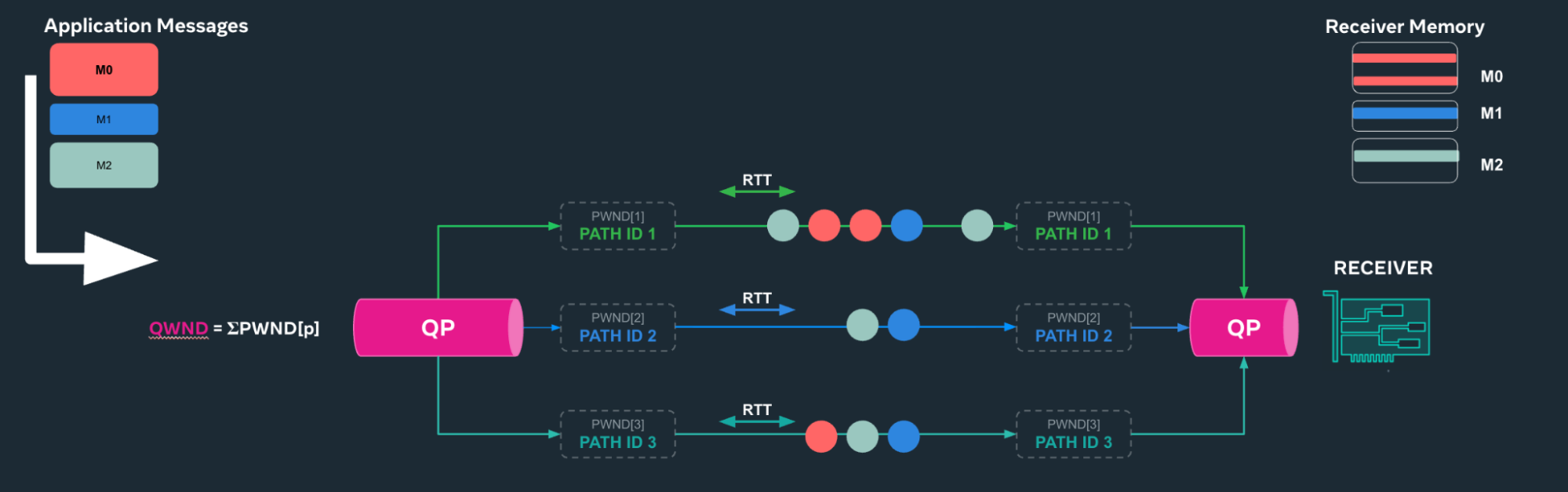
Unlike standard RoCE, which expects the network to deliver every frame in perfect sequence, MetaRoCE assumes out-of-order arrival as the default state. Because each packet carries its own destination information, data is written directly to its final memory location upon arrival. This eliminates the need for expensive reorder buffers and removes head-of-line blocking entirely.
2. Native Multipathing and Loss Tolerance
MetaRoCE sprays packets across multiple paths, utilizing each one independently. If a path fails or becomes congested, the NIC simply shifts traffic to a clear path without stalling the entire connection. Furthermore, the protocol is designed for loss. By abandoning the "lossless" requirement of PFC, MetaRoCE uses selective acknowledgments (SACK) to retransmit only the missing packets, enabling the network to maintain high throughput even in the face of significant packet loss.
3. Congestion Control from Both Sides
MetaRoCE implements a hybrid congestion control mechanism. It combines sender-driven AIMD (Additive Increase/Multiplicative Decrease) with receiver-driven rate hints. In every acknowledgment, the receiver provides the sender with its available bandwidth allocation. This allows senders to reach optimal speeds almost instantly, drastically reducing the impact of "incast" events where many servers respond to a single requester simultaneously.
Supporting Data: Validating the Protocol
To ensure MetaRoCE met the demands of production environments, Meta conducted rigorous benchmarking on a 64-node AMD GPU cluster. The results, compared against standard RoCEv2, were definitive:
- Resilience: Under heavy stress, MetaRoCE maintained approximately 86% of its peak throughput even at 1% packet loss, and continued to provide usable bandwidth at 10% packet loss—a scenario that would cause traditional protocols to collapse.
- Scalability: Testing across 4-plane and 8-plane topologies, involving up to 4,000 concurrent connections, confirmed that throughput scales linearly with the number of planes.
- Autonomous Recovery: During simulated plane failures, the protocol demonstrated a seamless, autonomous redistribution of traffic, requiring zero intervention from the application layer or network operators.
Implications for the Industry
The move to open-source MetaRoCE under the Open Compute Project (OCP) banner represents a significant shift in how hyperscalers influence the hardware ecosystem.
Vendor Neutrality and Interoperability
By providing a production-grade compliance suite and a software reference library (libsoftmetaroce), Meta is lowering the barrier to entry for silicon vendors. The protocol is designed to run on both programmable and fixed-function NICs. This ensures that Meta—and the wider industry—can avoid vendor lock-in while maintaining a unified, high-performance standard.
The "Scale-Up" and "Scale-Across" Future
Looking ahead, Meta is addressing two specific frontiers:
- Scale-Up: Optimizing the fast signaling path for short memory operations within a single rack, where every nanosecond of latency removed is a direct win for training speed.
- Scale-Across: Managing the challenges of long-haul, multi-building clusters. By treating paths as first-class entities, MetaRoCE allows for fairer sharing of contended long-haul links, enabling massive AI jobs to span thousands of kilometers without degradation.
Official Perspective: An Open Future for Networking
Meta’s decision to contribute the MetaRoCE specification to the OCP’s Ethernet Scalable Unified Network (ESUN) initiative is a strategic effort to foster industry-wide collaboration. The company’s engineers have emphasized that the challenges of modern AI infrastructure are too large for any single company to solve in isolation.
"We’re building this in the open because the challenges ahead benefit from broad industry collaboration," the engineering team noted. By providing an authoritative behavioral model that works on commodity Linux over standard UDP sockets, Meta is inviting hardware manufacturers, cloud providers, and AI researchers to converge on a single, efficient, and reliable transport protocol.
Conclusion: The Road Ahead
As the AI industry pushes toward the era of the "million-GPU cluster," the bottleneck is increasingly shifting from compute performance to network efficiency. MetaRoCE provides a sophisticated, resilient, and open-source path forward. By acknowledging the inherent nature of Ethernet as a lossy, multi-path medium and building intelligence directly into the endpoints, Meta has established a template for the future of high-speed data transmission.
The industry will get its first in-depth look at the implementation details at the upcoming OCP Global Summit. For those building the next generation of AI hardware, the message is clear: the future of AI networking is not about creating perfect, lossless switches—it is about building intelligent, resilient protocols that can thrive in the chaotic, high-speed reality of modern data centers.


 Jia Lissa
 Nila Kartika Wati
 Raul Delapena Setiawan
 Reynand Wu
 Sagoh
Sagoh

 Azzam Bilal Chamdy
 Ali Ikhwan