
 Laily UPN
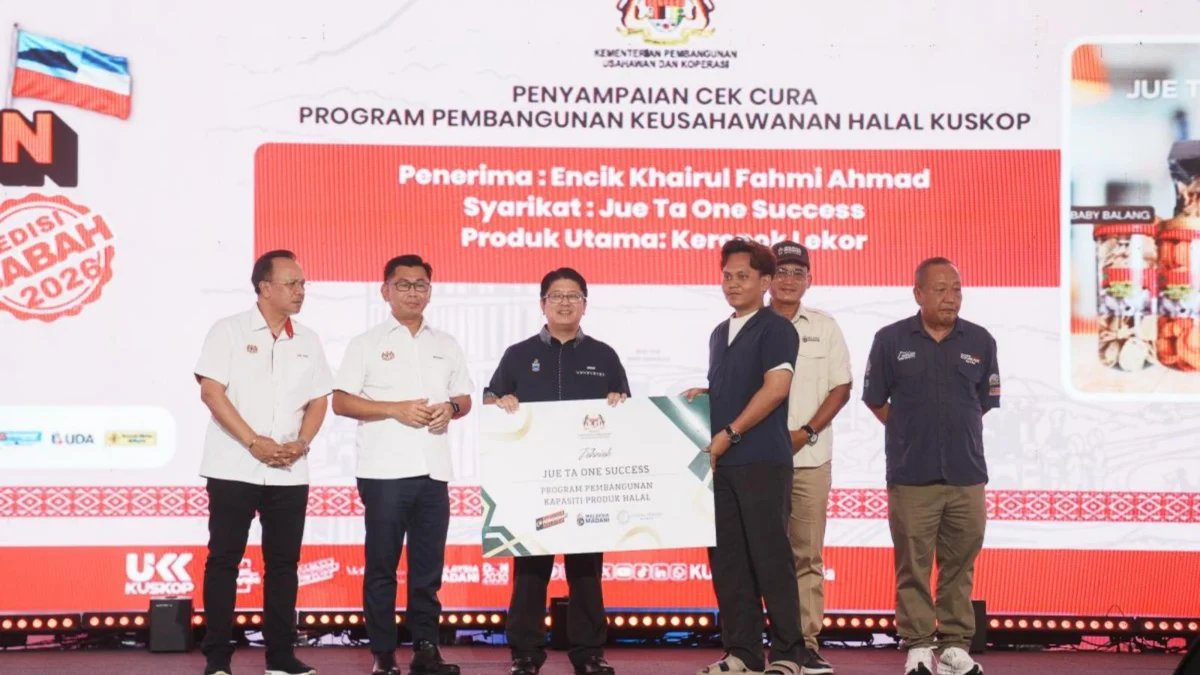
KOTA KINABALU – In a landmark development for the East Malaysian economic landscape, the state of Sabah has announced a massive capital injection into its grassroots economy. As of September 2026, a total of RM950.78 million in financing has been successfully channeled to 44,059 entrepreneurs and cooperatives across the state. This financial milestone, facilitated through the Ministry of Entrepreneur and Cooperative Development (KUSKOP) and its various agencies, signals a robust shift toward a more digitized, productive, and globally competitive local economy.
The announcement was made during the opening of the Sabah State Level 2026 Great Malaysia Business Carnival (HPM) held at Lintasan Deasoka. The event serves as a critical nexus for micro, small, and medium enterprises (MSMEs) to bridge the gap between local production and international market standards.
1. Main Facts: A Quantitative Leap in Small Business Support
The financing figure of nearly RM1 billion represents one of the most significant concentrated investments in Sabah’s entrepreneurial ecosystem to date. The disbursement has targeted a diverse demographic, ranging from urban tech startups to rural agricultural cooperatives, reflecting the state’s multi-pronged approach to wealth distribution and economic empowerment.
Chief Minister of Sabah, Datuk Seri Panglima Haji Hajiji Haji Noor, emphasized that this funding is not merely a fiscal handout but a strategic investment. The primary goal is to widen access to financing while simultaneously fostering the growth and competitiveness of local businesses. In a speech delivered by Datuk Ewon Benedick, Deputy Chief Minister III and Minister of Industrial Development, Entrepreneurship and Transport, the Chief Minister underscored the necessity of moving beyond traditional business models.
The "Enhancing Malaysian Business" (HPM) initiative, spearheaded by KUSKOP, is the vehicle for this transformation. Unlike previous financing schemes that focused primarily on capital, HPM adopts a holistic development philosophy. It integrates training, technology adoption, and market access into the financing package, ensuring that recipients are equipped to manage the complexities of a 21st-century economy.
2. Chronology: From Recovery to the SMJ 2.0 Vision
To understand the significance of this RM950.78 million injection, one must look at the trajectory of Sabah’s economic planning over the last five years.
- 2021–2025: The Foundation Phase. Following the global economic disruptions of the early 2020s, the Sabah government launched the initial Sabah Maju Jaya (SMJ) roadmap. This period focused on stabilizing the MSME sector and ensuring business continuity through emergency grants and low-interest loans.
- Early 2026: The Transition to SMJ 2.0. As the state entered the 2026–2030 development cycle, the focus shifted from "survival" to "competitiveness." The SMJ 2.0 Development Plan was inaugurated with a specific emphasis on adding value to local products and improving the state’s overall productivity.
- September 2026: The Milestone Achievement. The announcement of the RM950.78 million disbursement marks the first major status report of the SMJ 2.0 era. It demonstrates that the state and federal governments have successfully synchronized their agencies to deliver high-volume financing in a condensed timeframe.
- October 2026 and Beyond: The Budget 2027 Alignment. The state government has already begun aligning these local successes with the national agenda. With the recent unveiling of Malaysia’s Budget 2027, which prioritizes MSME development and lower costs of doing business, Sabah is positioning itself to be the primary beneficiary of federal allocations for the coming fiscal year.
3. Supporting Data: Breaking Down the RM950.78 Million Impact
The scale of the financing is best understood through the diversity of its recipients and the specific focus areas of the state’s agencies.
The Reach of KUSKOP Agencies
The RM950.78 million was not distributed by a single entity but through a network of specialized agencies under KUSKOP, including TEKUN Nasional, Bank Rakyat, and SME Bank. This decentralized approach allowed for specialized financing:
- Micro-Entrepreneurs: Received smaller, high-accessibility loans to stabilize neighborhood-level services and retail.
- Cooperatives: Significant portions were allocated to agricultural and credit cooperatives, which are essential for the socio-economic fabric of rural Sabah.
- SME-UP Assistance Programme: A state-specific initiative that complements federal funding, focusing specifically on upgrading machinery, enhancing packaging, and obtaining certifications (such as Halal and MeSTI) required for export.
Sectoral Growth
The state government has identified five key sectors that have shown the highest absorption of these funds:
- Food and Beverage (F&B): Moving from home-based kitchens to industrial-scale production.
- Agriculture: Integrating IoT and smart farming techniques to increase yields.
- Tourism: Supporting eco-tourism operators and local homestays to modernize their digital presence.
- Handicrafts: Transitioning traditional motifs into high-end fashion and interior design markets.
- Locally Sourced Products: Developing the "Sabah Brand" for products like highland coffee, seaweed, and processed seafood.
4. Official Responses: A Call for Radical Efficiency
The rhetoric from the state leadership at the Great Malaysia Business Carnival was one of "tough love" and high expectations. Datuk Ewon Benedick, speaking on behalf of the Chief Minister, noted that while financing is the fuel, the engine of the business must be efficient.
"Entrepreneurs not only need financing, but also training, technology, increased productivity, easier application processes, and access to a wider market," Datuk Hajiji’s speech read. This statement acknowledges a long-standing grievance among local business owners: the "red tape" of bureaucracy.
Reforming the Bureaucratic Engine
A pivotal part of the official response was the endorsement of KUSKOP’s efforts to reform bureaucratic processes. The Chief Minister welcomed the move to simplify procedures and shorten application processing times. The logic is simple: every hour an entrepreneur spends filling out repetitive forms is an hour lost in product development or customer acquisition. By digitizing the application funnel, the government aims to improve "service delivery," making the state a partner in business growth rather than a hurdle.
Synergy with Federal Policy
The state’s leadership also took the opportunity to laud the Federal Government’s Budget 2027. By aligning Sabah’s state-level SME-UP programme with federal initiatives, the government creates a "double-layered" support system. This synergy is intended to lower the overall cost of doing business in Sabah, which historically faces higher logistical costs compared to Peninsular Malaysia.
5. Implications: The Future of the "Sabah Brand"
The long-term implications of this RM950.78 million investment extend far beyond the immediate cash flow of 44,059 businesses. It represents a fundamental restructuring of the Sabahan economy.
Digitalization and Innovation
The push for entrepreneurs to become more "digital, productive, and innovative" is a direct response to the global shift toward e-commerce. The state is no longer satisfied with local products staying within the borders of Sabah. With improved packaging, branding, and product consistency—points emphasized heavily by the Chief Minister—Sabahan products are being prepared for the national and international stage. The financing is increasingly being tied to digital adoption, encouraging businesses to use social commerce, digital accounting, and data analytics.
Empowerment of Rural and Youth Demographics
A significant implication of the SMJ 2.0 plan is the decentralization of wealth. By targeting rural communities and young entrepreneurs, the government is attempting to stem the tide of urban migration. If a young person in a rural district can access KUSKOP financing, receive digital training, and sell their products to a global market via the internet, the economic incentive to move to Kota Kinabalu or Kuala Lumpur diminishes. This creates a more balanced and resilient state economy.
The Challenge of Sustainability
However, the success of this massive financial injection depends on "product consistency" and "market reach." The Chief Minister urged businesses to look beyond their existing horizons. The implication is clear: the government can provide the capital and the training, but the onus of maintaining international standards lies with the entrepreneurs. The transition from a "subsistence business" to a "local business leader" requires a change in mindset that the HPM Carnival seeks to instill.
Conclusion: A Collaborative Ecosystem
The 2026 Great Malaysia Business Carnival stands as a testament to what can be achieved when federal and state governments, financial institutions, and the private sector align their goals. With RM950.78 million already in the system and the SMJ 2.0 plan in full swing, Sabah is positioning itself as a burgeoning hub for MSME excellence in the BIMP-EAGA (Brunei-Indonesia-Malaysia-Philippines East ASEAN Growth Area) region.
As the state moves toward 2027, the focus will remain on ensuring that these 44,059 entrepreneurs do not just survive, but scale. The transformation of Sabah from a resource-based economy to an entrepreneurial powerhouse is no longer a distant vision—it is a well-funded reality.


 Pevita Pearce
 Ali Ikhwan

 Lina Irawan


 Suro Senen

 Muslim

 Ammar Sabilarrohman

 Raul Delapena Setiawan
