
 Asro
Asro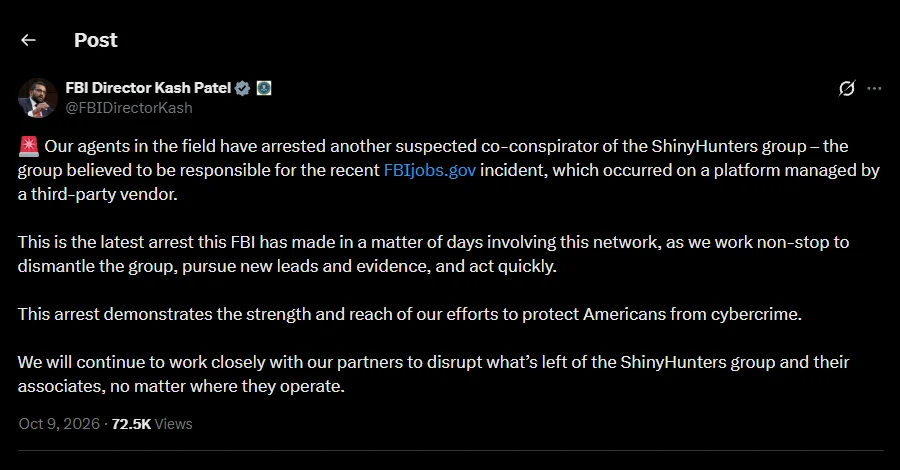
By Swati Khandelwal | October 9, 2026
In an escalating international crackdown on the notorious cyber-extortion syndicate known as "ShinyHunters," the Federal Bureau of Investigation (FBI) has announced the apprehension of another key suspect tied to the group’s high-profile breach of the Bureau’s own recruitment portal. The announcement, made by FBI Director Kash Patel on October 9, marks a significant milestone in a rapidly unfolding global investigation that has spanned three continents and involved deep cooperation between international law enforcement agencies.
The arrest of a Canadian national in Pennsylvania represents the latest strike in the FBI’s mission to dismantle the group responsible for compromising the sensitive personal information of thousands of FBI agents and applicants. As the dust settles on the September breach, the implications of this digital intrusion continue to ripple through the intelligence community, raising critical questions about third-party contractor security and the resilience of government infrastructure.
A Targeted Breach: The Anatomy of the FBIjobs.gov Incident
The crisis began in late September 2026, when the extortionist group ShinyHunters publicly claimed responsibility for infiltrating the FBI’s official job application portal, FBIjobs.gov. The breach, which quickly gained notoriety, involved the theft of vast quantities of data. Preliminary investigations and leaks shared by the attackers suggest that the compromised files contained highly sensitive information, including names, contact details, psychiatric evaluations, and medical histories of individuals seeking employment or currently serving within the Bureau.
For the FBI, this was not merely a data security failure; it was a profound breach of operational security. The threat actors utilized the stolen data as leverage, attempting to coerce the agency by exposing the personal lives of those tasked with upholding the law.
The Investigation: A Global Chain of Arrests
The apprehension of the Canadian suspect in Pennsylvania is the third major arrest linked to the ShinyHunters case. The investigation, which has been characterized by intense, real-time collaboration with international partners, has followed a trail that suggests a geographically dispersed leadership and support network.

Chronology of Key Interventions
- September 15, 2026 (The Netherlands): Dutch authorities, acting on intelligence supported by the FBI, apprehended a 24-year-old Amsterdam resident. Sources identified the individual as Pepijn van der Stap. While Dutch police remained tight-lipped regarding the specific nature of the charge, the FBI later released a video statement identifying the suspect as an alleged leader within the ShinyHunters hierarchy. Despite this, representatives linked to the group have publicly denied any formal association with the suspect.
- September 29, 2026 (Jordan): Following a tip-off and international coordination, a second suspect—identified by sources as Saif al-Din Khader—was detained in Jordan. Reports indicate that Khader has been cooperating with the FBI, potentially providing the Bureau with the intelligence necessary to track other members of the group.
- October 9, 2026 (United States): FBI Director Kash Patel confirmed the arrest of a third individual, a Canadian citizen, in Pennsylvania. While the FBI has not yet released the suspect’s name or specific charges, the move signals that the Bureau is broadening its dragnet to include those who may have provided logistical or technical support to the primary attackers.
Security Failures and the Contractor Dilemma
One of the most damaging revelations to emerge from the aftermath of the hack is the nature of the vulnerability that allowed it to occur. Contrary to initial fears of a sophisticated "zero-day" exploit targeting core FBI systems, the breach was the result of a mundane but catastrophic human error.
The Missing Patch
According to Brett Leatherman, Assistant Director of the FBI’s Cyber Division, the intrusion was made possible by a failure to implement a critical security patch on a third-party managed platform. The patch, which had been explicitly issued to mitigate known vulnerabilities, was neglected by an external contractor.
While the FBI has remained officially silent on the identities of the parties involved, industry analysts and media reports point to a chain of responsibility involving Oracle’s PeopleSoft software and the professional services firm Accenture. The FBI has since terminated its contract with the firm responsible for the oversight, highlighting the increasing tension between government agencies and their reliance on private sector vendors. Accenture, in a brief statement, noted its pride in supporting the FBI’s mission but declined to address the specifics of the security lapse or the termination of the contract.
The Motivation: Why the FBI?
ShinyHunters, which has a documented history of breaching over 140 organizations and extorting upwards of $70 million in the past year alone, claimed that their attack on the FBI was an act of retaliation. The group cited a May 2026 Public Service Announcement (PSA) released by the FBI’s Internet Crime Complaint Center (IC3), which characterized the group as a criminal entity specialized in large-scale data theft.
By targeting the FBI, ShinyHunters sought to challenge the agency’s credibility and demonstrate that even the most secure institutions are not immune to their reach. The group’s modus operandi—blending massive data theft with high-profile "trophy" hacks—has solidified their reputation as one of the most dangerous cyber-extortion syndicates operating today.
Implications for Federal Cybersecurity
The FBIjobs.gov incident has sparked a necessary, if uncomfortable, debate within the U.S. government regarding the risks of outsourcing critical infrastructure.

- Supply Chain Rigidity: The incident serves as a stark reminder that an organization is only as secure as its weakest third-party vendor. The FBI’s reliance on external contractors for HR and recruitment processes effectively bypassed the internal security protocols that the Bureau typically mandates.
- Increased Surveillance of Extortion Groups: The success of the international manhunt indicates that the FBI is shifting from a defensive posture to a proactive, disruptive one. By working with the Dutch and Jordanian authorities, the FBI has demonstrated a capability to project law enforcement power globally, putting members of such groups on notice that their physical location provides no sanctuary.
- Data Privacy for Public Servants: The exposure of psychiatric and medical data of FBI personnel creates long-term risks. Such information is prime material for foreign intelligence services looking to identify "insider threat" candidates who could be blackmailed or coerced. The Bureau now faces the arduous task of providing long-term monitoring and protection for the affected employees.
Looking Ahead: The Future of the Hunt
As the investigation continues, FBI Director Patel has made it clear that the Bureau is not satisfied with these three arrests. In his post on X, Patel emphasized that the FBI would continue to collaborate with international partners to "disrupt what’s left of the ShinyHunters group and their associates, no matter where they operate."
For the victims of the breach, the path to justice will be long. The legal proceedings in the Netherlands, Jordan, and the United States will be closely watched by the cybersecurity community, as they set a precedent for how nations prosecute transnational cyber-crimes.
The ShinyHunters breach of the FBI serves as a seminal moment in the history of modern cyber-warfare. It highlights the intersection of criminal extortion, government security, and the precariousness of the digital supply chain. As the FBI continues its pursuit, the message to global cyber-syndicates remains unequivocal: the Bureau’s reach extends far beyond the borders of the United States, and the costs of targeting federal infrastructure will be met with the full force of international law.
This report is based on current investigative developments and official communications from the FBI, as well as ongoing reporting from reputable media outlets. As legal proceedings against the suspects evolve, further updates will be provided.


 Layla Zulfa
 Rifan Muazin
 Sagoh
Sagoh
 Ali Ikhwan
 Laily UPN
 Jia Lissa
 Neng Nana
 Iffa Jayyana