
 Layla Zulfa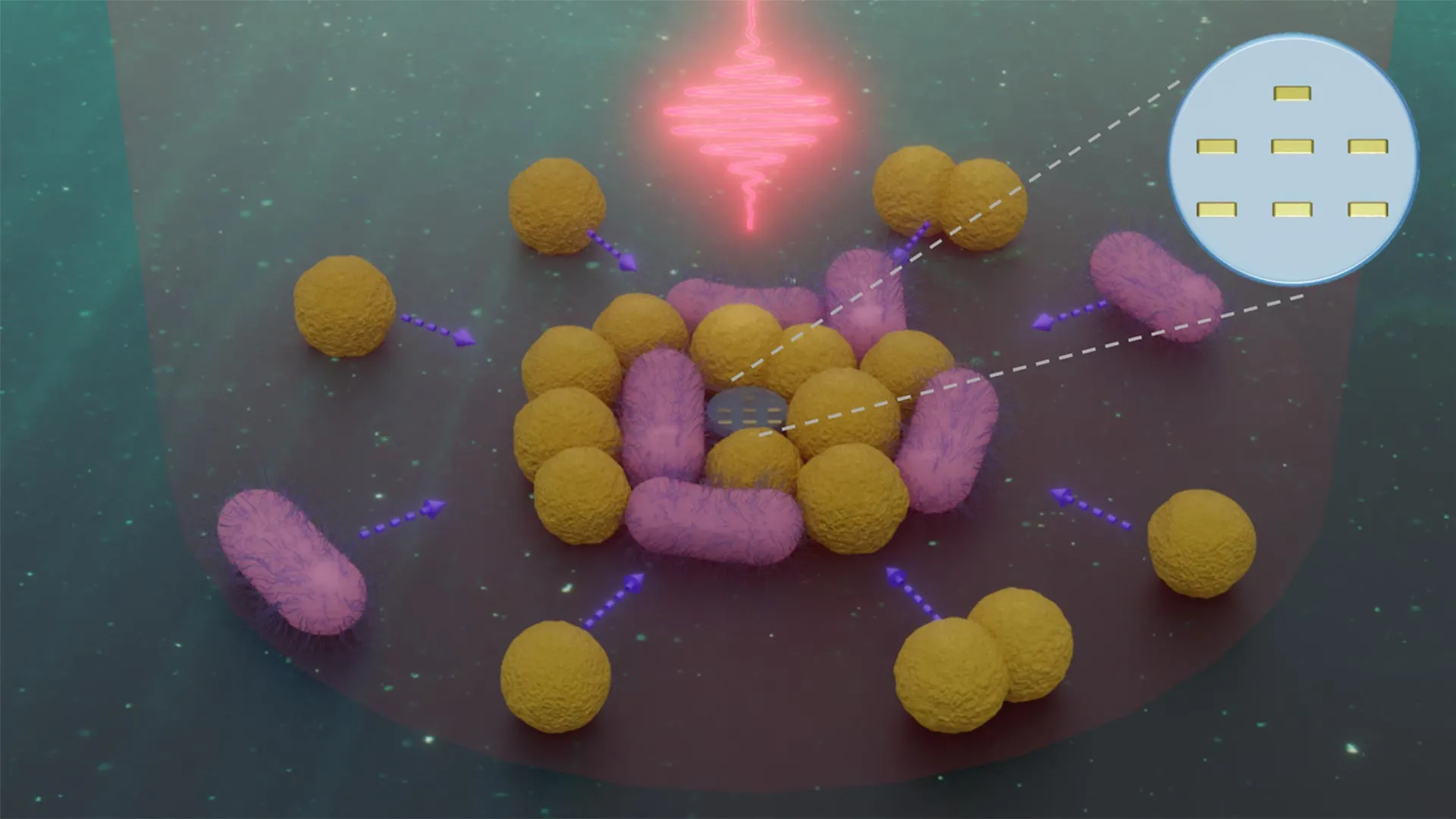
In the quiet, shimmering realm of the microbial world, the laws of physics behave differently. At the scale of a single bacterium, the viscosity of water feels like swimming through molasses, and the challenges of manipulating objects are immense. For decades, scientists have dreamed of building machines small enough to inhabit this domain—tools capable of grasping, moving, and rearranging the building blocks of life. Now, a breakthrough from Julius-Maximilians-Universität Würzburg (JMU) has brought this science-fiction vision into the realm of reality.
Researchers led by Professor Bert Hecht have engineered light-driven nanorobots, roughly 50 times smaller than the diameter of a human hair, that can navigate, capture, and transport bacteria. These "microdrones" represent a leap forward in our ability to interact directly with the microscopic world, effectively turning light into a remote-control steering wheel for the smallest machines ever devised.
The Chronology of a Microscopic Breakthrough
The path to this achievement has been defined by a fundamental struggle: how to propel a machine that is too small for traditional motors, batteries, or gears.
The Physics of Recoil
For several years, the JMU team focused on the concept of photon recoil. In classical physics, when a firearm is discharged, the projectile’s forward momentum generates an equal and opposite force, or recoil, on the weapon. At the nanoscale, where mass is infinitesimal, the momentum of a single photon—if directed precisely—can be harnessed to move a structure.
Early iterations of these devices relied on plasmonic nanoantennas. By absorbing light of a specific color and helicity and re-emitting it in a calculated direction, the robots could generate a localized thrust. However, early models were cumbersome, requiring complex arrangements that limited their mobility and size.
Achieving Sub-Micron Scale
The most recent phase of the research, published as a significant milestone, saw the team move beyond these limitations. By integrating nanoscale antenna wires directly into the structure of the robots, the researchers successfully reduced the footprint of the devices to less than one micrometer. This reduction was not merely a feat of miniaturization; it was a redesign of the navigational architecture. By utilizing the polarization of incoming light to align the robot’s antennas, the team created a steering system that is both elegant and remarkably responsive.
Supporting Data and Technical Architecture
The architecture of these nanorobots relies on the marriage of plasmonics and photonics. Each robot is equipped with up to four plasmonic nanoantennas. These structures act as the "engines" and "rudders" of the craft.
The Propulsion Mechanism
When light interacts with the nanoantennas, it is absorbed and redirected. Because the robot has such a low mass, even the tiny recoil force generated by these redirected photons results in substantial acceleration. This allows the robots to reach speeds that are significant relative to their own size, overcoming the high-viscosity "drag" of the aqueous environments in which they operate.
Steering Through Polarization
The true innovation of the recent study lies in the steering mechanism. The researchers discovered that the integrated antenna wires have a natural affinity for the polarization direction of incident light. By modulating the polarization of the light source, operators can rotate the robot on its axis, effectively turning the device in any desired direction. This allows for rapid, precise maneuvers, including 90-degree turns that enable the robots to scan a sample grid with surgical precision.
Performance Metrics
In laboratory tests, the robots demonstrated impressive endurance and load-bearing capabilities. While the speed of the nanorobot naturally decreases when it is tethered to a cluster of bacteria, it remains fully maneuverable. This stability is critical, as it confirms that the propulsion system is robust enough to overcome both the fluid resistance of the environment and the drag created by the "cargo" it is carrying.
Official Responses and Expert Commentary
The significance of this development has been met with enthusiasm by the scientific community, particularly those working at the intersection of optics and biology.
Perspectives from the Lead Experimentalist
Jin Qin, the lead experimental scientist on the study, emphasized that the simplicity of the design is the key to its future success. "In essence, we have built a light-driven nanorobot that can track down and collect bacteria," Qin stated. "By simplifying the design, we reached a size at which these robots can operate directly in the microbial world—almost like microscopic cleaning devices."
The Vision of Professor Bert Hecht
Professor Bert Hecht, who spearheaded the project, contextualized the discovery within the broader scope of nanotechnology. "This is a striking example of how light can be used not only to observe the microscopic world, but also to actively shape it," Hecht explained. He noted that while the concept of "nanobots" often conjures images of futuristic, autonomous swarms, his team is proving the physical principles that make such technology viable today. Hecht believes that the ability to transition from passive observation to active manipulation marks a turning point in how we will approach laboratory-based biology in the future.
Implications for the Future of Science
The implications of having "microscopic cleaners" at our disposal are profound, spanning industries from medicine to environmental science.
Revolutionizing Biomedical Research
Currently, isolating specific cells or bacteria for analysis is a laborious process that often requires complex microfluidic systems. Nanorobots could automate this process, moving specific biological materials to designated areas of a slide or testing apparatus with zero contamination risk. In a clinical setting, this could eventually lead to "lab-on-a-chip" diagnostics where nanorobots perform the heavy lifting of sorting and organizing cellular samples at lightning speed.
Environmental Remediation
The "microscopic cleaning" metaphor is not just poetic—it is a functional goal. The ability to collect, transport, and release biological matter suggests a future where nanorobots could be deployed to clean up targeted microbial contamination or assist in the synthesis of complex biological materials. By maneuvering through aqueous solutions, these devices could extract harmful bacterial strains from a sample, effectively purifying the environment on a scale previously thought impossible.
The Roadmap Toward Autonomy
While the current robots are driven by external light sources, the success of this project provides a foundation for the next generation of nanomachines. Researchers are already looking toward integrating more complex logic into these devices. Could these robots eventually be programmed to "self-navigate" toward specific chemical signatures? Could they be deployed in swarms to perform collaborative tasks, such as repairing damaged tissues or delivering targeted molecular payloads?
The work at JMU demonstrates that the barrier to entry for microscopic manipulation is falling. By mastering the recoil of light, scientists have gained a lever with which they can move the world—a world that, until now, has been entirely out of reach.
Conclusion
The transition from observation to manipulation is the hallmark of any maturing field of science. With the development of these light-driven nanorobots, the field of nanotechnology has officially graduated from the era of "watching" the microscopic world to "working" within it.
The achievement of Professor Bert Hecht and his team at JMU serves as a beacon for the next generation of researchers. By harnessing the fundamental forces of light and physics, they have bridged the gap between our macroscopic reality and the complex, chaotic, and vital world of the microbe. As the technology matures, we can expect these tiny machines to become as essential to the laboratory of the future as the microscope is to the laboratory of today. We are no longer just looking at the building blocks of life; we are beginning to hold them.


 Dwi Wanna


 Muslim
 Nana Wu

 Rifan Muazin
 Asro
Asro