
 Layla Zulfa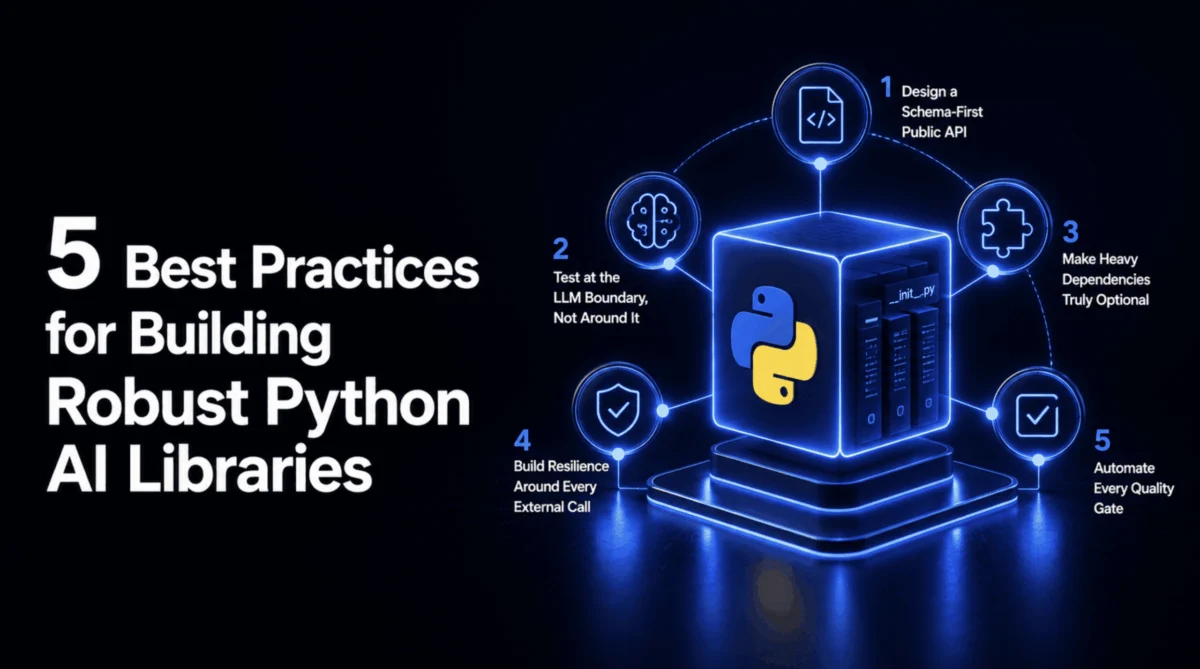
In the rapidly evolving ecosystem of artificial intelligence, a troubling pattern has emerged. An open-source AI wrapper, celebrated on social media and seemingly flawless in the developer’s demo notebook, undergoes a quiet collapse just days after reaching the hands of production users.
This scenario is all too common. A missing API key triggers a cryptic KeyError instead of a user-friendly diagnostic. A lightweight text-classification feature unexpectedly pulls in four gigabytes of deep learning dependencies, bloating deployment environments. Perhaps most frustratingly, the library’s test suite passes only when the third-party model provider experiences a "good day," as the tests were designed to validate the model’s prose rather than the library’s internal logic.
These are not merely "bad code" issues; they represent a fundamental category mismatch. Most established Python packaging paradigms were designed for static utilities—libraries that interact with predictable databases or file systems. AI libraries, by contrast, face a far more volatile environment: non-deterministic outputs, massive dependency footprints, and third-party API behaviors that defy traditional REST-client expectations.
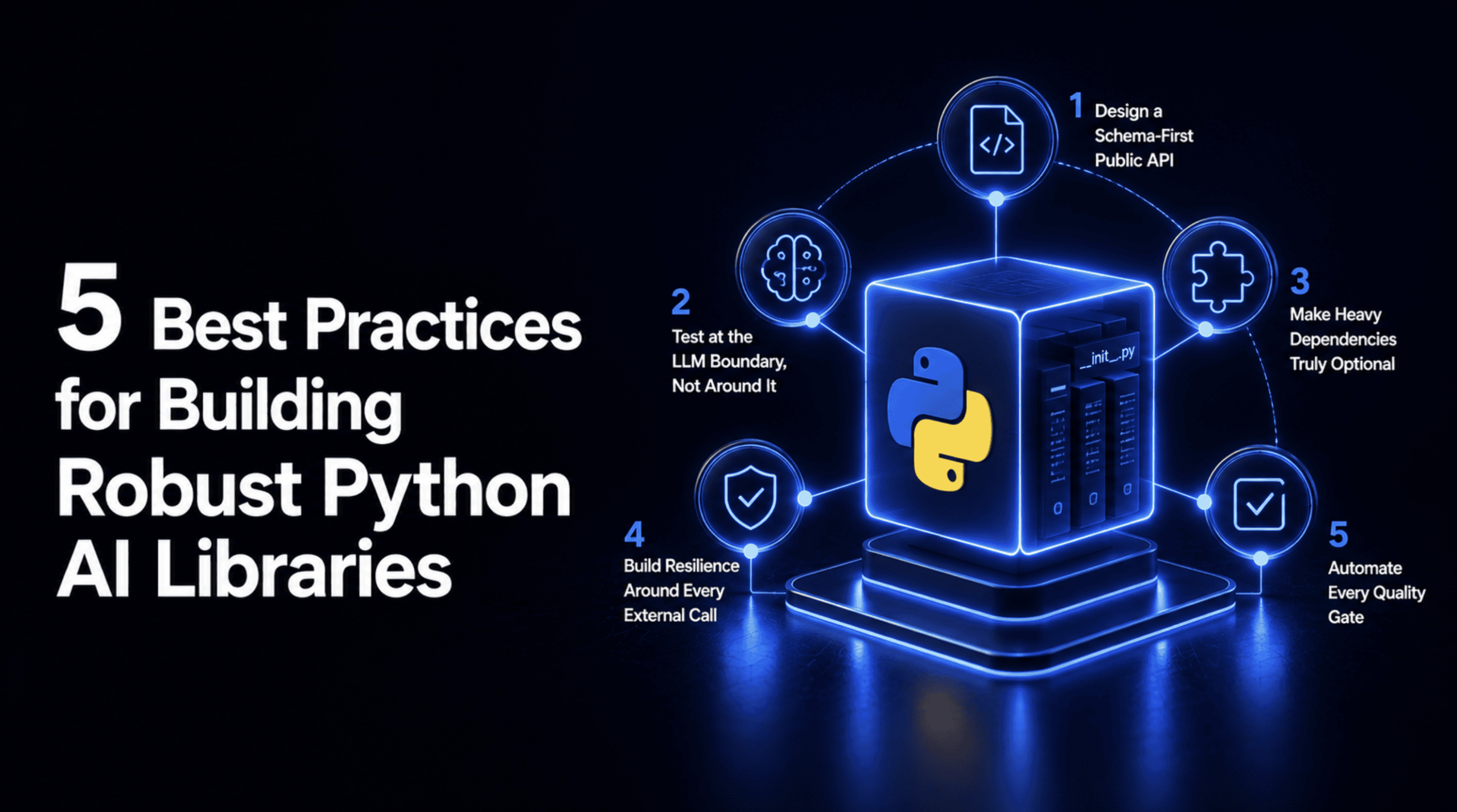
To bridge this gap, developers must move beyond legacy standards. This guide outlines five essential practices for constructing production-ready Python AI SDKs, transforming ephemeral prototypes into robust, professional-grade infrastructure.
The New Standard: What Defines a Robust AI Library?
Before architectural improvements can be implemented, developers must align with modern expectations. According to the Python Packaging User Guide and recent industry standards for 2026-era library construction, a robust AI package must exhibit several core traits:
- Type Safety: Full type coverage, signaled by a
py.typedmarker, ensuring downstream type checkers provide accurate feedback rather than treating the package as a black box. - Modern Configuration: A
pyproject.toml-first structure compliant with PEP 621, discarding fragmented legacy files. - Input/Output Validation: A public API that treats model output as inherently untrustworthy, enforcing strict schema validation.
- Dependency Granularity: Isolation of heavy AI frameworks so users can install only what they require.
- Resilient Design: External call handling that anticipates outages, rather than treating them as edge cases.
Practice 1: Designing a Schema-First Public API
The golden rule of AI library design is simple: Never allow raw, untyped data from a model to cross your library’s public boundary.
Model outputs are notoriously unpredictable—they may return malformed JSON, omit required fields, or provide data in incorrect types. If this raw output propagates through your system, the resulting failure will likely occur far from the source, making debugging an exercise in frustration.
Implementation Example
By utilizing Pydantic to enforce schemas, you create a contract between the model and the consumer. Consider this pattern for extracting invoice data:
from pydantic import BaseModel, ValidationError
from openai import OpenAI

client = OpenAI()

class ExtractedInvoice(BaseModel):
    vendor: str
    total: float
    due_date: str

def extract_invoice(raw_text: str) -> ExtractedInvoice:
    response = client.chat.completions.create(
        model="gpt-4o",
        messages=["role": "user", "content": raw_text],
        response_format="type": "json_object",
    )
    raw_json = response.choices[0].message.content
    try:
        return ExtractedInvoice.model_validate_json(raw_json)
    except ValidationError as e:
        raise SchemaValidationError("Invalid model response format.") from e
By forcing the model to return JSON via response_format, you eliminate a massive category of parsing errors, ensuring the end-user receives a validated object, not a volatile dictionary.
Practice 2: Testing at the Boundary, Not Around It
AI developers often struggle with "flaky" tests—tests that fail because the LLM’s response changed slightly. This occurs because the developer is testing the model’s reasoning rather than the library’s logic.
The solution is to mock the boundary where your code meets the provider’s API. By injecting a controlled, deterministic response, you verify your code’s ability to handle success, malformed data, or connectivity issues without relying on the model’s whims.
The Strategy
Use unittest.mock.patch to isolate the client object within your specific module. This allows you to verify that your prompts are constructed correctly and that your parsing logic behaves as expected. This approach is not only faster and free of API costs, but it also provides 100% reproducibility in CI/CD environments.
Practice 3: Making Heavy Dependencies Truly Optional
AI libraries often suffer from "dependency bloat." A user interested in a simple hosted API client should not be forced to install torch or transformers.
The most effective strategy involves pyproject.toml’s optional dependencies, paired with a "lazy import" pattern. By wrapping imports in a helper function that provides a clear, actionable error message if a dependency is missing, you provide a superior developer experience (DX). Instead of a vague ModuleNotFoundError, the user receives a helpful tip: "Install this feature with: pip install ‘mylib[local]’".
Practice 4: Building Resilience Around External Calls
AI infrastructure is entirely dependent on third-party reliability. Rate limits, 503 errors, and transient network hiccups are inevitable. A robust library must incorporate a retry-with-backoff mechanism.
Using libraries like tenacity, you can build resilience that is both safe and intelligent. Key parameters include:
stop_after_attempt: Prevents infinite loops and runaway billing.wait_exponential: Prevents "thundering herd" problems by spacing out retries.retry_if_exception_type: Ensures you only retry on transient issues (like timeouts), not on configuration errors (like invalid API keys).
Practice 5: Automating Every Quality Gate
None of the above practices will survive the passage of time without automation. Manual linting and testing are insufficient.
A modern CI pipeline—leveraging tools like uv for dependency management, ruff for linting, and mypy for static type checking—is the final line of defense. By enforcing these checks on every pull request, you ensure that style drift, type regressions, and missing test coverage are caught long before they reach production.
The CI Workflow
Your .github/workflows/ci.yml should act as an uncompromising gatekeeper:
- Syncing:
uv sync --all-extras --devensures the full environment is tested. - Linting:
ruffchecks for style and formatting violations. - Typing:
mypyconfirms that the Pydantic schemas and logic are type-safe. - Testing:
pytestruns the boundary-mocked suite, reporting coverage gaps.
Implications and The Path Forward
The difference between a library that survives a weekend and one that powers enterprise-grade AI is rarely found in the "intelligence" of the model. It is found in the engineering discipline applied to the wrapper.
When you prioritize schema validation, boundary testing, and optional dependencies, you aren’t just writing code; you are building trust. You are telling your users that when the model acts unpredictably, your library will catch it. When the provider has a bad night, your library will handle it.
As we look toward the future of software development, the "AI-native" library will be defined by its resilience. Developers who adopt these practices now are not just future-proofing their code—they are setting the standard for the next generation of AI tooling.
By answering the user’s need for stability before the first incident occurs, you move your project from the realm of the "demo" to the essential utility—a library that, quite simply, people keep using.


 Dwi Wanna

 Raul Delapena Setiawan

 Muslim
 Nana Wu

 Rifan Muazin