
 Laily UPN
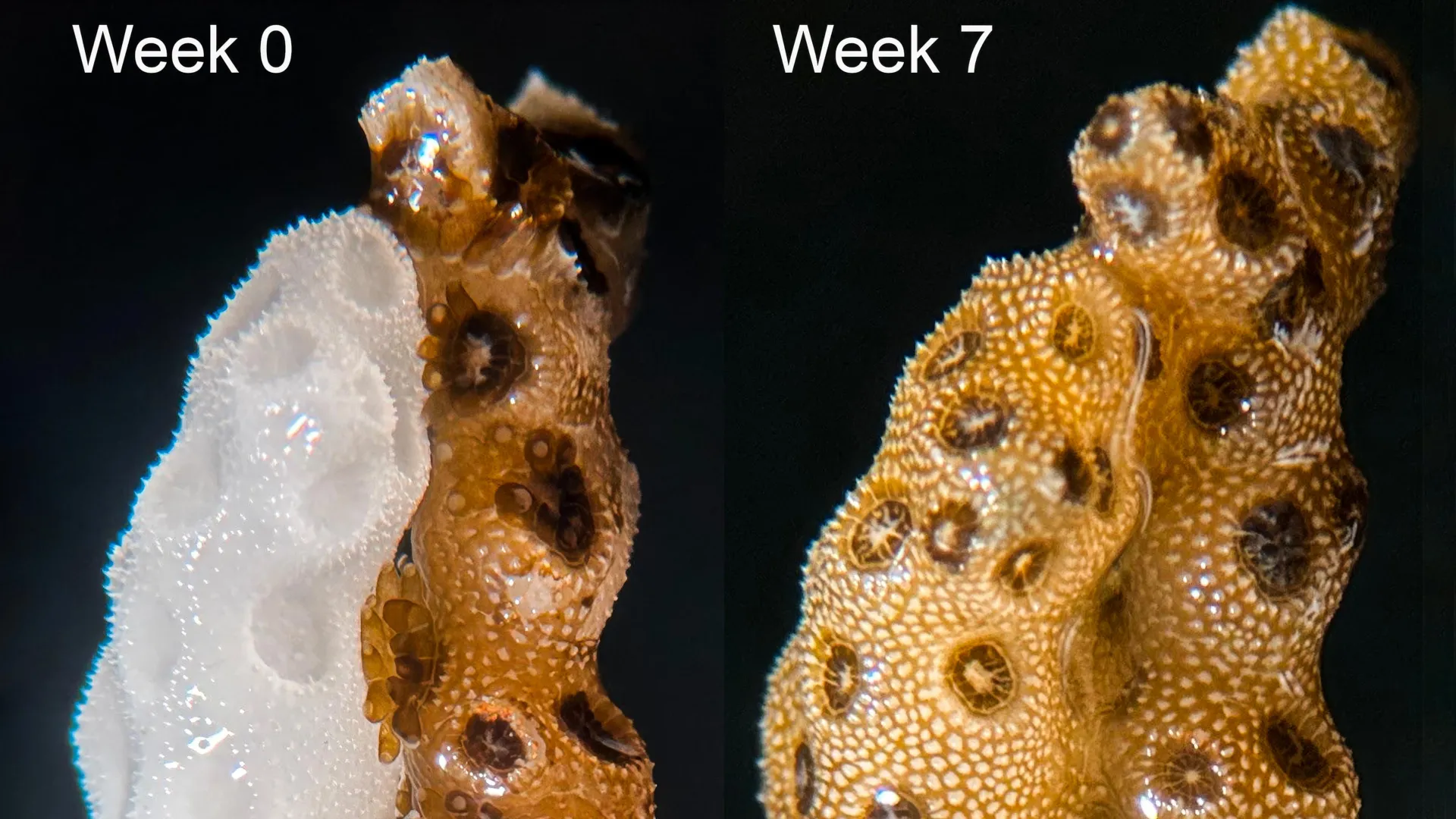
In a discovery that could redefine the future of marine conservation, researchers at Stanford University have unlocked a potential biological "reset button" for the world’s dying coral reefs. A study published on October 14 in the journal Science Advances reveals that severely bleached corals—often written off as beyond salvation—can achieve a full recovery in just seven weeks if they are allowed to make physical contact with a healthy, genetically identical counterpart.
This breakthrough offers a rare glimmer of hope for marine ecosystems globally, which are currently facing an existential threat from climate change. As marine heat waves become more frequent and intense, the world’s reefs are experiencing mass bleaching events that strip them of the essential algae required for their survival. This new research suggests that we may be able to intervene in these "lost cause" scenarios, providing a much-needed bridge to recovery for corals pushed to the brink of death.
The Fragile Foundation: Understanding Coral Bleaching
To appreciate the significance of this discovery, one must first understand the delicate symbiosis at the heart of the reef. Corals, though they may resemble inanimate rock formations or colorful plants, are complex animals. Their survival is intrinsically linked to microscopic algae, known as zooxanthellae, which reside within their tissues.
These algae act as the coral’s primary energy source. Through photosynthesis, they provide the oxygen and nutrients that allow corals to grow, build their calcium carbonate skeletons, and maintain their vibrant colors. However, when ocean temperatures rise—even by a few degrees—this relationship falters. Under thermal stress, corals expel these vital symbionts.
The result is "bleaching": the coral turns a ghostly white, loses its primary food source, and becomes highly vulnerable to disease and starvation. While a bleached coral is not necessarily dead, it enters a state of extreme metabolic compromise. Regaining health in the wild is a grueling process that typically takes months or years, provided the environmental conditions return to normal quickly enough. Many, however, do not survive this interim period, leading to the catastrophic collapse of reef structures worldwide.
The Chronology of a Serendipitous Discovery
The path to this discovery was neither linear nor planned. It began in 2025 within the controlled environment of a Stanford University laboratory, where marine scientists were observing various coral samples.
Steve Palumbi, the Jane and Marshall Steel, Jr. Professor in Marine Sciences, noticed an anomaly in one of his aquariums. Two fragments from the same coral colony—one healthy and one bleached—had accidentally drifted against one another. As Palumbi observed the pair, he noticed something impossible: the bleached fragment was regaining its color precisely at the point of contact.
Recognizing the potential for a breakthrough, the research team, led by PhD student Danny Collins, launched a formal investigation. They were particularly intrigued by the mechanics of tissue fusion. Collins, who was already studying how pathogens travel through physical contact between plastic debris and coral, pivoted his focus to see if this "contact" mechanism could be used to transmit life-saving symbionts rather than deadly bacteria.
The team designed a controlled experiment using 10 pairs of genetically identical coral fragments. Five pairs were placed in direct physical contact, while the other five were separated by a gap of just a few millimeters. The results were stark: within seven weeks, every single bleached fragment that had touched its healthy partner had fully recovered. Conversely, the fragments kept apart succumbed to the stress of bleaching and died.
The Mechanism of Recovery: Tissue Fusion and Algal Transfer
The success of this recovery is rooted in the biology of coral cloning. Because corals reproduce by creating genetically identical copies of themselves, they possess an innate biological recognition system. When two fragments from the same colony meet, they do not view each other as foreign invaders; instead, they recognize their own genetic markers.
Under high-resolution microscopy, the researchers observed the two fragments fusing together. Tiny, complex channels within the coral tissue aligned, effectively creating a circulatory bridge between the two organisms. Through these channels, the healthy coral began a "transfusion" of beneficial algae into its bleached partner.
The most startling data point from the study was the speed of the recovery. The researchers found that the bleached corals only needed between five and seven days of physical contact to receive enough algae to initiate a full recovery. Once that threshold was met, the corals could be separated, and they would continue to thrive on their own.
Once inside the bleached host, the algae did not merely survive; they proliferated at an unprecedented rate. During the second week of the experiment, the population of algae within the bleached fragments doubled every four days—a growth rate roughly ten times faster than what is typically observed in wild, undisturbed corals. This "bloom" of symbionts rapidly restored the coral’s energy reserves, allowing it to recover in seven weeks, a timeframe that would usually be considered impossible for such severely damaged organisms.
Official Perspectives and Scientific Implications
The study has sent a ripple of excitement through the marine biology community, as it provides a new conceptual framework for reef restoration.
"While bleached corals may be dying, they are not dead yet," says lead author Danny Collins. "The question we wanted to answer is, once a coral has bleached, what can we do? We’ve found that we can actually use the coral’s own biology to jump-start its recovery."
Fiorenza Micheli, a professor of oceans and faculty advisor on the project, notes that the discovery challenges the traditional view of bleached corals as a "lost cause."
"We hope this new research will inspire solutions that keep corals healthy long enough to enable full recovery after heat waves through slower processes such as growth, reproduction, and recruitment of new colonies," Micheli stated. By providing this immediate boost, scientists might be able to prevent the irreversible mortality that follows severe marine heat waves.
However, the team remains grounded in the realities of the field. The current methodology requires a "donor" coral that is genetically identical to the recipient, which is logistically difficult to implement on a global scale across diverse, sprawling reef systems.
Future Horizons: From Lab to Ocean
While the "direct contact" method is not yet a scalable solution for the world’s oceans, the study has paved the way for more practical applications. The researchers are now investigating whether it is possible to bypass the need for physical contact entirely.
If scientists can harvest and store beneficial algae from healthy corals before a heat wave occurs, they might be able to deliver these algae directly to bleached corals in the wild. This would act as a probiotic treatment, potentially allowing reefs to "re-seed" themselves with the specific, resilient strains of algae they need to survive warming waters.
The research team, which includes a diverse group of experts from Stanford’s Woods Institute for the Environment and the Department of Biology, continues to explore the limits of this recovery. Their work is supported by the National Science Foundation and the "Big Ideas for Oceans" grant program, reflecting the high stakes of this research.
As climate change continues to threaten the structural integrity of marine habitats, the ability to rapidly restore coral health could be the difference between a thriving ocean and a barren one. While the path from the laboratory aquarium to the open ocean remains complex, this discovery provides a crucial scientific foundation. By understanding the ways in which corals can support one another, humanity may finally have a tool capable of helping these ancient ecosystems weather the heat of the 21st century.

 Lina Irawan

 Iffa Jayyana

 Pevita Pearce

 Suro Senen

 Muslim

 Ammar Sabilarrohman

 Raul Delapena Setiawan
