
 Pevita Pearce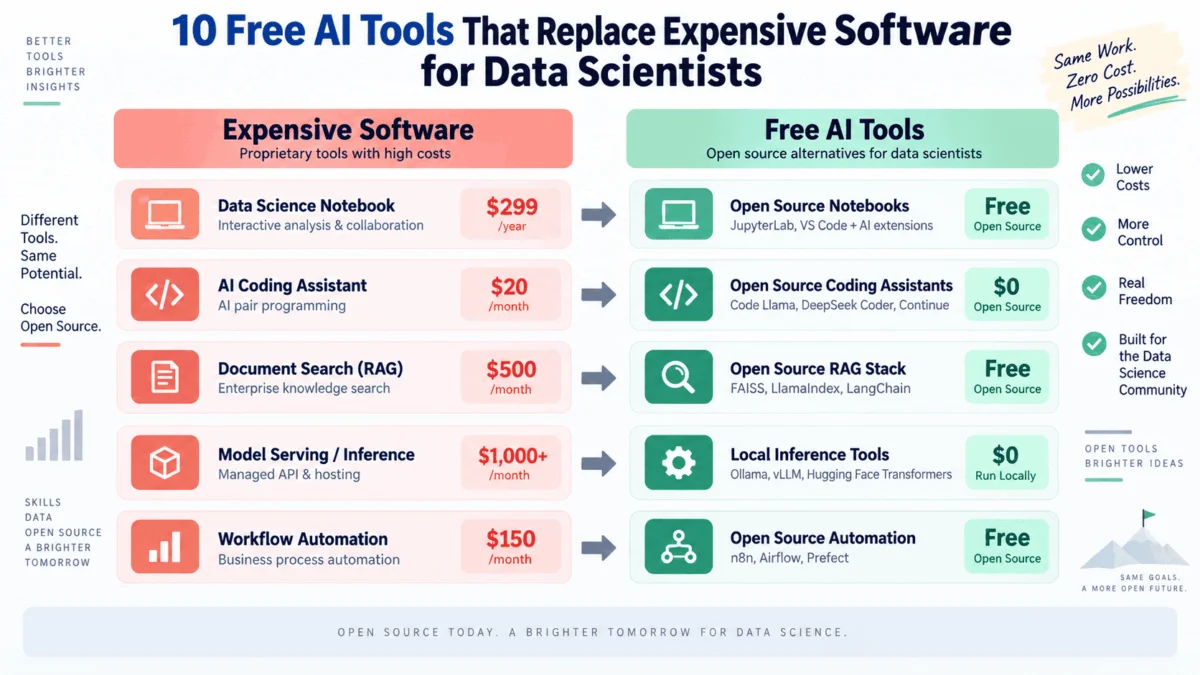
The modern enterprise data science budget is under siege. For years, the industry has operated on a "subscription-first" model, where the convenience of managed cloud services—DataRobot, Tableau, Snowflake, and OpenAI—came with a compounding price tag. A single seat for a premium AI tool can exceed $50,000 annually, while API consumption costs for Large Language Models (LLMs) often scale linearly with success, creating a dangerous "no-ceiling" scenario for data-intensive teams.
However, a fundamental shift is currently underway. The performance gap between proprietary enterprise platforms and their open-source counterparts has not only narrowed—it has, in many critical workflows, effectively evaporated. Today, developers and data scientists can assemble a professional-grade stack that runs entirely on local hardware, ensuring data sovereignty, eliminating recurring costs, and providing performance that matches, or occasionally exceeds, state-of-the-art commercial equivalents.
The Financial and Technical Impetus for Change
The current economic environment has forced organizations to scrutinize their software spending. When a team running continuous data extraction or summarization pipelines realizes their monthly inference fees are climbing into the thousands, the "convenience premium" of commercial APIs begins to look like a liability.
The move toward open-source tools is not merely about cost-cutting; it is about architectural control. By shifting to local or self-hosted infrastructure, companies are reclaiming ownership of their data pipelines, mitigating compliance risks, and removing the latency associated with third-party cloud round-trips.
The Toolkit: Replacing the Giants
The following ten tools represent the frontline of this open-source movement, mapping directly to expensive enterprise incumbents.
1. Ollama + Open WebUI (Replacing OpenAI/Anthropic APIs)
Commercial LLM APIs operate on a per-token pricing model that can become fiscally irresponsible for high-volume tasks. Ollama has emerged as the definitive solution for local inference, allowing users to run powerful open-weight models like DeepSeek-R1, Llama 3.3, and Mistral directly on local hardware.
When paired with Open WebUI, teams get a sophisticated, browser-based chat interface that mirrors the experience of ChatGPT. This setup provides privacy that commercial providers cannot guarantee, as sensitive proprietary documents never leave the local environment, bypassing complex compliance hurdles.
2. Tabby (Replacing GitHub Copilot & Tabnine)
For software-heavy data teams, AI coding assistants like GitHub Copilot are standard, but at $19 to $59 per user per month, they represent a significant recurring cost. Tabby provides a self-hosted alternative that offers context-aware code completion within IDEs like VS Code and JetBrains. Its true value lies in repository-level context indexing—Tabby can be trained on an organization’s specific codebase, allowing it to understand internal libraries and naming conventions far better than a generic, cloud-based model.
3. AutoGluon (Replacing DataRobot & H2O)
AutoML platforms are among the most expensive tools in the data scientist’s arsenal, with enterprise licenses often reaching six figures. Developed by AWS, AutoGluon is an open-source powerhouse that automates the entire machine learning lifecycle—from preprocessing to hyperparameter tuning and ensemble stacking. Because it runs within a standard Python environment, there are no dataset size limits or per-row pricing, allowing for more aggressive experimentation than paid cloud alternatives.
4. PandasAI (Replacing ThoughtSpot & Alteryx)
Data exploration often requires complex SQL or Python manipulations. Tools like ThoughtSpot offer natural language querying for a high price, but PandasAI democratizes this capability by adding an AI layer directly onto Pandas DataFrames. It translates plain English queries into executable code, significantly accelerating exploratory data analysis (EDA) for both technical and non-technical stakeholders.
5. AnythingLLM (Replacing Enterprise RAG Platforms)
Retrieval-Augmented Generation (RAG) is the backbone of modern corporate knowledge management. AnythingLLM simplifies the process of turning local documents, PDFs, and repositories into a searchable AI knowledge base. It handles the entire stack—chunking, vector storage, and retrieval—without the need for external API keys or cloud storage fees.
6. Autodistill (Replacing Scale AI & Labelbox)
Computer vision projects traditionally rely on expensive human annotation services like Scale AI. Autodistill disrupts this by using large foundation models (like the Segment Anything Model) to automatically label datasets. By "distilling" the knowledge of these massive models into smaller, deployment-ready models, teams can bypass the high costs and lengthy timelines of manual annotation.
7. PyGWalker (Replacing Tableau & Power BI)
Visual analytics is a cornerstone of business intelligence, but the license costs for Tableau Creator or Power BI Premium are persistent. PyGWalker transforms Jupyter notebooks into interactive, drag-and-drop visualization environments. It offers the same functionality as a BI tool but keeps the data and the logic within the local development environment, ensuring full reproducibility.
8. MLflow (Replacing Weights & Biases Enterprise)
Experiment tracking is vital for model governance. MLflow has become the industry standard for logging parameters, metrics, and model versions. With its recent focus on LLM observability—tracking prompt versions and token usage—it provides a comprehensive alternative to proprietary platforms like Weights & Biases, all while keeping the experiment data on-premises.
9. DuckDB (Replacing Snowflake & BigQuery)
For small to mid-sized analytical workloads, the overhead of a cloud data warehouse is often unnecessary. DuckDB acts as an in-process analytical database that queries files directly on the local disk. Its performance often rivals that of cloud warehouses for datasets under 100GB, allowing for lightning-fast analysis without the monthly compute bills.
10. Langfuse (Replacing LangSmith)
As teams move LLM applications into production, observability becomes the most critical hurdle. Langfuse provides a robust, open-source platform for tracing LLM calls, evaluating prompt performance, and monitoring latency. It offers the same visibility as commercial platforms like LangSmith but can be deployed via Docker in minutes, keeping data secure behind the company firewall.
Implications for the Industry
The shift toward these open-source tools is not just a trend; it is a fundamental realignment of the data science workflow.
Economic Implications
The primary implication is the democratization of high-level AI capabilities. By removing the "gatekeepers"—the vendors charging per-token or per-seat—smaller teams can now compete with the R&D budgets of massive corporations. The "cost-to-experiment" ratio drops significantly, encouraging innovation rather than risk aversion.
Operational Challenges
The trade-off for this newfound freedom is configuration and maintenance. Commercial SaaS platforms provide a "turn-key" experience. In contrast, an open-source stack requires internal technical expertise to set up, secure, and maintain. As Vinod Chugani, an AI educator and advocate for this transition, notes, the investment is usually measured in hours of setup time, which eventually pays for itself in both dollar savings and increased control over the data lifecycle.
Data Privacy and Sovereignty
Perhaps the most significant implication is the shift in security posture. In an era where data leaks and model training on private data are major concerns, local-first architectures are becoming the preferred standard for regulated industries like finance, healthcare, and government. By keeping everything within the private cloud or local infrastructure, organizations can innovate without the fear of intellectual property leakage.
Conclusion: How to Start the Migration
For organizations looking to break free from the "vendor lock-in" cycle, the strategy should be methodical. The goal is not to replace the entire stack overnight, but to identify the single most expensive line item—the tool that provides the least relative value for its high cost—and begin the migration there.
The transition to an open-source, locally-driven data science stack is an investment in long-term agility. While it demands a higher degree of technical literacy from the team, the result is a lean, highly performant, and completely independent AI operation that is built for the future of enterprise data. By choosing the right open-source tools, data scientists can stop worrying about the billing dashboard and start focusing entirely on what matters: the quality and impact of their models.

 Nana Wu
 Asro
Asro
 Iffa Jayyana
 Evan Lee Salim
 Rifan Muazin

 Nana
Nana