
 Nana Muazin
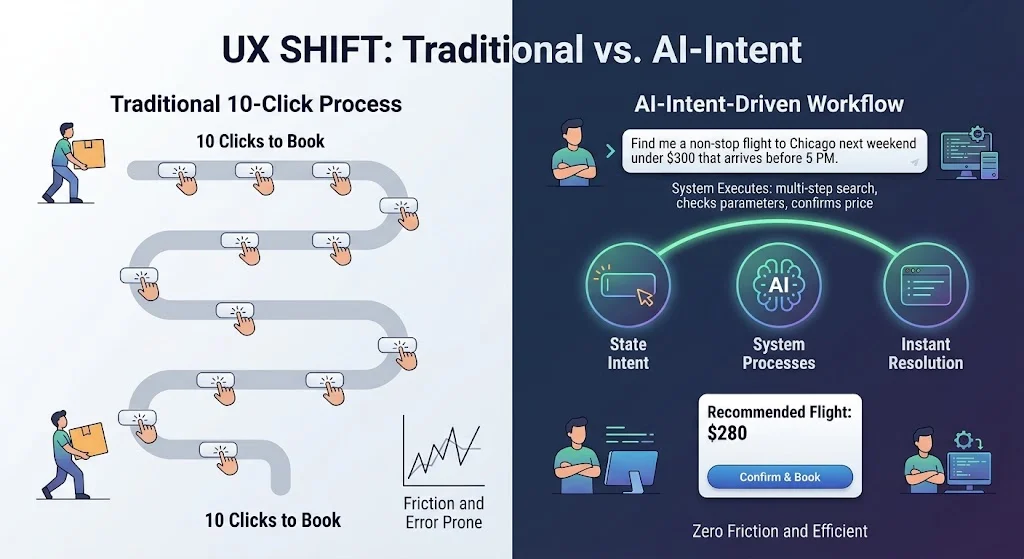
For over four decades, the digital landscape has been defined by the "point-and-click" orthodoxy. From the Xerox Star to the original Apple Macintosh, our interaction with software has been a manual, high-friction affair: we click menus, navigate labyrinthine forms, toggle range sliders, and manage dozens of browser tabs just to complete a single, basic task. We have become accustomed to spending more time "managing the software" than actually achieving our goals.
However, a radical shift is underway. Driven by the meteoric rise of Large Language Models (LLMs) and autonomous agent frameworks, the web is moving toward an era of Intent-Driven Design. The goal is no longer to build prettier buttons or more engaging animations; it is to eliminate the interface entirely.
Main Facts: The End of the "10-Click" Era
The fundamental contract between software and the user is being rewritten. In the traditional paradigm, the computer is a passive container of data, and the human is the overworked orchestrator. To book a flight, a user must visit a site, input dates, filter by airline, compare times, select seats, and navigate payment gateways. This is a "10-click" process designed to force user engagement.

Intent-driven design flips this dynamic. Instead of requiring the user to navigate the mechanical steps of how to find a flight, the system asks, "What are you trying to accomplish?" When a user inputs a high-level goal—such as, "Find me a non-stop flight to Chicago next weekend under $300 that arrives before 5 PM"—the software interprets the intent, executes the complex multi-step search, cross-references databases, and presents a single, actionable resolution.
This shift signifies a transition from Command-Based Interaction (telling the computer which button to press) to Outcome-Specification (telling the computer what result you desire).
Chronology: From Graphical Interfaces to Invisible Agents
To understand the magnitude of this transition, we must look at the historical arc of Human-Computer Interaction (HCI):
- 1980s: The GUI Revolution: The introduction of the Graphical User Interface transformed computing from code-based terminal commands to visual metaphors (files, folders, trash cans). This made computers accessible to the masses but entrenched the "point-and-click" interaction model.
- 2000s: The Web 2.0 Expansion: As the web grew, interfaces became increasingly complex. Designers prioritized "engagement metrics," leading to the rise of infinite scrolling, complex navigation bars, and pervasive pop-ups.
- 2015: The "No-Interface" Manifesto: Visionaries like Golden Krishna argued in The Best Interface Is No Interface that the most successful technology is that which solves problems without requiring the user to learn a new digital language.
- 2023–2025: The Generative AI Inflection Point: The widespread integration of LLMs allowed software to parse natural language intent with high accuracy. Platforms like Perplexity, Vercel v0, and Goblin.tools began replacing static menus with dynamic, AI-generated outcomes.
- Present Day: The Agentic Web: We are moving into an era where "Agents" operate in the background, performing multi-step tasks across disparate web services on behalf of the user, effectively rendering traditional "forms" obsolete.
Supporting Data: The Efficiency Gap
The inefficiency of the traditional UI paradigm is quantifiable. Research into user flow completion times suggests that intent-driven interfaces can reduce the "Time to Resolution" (TTR) for complex tasks by as much as 70–80%.
Consider the three primary platforms currently pioneering this space:
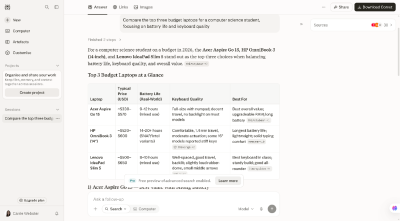
- Perplexity AI: By synthesizing search results into a single answer, it bypasses the "10-link" browsing loop. Users spend less time scanning ads and more time consuming synthesized, high-quality information.
- Vercel v0: This platform demonstrates the shift in professional tools. Designers no longer spend hours drawing rectangles or writing CSS for basic layouts. By typing a natural language request, they generate functional, responsive code components instantly.
- Goblin.tools: Specifically designed for neurodivergent users, this platform strips away the "productivity theater" of Kanban boards and status trackers, focusing entirely on breaking down complex, overwhelming tasks into manageable, actionable steps.
Official Perspectives and Expert Consensus
Industry experts and academic bodies have begun codifying the shift. The Nielsen Norman Group (NN/g) has identified this as the most significant change in UX history, noting that the "AI Paradigm" is moving away from the static, uniform layouts of the past toward "Generative UI."
Furthermore, the Google PAIR (People + AI Research) Guidebook emphasizes the necessity of "Feedback Loops." Because the interface is now dynamic, designers must provide "Explainability." If the AI makes a choice for the user, the interface must explicitly state its reasoning (e.g., "I selected this flight because it is the cheapest non-stop option that meets your arrival time requirement") so that the user remains in control.
Implications for UX Designers: A New Mandate
The role of the UX designer is not disappearing; it is undergoing a profound transformation. In the past, designers were "Interface Architects," building the walls, doors, and hallways of a digital building. Today, they must become "Intent Curators."
1. The Death of Static Layouts
Designers can no longer rely on designing a "home page" that every user sees. They must design Generative UI components—atomic building blocks that assemble themselves on the fly based on what the user needs at that specific second.
2. From Prevention to Reversibility
Traditional UX is obsessed with prevention (e.g., "Are you sure you want to delete this?"). Intent-driven design prioritizes Easy Reversibility. Since AI agents will inevitably make mistakes, the designer’s job is to create frictionless "Undo" buttons, transparent audit logs, and clear paths for users to correct the AI’s interpretation of their goal.
3. The Ethical Guardrails
There is a significant risk of "The Illusion of Control." The Center for Humane Technology has warned that without careful design, AI can nudge users toward outcomes that benefit the platform rather than the user. Designers must ensure that automation serves the user’s intent, not the corporation’s engagement metrics.
Conclusion: The Ultimate Goal is Absence
For decades, the digital industry measured success through "Time Spent in App"—a metric that rewarded friction and complexity. The new standard for success is the exact opposite: Seamless, invisible completion.
If a user opens an application, solves their problem, and closes it in five seconds because the AI handled the background work, that is not a failure of engagement; it is a triumph of design. The future of the web isn’t more interactions, more flashy animations, or more clever buttons. The future of the web is the graceful, silent, and efficient dissolution of the interface itself.
We are entering an era where the best software is the software you don’t have to "learn" to use, because it already understands what you want to do.

 Sagoh

 Neng Nana

 Azzam Bilal Chamdy
 Raul Delapena Setiawan

 Ali Ikhwan

 Pevita Pearce
