
 Raul Delapena Setiawan
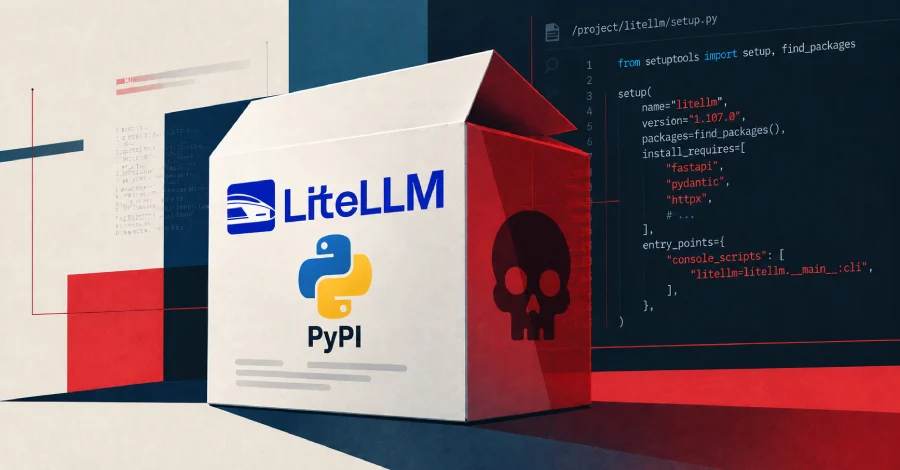
In a sobering reminder of the fragility inherent in modern software supply chains, the open-source community is reeling from a sophisticated security breach that resulted in the distribution of a malicious version of the popular Python library, LiteLLM. The incident, which unfolded over several months, underscores the catastrophic potential of "security debt"—specifically, the failure to properly rotate and revoke credentials following a minor leak.
The breach, centered on version 1.107.0 of the LiteLLM package, allowed an unknown threat actor to execute arbitrary code on the systems of unsuspecting developers and organizations. By leveraging an inadvertently exposed master key, the attacker successfully infiltrated the project’s infrastructure, demonstrating that even widely used, security-conscious tools are vulnerable to the most basic of operational oversights.
The Genesis: A Configuration Error with Long-Term Consequences
The root of the compromise can be traced back to May 27, 2026. On that date, a developer working on the LiteLLM-Labs/lite-harness repository committed a configuration file to a public GitHub repository. This file contained the master key for a deployment of the LiteLLM Agent Platform, an orchestration tool used by the team to manage various autonomous agents.
While the error was identified almost immediately—leading the team to force-push a correction to the repository—the incident highlights a critical failure in the organization’s security hygiene: the failure to invalidate the compromised key. In the world of cloud-native development, a "force push" on GitHub hides the history of a commit, but it does not magically revoke the validity of a key that has already been exposed to the public internet. Because the master key remained active, it sat like a ticking time bomb, waiting for an opportunistic actor to discover it.

Chronology of the Attack
The timeline of the LiteLLM breach reveals a calculated, patient adversary who understood the value of the access they had obtained.
- May 27, 2026: A master key for the LiteLLM Agent Platform is accidentally exposed in a public GitHub repository. Despite a rapid attempt to "fix" the commit, the underlying key is never revoked.
- October 10, 2026: The attacker, operating from the IP address
69.48.229.143, uses the unrevoked master key to gain access to the LiteLLM Agent Platform. Once inside, they extract a GitHub CLI OAuth token configured for the service. This token, which was inadequately scoped, provided the attacker with owner-level access to the organization’s entire GitHub infrastructure. - October 10–12, 2026: The attacker executes two malicious commits to a hidden, short-lived branch in the repository. These commits inject custom GitHub Actions workflows (
.github/workflows/cache.yml) designed to harvest sensitive environment variables, API keys, and database credentials. - October 13, 2026: The attacker registers a domain,
litellm[.]dev, to serve as the landing point for exfiltrated data. - Mid-October 2026: The malicious version 1.107.0 of the LiteLLM Python package is published to PyPI, containing backdoors and credential-stealing capabilities.
The Mechanics of the Breach: How the Malicious Code Operated
The sophistication of the malicious LiteLLM package lies in its persistence and stealth. Unlike typical malware that requires an explicit execution command, the compromised version of LiteLLM was engineered to trigger automatically.
The "Always-On" Backdoor
Security researchers from Microsoft and other firms identified that the files bundled with version 1.107.0 utilized Python startup hooks. This meant that the malicious payload would execute the moment the Python interpreter was initialized, regardless of whether the developer had actually imported the LiteLLM library into their project. This design choice effectively turned every machine that downloaded the package into a potential node for the attacker’s botnet.
Credential Harvesting at Scale
The malicious payload functioned as a comprehensive vacuum for secrets. It targeted:

- Developer Tooling: Credentials for npm, PyPI, pip, Yarn, Maven, Gradle, and Composer.
- AI and Cloud Infrastructure: API keys for OpenAI, Anthropic, AWS Bedrock, and Together AI.
- System and Environment: SSH keys, Git/GitLab tokens, and environment variables.
- Web Browsers: Playwright storage states, which allowed the attacker to bypass multi-factor authentication (MFA) on services like Linear by simulating an authenticated browser session.
The exfiltration process was remarkably efficient, sending compressed data packets via HTTP POST requests to the attacker-controlled litellm[.]dev/healthcheck endpoint.
The Role of GitHub Actions and Workflow Manipulation
The attackers did not just modify the code; they manipulated the very infrastructure used to build and ship the software. By obtaining an organization-owner token, the attacker was able to circumvent established security protocols.
LiteLLM maintainers previously had a "locked" release process that required approval from an account tied to a physical device in their office. However, to accommodate a temporary increase in release velocity and bugfix backports, this policy had been relaxed to allow any two engineers to authorize a release. The attacker, possessing the stolen tokens, acted as both the "requester" and the "approver," effectively signing off on their own malicious build.
Socket, an application security firm, noted that the attacker was careful to keep these activities out of the main commit history. By creating and deleting "ci-tmp" branches within minutes, they ensured that the audit trail was virtually non-existent for anyone conducting a cursory review of the repository’s main branches.

Implications for the Software Supply Chain
The LiteLLM incident is a watershed moment for the AI and open-source ecosystems. It raises three fundamental questions regarding how modern software is built:
1. The Danger of Over-Privileged Tokens
The fact that a single OAuth token provided owner-level access to an entire organization’s repositories is a critical failure of the "principle of least privilege." Developers must move toward scoped tokens that expire quickly and grant access only to the specific resources required for a task.
2. The Illusion of "Secret Scanning"
The attackers were so brazen that they even exfiltrated the GITGUARDIAN_API_KEY. By gaining control over the organization’s secret-scanning tools, the threat actor could potentially suppress alerts related to their own malicious activity, effectively blinding the security team to the very breach occurring in real-time.
3. The "Python Startup" Vector
The ability to run code at Python startup is a powerful technique that developers rarely monitor. This incident proves that simply "having the package installed" is a security risk, even if the code itself is not called. Organizations need to adopt more rigorous Software Bill of Materials (SBOM) scanning and move toward immutable build environments that detect unauthorized modifications to dependencies.

Official Responses and Remediation Efforts
In the wake of the discovery, LiteLLM’s maintainers, Oliver Jensen and Mateo Wang, have been transparent about the errors that led to the compromise. The team has initiated a massive effort to revoke every token associated with their internal systems and third-party vendors.
"The investigation was a process in which we continually learned additional information," Jensen stated in a GitHub issue thread. The team is currently rebuilding their security infrastructure from the ground up, moving away from long-lived secrets and implementing stricter hardware-backed authentication for all code deployments.
Microsoft’s Security Research team has urged all users of LiteLLM to immediately upgrade to a secure version and, more importantly, to inspect their local environments for residual startup hooks. Because the malicious code resided outside the application directory, simply uninstalling the LiteLLM library is insufficient. Users must ensure their Python configuration files are clean to prevent the backdoor from re-triggering.
Conclusion
The compromise of LiteLLM serves as a grim warning to the open-source community. It highlights that the weakest link in the software supply chain is often not the code itself, but the operational security surrounding the tools that build, test, and ship that code. As AI-centric tools become more prevalent, the potential for high-impact, low-visibility attacks increases. Developers must adopt a "zero-trust" mentality toward their own internal workflows, recognizing that the keys to the kingdom are often hiding in plain sight—waiting for the right (or wrong) person to find them.


 Basiran
 Iffa Jayyana

 Azzam Bilal Chamdy

 Ali Ikhwan

 Pevita Pearce

 Sagoh
 Nana Muazin
