
 Sagoh
Sagoh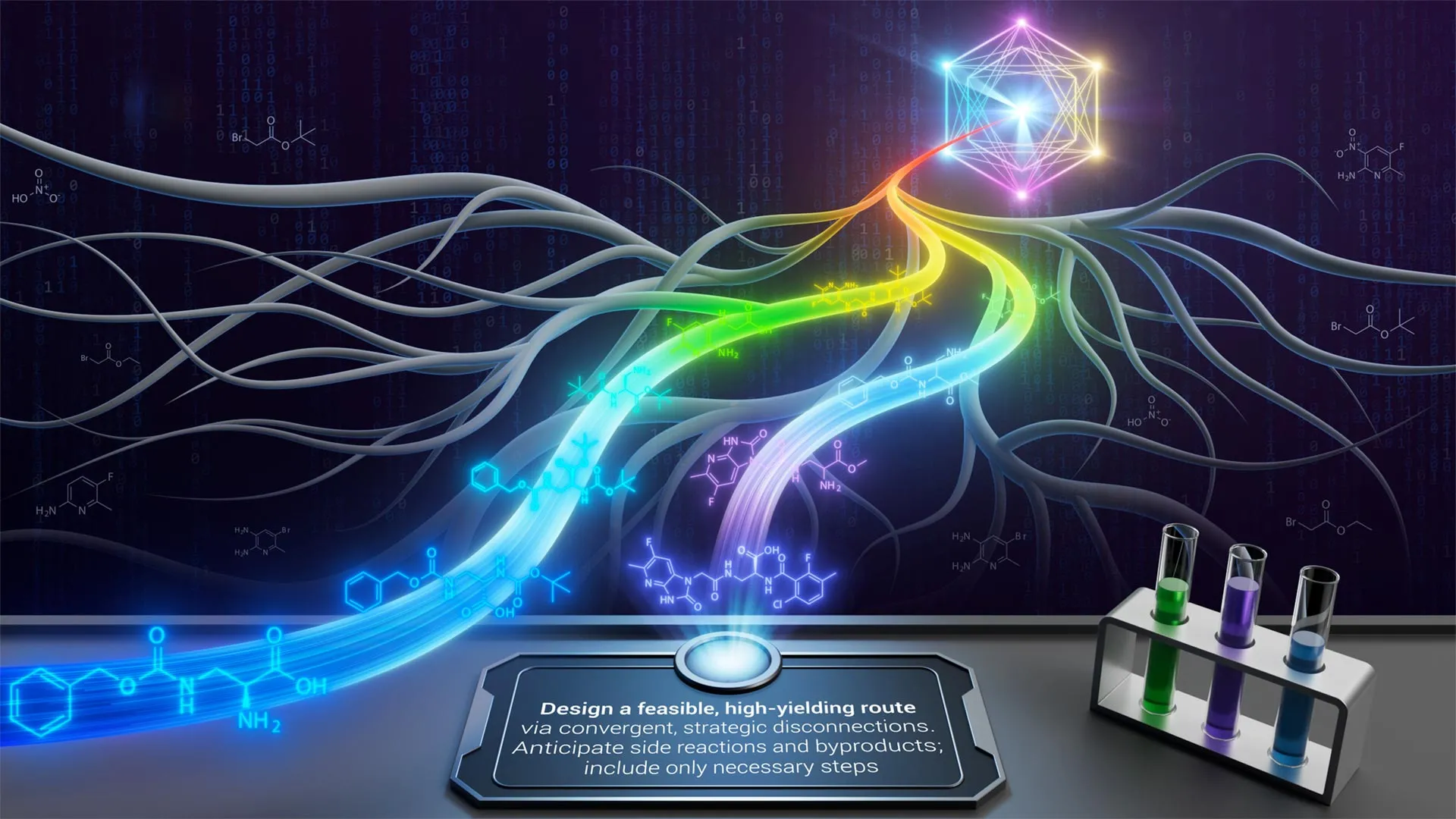
The synthesis of complex molecules—the bedrock of modern medicine, material science, and sustainable energy—has long been regarded as an art form as much as a science. For decades, the ability to architect a molecule, atom by atom, was a skill acquired through years of grueling trial and error at the laboratory bench. Today, that paradigm is shifting. A groundbreaking development from researchers at the École Polytechnique Fédérale de Lausanne (EPFL) has introduced a new framework called "Synthegy," which leverages the reasoning capabilities of Large Language Models (LLMs) to transform how chemists plan synthetic routes and interpret complex reaction mechanisms.
The Architecture of Discovery: The Challenge of Retrosynthesis
To understand the magnitude of this advancement, one must first appreciate the Herculean task of retrosynthesis. In the traditional chemical workflow, a scientist identifies a target molecule—perhaps a promising new cancer therapeutic or a high-performance polymer—and attempts to work backward. They must deconstruct the final structure into simpler, commercially available precursors, navigating a "chemical space" that is effectively infinite.
This process is fraught with strategic dilemmas. Chemists must decide when to form rings, which functional groups require "protection" (a chemical shield to prevent unwanted side reactions), and how to minimize the number of steps to ensure the process remains economically and environmentally viable. Historically, computational tools have attempted to map these pathways, but they have often been limited by rigid, rule-based algorithms that lack the nuanced intuition of a veteran researcher. When faced with the creative demands of total synthesis, traditional software often hits a wall, unable to prioritize the most elegant or efficient path.
A New Paradigm: Synthegy’s Human-Centric Reasoning
The EPFL research team, led by Philippe Schwaller, has pivoted away from the idea that AI should simply "generate" chemical structures. Instead, they have positioned LLMs as sophisticated evaluators—tools that act as the chemist’s digital colleague. Published in the journal Matter, the study detailing the Synthegy framework demonstrates how AI can bridge the gap between abstract natural language instructions and concrete chemical logic.
Synthegy functions by integrating traditional, robust search algorithms with the linguistic reasoning of an LLM. Rather than forcing a chemist to interact with a cumbersome, jargon-heavy interface, Synthegy allows the user to articulate their strategy in plain English. A scientist might instruct the system, "Prioritize pathways that avoid the use of orthogonal protecting groups," or "Favor routes that form the central macrocyclic ring in the final step." The AI then ingests these constraints, evaluates thousands of potential computational pathways, and filters them based on how well they align with the researcher’s strategic intent.
Chronology of the Research: From Concept to Validation
The development of Synthegy did not happen in a vacuum; it is the culmination of a multi-year effort to integrate computational chemistry with deep learning.
- Initial Conceptualization: The EPFL team recognized that the bottleneck in drug discovery wasn’t just computing power, but "reasoning power." They began experimenting with LLMs not to solve equations, but to interpret the why behind chemical transformations.
- Framework Integration: Over the past eighteen months, the researchers built a pipeline where standard retrosynthesis software—the "engine"—is coupled with an LLM "navigator." This navigator converts complex reaction graphs into textual descriptions that the model can process.
- The Double-Blind Study: To prove the efficacy of the tool, the team conducted a rigorous double-blind study. They invited 36 professional chemists to evaluate 368 different synthetic pathways generated by the system. The results were striking: the AI’s assessments and the human experts’ judgments were in agreement 71.2% of the time, validating that the model had successfully learned to "think" in a way that resonated with human practitioners.
Decoding the Mechanism: Beyond Mere Planning
Synthegy’s utility extends beyond the high-level planning of retrosynthesis; it delves into the "mechanistic" layer of chemistry. Understanding how a reaction proceeds—the step-by-step movement of electrons—is vital for improving yield and predictability.
In the laboratory, even a minor change in temperature or solvent can alter a reaction’s mechanism, leading to different products. Synthegy addresses this by breaking down chemical transformations into fundamental electron movements. By applying the LLM’s reasoning to these mechanistic steps, the system can steer a search toward pathways that are not only theoretically possible but chemically "sensible."
This capability allows researchers to incorporate expert hypotheses directly into the software. If a chemist suspects that a specific catalytic cycle is the most efficient route, they can "tell" the AI to explore that hypothesis. The system then evaluates the feasibility of that pathway, effectively creating a feedback loop between the scientist’s intuition and the computer’s raw processing power.
Official Perspectives: The Human-AI Symbiosis
Andres M. Bran, the lead author of the study, emphasizes that the goal is not to replace the chemist, but to augment their capabilities. "When making tools for chemists, the user interface matters a lot," Bran stated in the project’s summary. "Previous tools relied on cumbersome filters and rules. With Synthegy, we’re giving chemists the power to just talk, allowing them to iterate much faster and navigate more complex synthetic ideas."
The professional community has reacted with cautious optimism. For years, the "black box" nature of AI—where the computer provides an answer without explaining how it reached it—has been a point of friction. Synthegy changes this by providing a textual justification for its scores. When the model ranks a particular pathway as "superior," it explains its reasoning, citing factors like atom economy, functional group compatibility, or the avoidance of unnecessary steps. This transparency builds trust, allowing the chemist to accept or reject the AI’s suggestions with a full understanding of the underlying logic.
Supporting Data and Performance Metrics
The scalability of the Synthegy framework was a central focus of the research. The team found a direct correlation between the size of the language model and its reasoning ability. Larger, more robust models consistently outperformed smaller ones, suggesting that the "reasoning" capability is an emergent property of the model’s complexity.
Furthermore, the framework demonstrated a high degree of flexibility. Because it relies on natural language, the system can be updated with new chemical literature without requiring a complete redesign of the code. If a new, highly efficient catalyst is discovered, a researcher can simply update the system’s knowledge base by providing relevant papers, and the model will immediately incorporate this new strategy into its future evaluations.
Implications for the Future of Chemistry
The implications of the Synthegy project are profound, particularly for the pharmaceutical and material science sectors. In drug discovery, the "time-to-market" for a new compound is often measured in years and millions of dollars. By reducing the number of failed experiments—"trial and error"—that a team must conduct at the bench, Synthegy could significantly compress development timelines.
Moreover, the tool represents a democratization of expertise. While a junior researcher may not yet possess the decades of experience required to intuitively spot the best synthetic route, Synthegy acts as a mentor, guiding them through the complex decision-making process.
Perhaps most importantly, the project highlights a shift in how we conceive of AI in the sciences. We are moving away from the era of "AI as a oracle" that spits out final answers, toward "AI as a collaborator" that participates in the discourse of science. By bridging the gap between computational synthesis planning and the mechanistic understanding of reactions through a natural language interface, the EPFL team has created a tool that speaks the language of chemistry.
As the industry continues to integrate these technologies, we can expect a new generation of chemical processes that are faster, cleaner, and more efficient. The laboratory of the future will likely look very different from the one of today, characterized by a seamless dialogue between the scientist and the machine—a conversation where the chemist provides the vision, and the AI provides the path to realization.


 Evan Lee Salim
 Nana Muazin
 Nila Kartika Wati
 Jia Lissa
 Basiran


 Lina Hope