
 Nana Muazin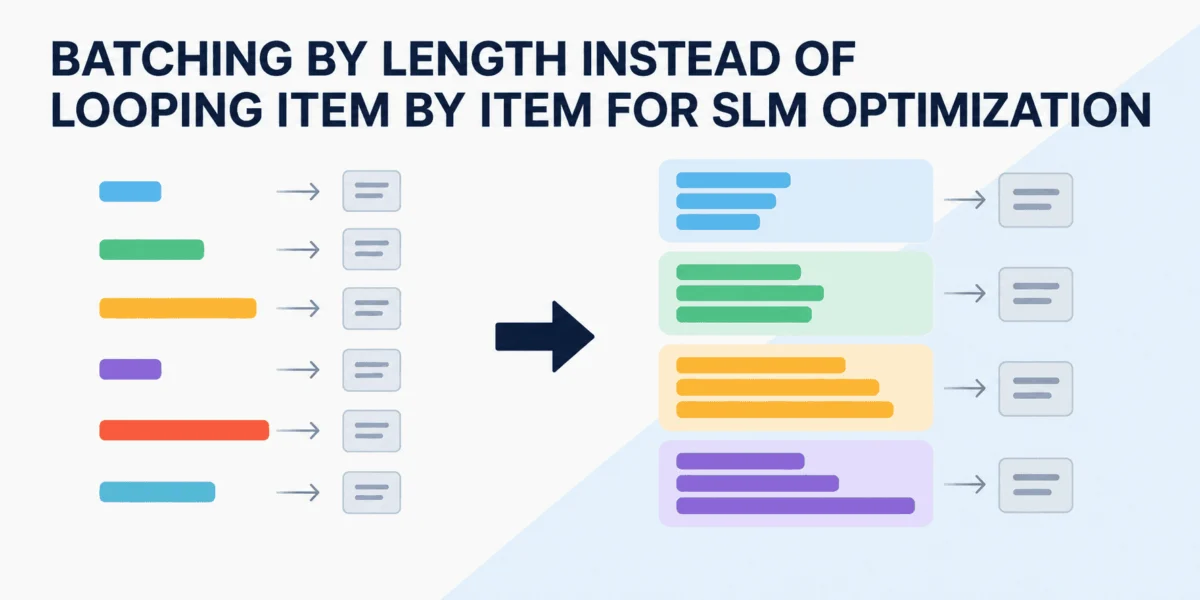
In the rapidly evolving landscape of artificial intelligence, the industry’s focus has largely been on the "bigger is better" paradigm—scaling up model parameters to achieve general intelligence. However, for real-world applications like automated customer support, document classification, and data extraction, the future is increasingly leaning toward Small Language Models (SLMs). These models offer a compelling balance of speed, cost-efficiency, and deployment flexibility.
As we conclude our three-part series on SLM narrow-automation optimization, we turn our attention to one of the most significant performance bottlenecks in machine learning pipelines: the inefficient processing of data batches. By moving away from item-by-item loops and implementing "batching by length," developers can achieve dramatic throughput gains without sacrificing a shred of model accuracy.
The Core Challenge: Memory-Bound vs. Compute-Bound Operations
To understand the optimization, one must first understand the problem of hardware utilization. When processing a single inference request (batch size of 1), an SLM is typically memory-bandwidth bound. This means the hardware spends the vast majority of its time streaming model weights from memory to the processor. By the time the arithmetic units (the "compute" portion of the chip) are ready to perform the matrix multiplications required for inference, the weight data has already moved through, and the processor sits idle, waiting for the next sequence.
This is true whether you are running a model on a high-end GPU or, as demonstrated in our benchmarks, on the Neural Engine of an M2 MacBook Air. Processing one ticket at a time is the single largest source of "waste" in the typical inference pipeline.
The Naive Batching Trap
The obvious solution—batching—is designed to amortize weight reads across multiple sequences. However, standard batching introduces a secondary inefficiency: padding. Because tensors in a batch must be rectangular, every sequence in a batch is padded to match the length of the longest sequence. In real-world datasets, which often follow a "long-tail" distribution (where most tickets are short, but a few are significantly longer), this leads to massive computational waste, as the model spends precious cycles processing meaningless padding tokens.
Chronology of Optimization: The Path to Efficiency
This series has explored three distinct strategies to optimize SLMs for narrow, repetitive tasks. Each step was designed to refine the pipeline, ensuring the model remains accurate while becoming significantly faster.
Phase 1: Constraining Output Space
Our initial exploration focused on restricting the model’s output. By limiting the model to specific, valid tokens (e.g., forcing a choice between "billing," "technical," or "account"), we eliminated the need for the model to generate lengthy, unnecessary text. This approach ensures that every forward pass is targeted and efficient.
Phase 2: Reusing the Prompt Prefix
In the second installment, we implemented Key-Value (KV) caching. By caching the static portions of a prompt—the "system instructions" that never change—the model doesn’t need to recompute the attention scores for those tokens every time a new ticket arrives. This drastically reduces the computational burden per request.
Phase 3: Batching by Length
The final piece of the puzzle, detailed here, is length-bucketed batching. Instead of feeding data into the model in its raw, random order, we sort the entire dataset by token length before batching. By grouping items of similar lengths together, each batch only needs to pad to its local maximum. This minimizes the "padding tax" and maximizes the efficiency of the arithmetic units.
Supporting Data: Benchmarking the Improvements
To validate this approach, we utilized the Qwen2.5-0.5B-Instruct model, running in float16 via Hugging Face Transformers. The objective was to classify support tickets.
The Baseline: Looping Item-by-Item
In our baseline test, we processed 600 tickets individually. The results were suboptimal:
- Throughput: 4.2 items per second.
- Total Time: 144.35 seconds.
- Padding Waste: High potential waste if global maximums were used.
The Solution: Length-Bucketed Batching
When we implemented sorting by token length and processed the same 600 tickets in batches of 32, the performance profile changed dramatically:
- Throughput: 7.5 items per second.
- Total Time: 79.60 seconds.
- Padding Overhead: Only 7.6% of tokens were padding.
By simply reordering the data, we nearly doubled our throughput. Importantly, we verified the accuracy of the batched output against the unbatched baseline. By probing a selection of tickets, we confirmed 100% alignment between the two methods. This confirms that the optimization is purely a scheduling efficiency and does not alter the model’s reasoning capabilities.
Implications for Production AI
The implications of these optimizations are profound for companies deploying SLMs at scale.
- Hardware Democratization: The ability to achieve high performance on local hardware (like an M2 MacBook Air) means that many companies can move sensitive data processing from expensive, external cloud APIs to private, on-premise infrastructure without sacrificing speed.
- Cost-to-Serve Reduction: By reducing the time-to-inference, the total energy consumption and compute costs per request drop significantly. In an era of high AI operational costs, these "micro-optimizations" accumulate into significant annual savings.
- Improved User Experience: For end-users of automated support systems, faster inference translates to near-instantaneous responses, creating a more seamless interaction.
Important Technical Caveats
While these optimizations are powerful, they are not "plug-and-play." Developers must be cautious when combining them. For instance, combining prefix caching with batching requires careful tensor manipulation. Because the KV cache is typically built for a single sequence, it must be carefully expanded and cropped when applied to a batch of sequences. Failing to handle these dimensions correctly will lead to incorrect model outputs.
Conclusion: The Philosophy of Optimization
The overarching theme of this series is that "intelligence" and "efficiency" are distinct variables. Optimization should never come at the cost of accuracy. A faster model that produces a different answer than a slower one is not an optimization; it is a regression.
By rigorously verifying each step—from constraining the output space to caching the prefix and, finally, batching by length—we have built a pipeline that is roughly twice as fast as the initial implementation, while maintaining the exact same logic.
For developers building the next generation of narrow-automation tools, the message is clear: look at your data distribution, manage your memory bandwidth, and optimize your scheduling. When it comes to SLMs, the most significant performance gains are often found not in the model weights themselves, but in the engineering surrounding them.
Series Recap:
- Part 1: Constraining the Output Space (reducing token generation).
- Part 2: Prefix Caching (reducing redundant computations).
- Part 3: Length-Bucketed Batching (maximizing hardware utilization).
As we look toward the future of AI, the winners will be those who can deploy these models with the highest efficiency, ensuring that the promise of AI is not just powerful, but practical and sustainable.


 Evan Lee Salim
 Laily UPN
 Nila Kartika Wati
 Jia Lissa
 Basiran
 Sagoh
Sagoh

 Lina Hope