
 Sagoh
Sagoh
In an era where marketing budgets are stretched across an ever-expanding ecosystem of digital and traditional channels, the "holy grail" of advertising has long been a unified view of performance. For years, Chief Marketing Officers (CMOs) have struggled to reconcile the performance of a high-reach television spot with a precision-targeted retail media placement or a viral social media campaign.
Coca-Cola, in partnership with Top Line Marketing and Kantar, is attempting to solve this perennial industry headache. The beverage giant is currently championing the Universal Media Measurement (UMM) framework, a system designed to provide marketers with a "single currency" to compare the effectiveness of paid, owned, earned, and shared media on a standardized scale. Unveiled to a global audience at the World Federation of Advertisers (WFA) Media Forum in Stockholm last month, the framework represents a significant attempt to bring scientific rigor to the often-fragmented world of media investment.
The Genesis and Evolution of UMM
The development of the UMM framework is not a recent pivot but the result of a long-term strategic initiative. According to industry reports, the tool has been under development for approximately seven years. This gestation period suggests that Coca-Cola has moved beyond theoretical modeling, having stress-tested the framework in real-world scenarios.

Currently, the UMM system is operational across Coca-Cola’s global marketing organization, spanning more than 20 countries. By deploying the framework at such a scale before pitching it to the broader industry, the company has effectively transformed a corporate internal project into a potential industry standard. The presentation at the WFA Media Forum was more than a mere showcase; it was a signal that Coca-Cola is looking to catalyze a shift in how multinational brands evaluate the return on their massive advertising outlays.
What UMM is Supposed to Do
At its core, the UMM framework is designed to dismantle the silos that currently prevent holistic media analysis. The official documentation from the UMM project asserts that the primary objective is to "place all media under a similar language and measurement system."
In practical terms, the tool functions as an ingestion engine. It aggregates data from the four pillars of modern marketing—paid, owned, earned, and shared media—and processes them through a standardized criteria set. This allows the system to output a dashboard that provides comparable "quality ratings" for consumer touchpoints, regardless of whether they exist in an online or offline environment.
Key features of the system include:
- Impact Analysis: A standardized method for determining the weight of a consumer interaction.
- Quality Ratings: A system-assigned score that normalizes performance metrics across disparate channels.
- Cost-per-Impact Metrics: By unifying data, the system aims to provide a reliable estimate of what it truly costs to achieve a specific level of consumer resonance, moving beyond superficial metrics like CPM or CPC.
By providing a common currency, UMM attempts to solve the "apples-to-oranges" problem that plagues most marketing dashboards. It allows a brand to see how a billboard’s impact, for example, compares to a programmatic display ad, effectively aligning all touchpoints on a single, coherent spreadsheet.
Why This Matters: The Fragmentation Crisis
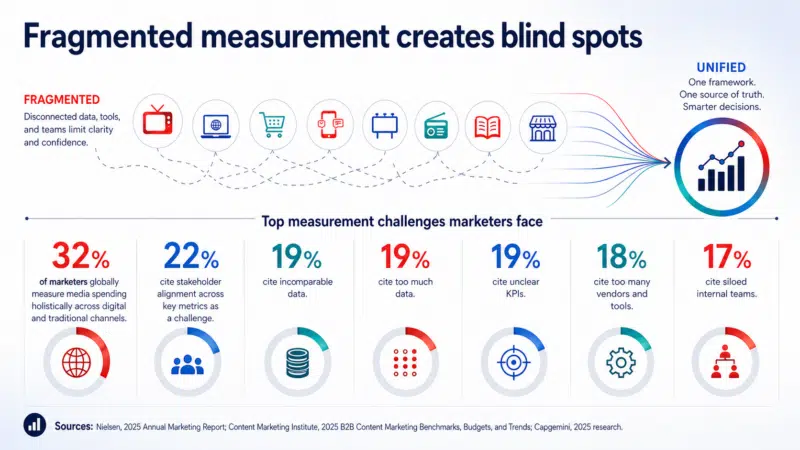
The introduction of UMM comes at a critical inflection point for the industry. Modern media planning has become increasingly complex, with spend fragmented across retail media networks, connected TV (CTV), packaging, influencer partnerships, and traditional broadcast channels.

The Data Gap
The necessity for such a tool is underscored by alarming industry statistics. According to Nielsen’s 2025 Annual Marketing Report, a mere 32% of marketers globally possess the capability to measure media spending holistically across both digital and traditional channels. This lack of visibility is not merely a technical nuisance; it is a strategic liability. Nielsen identifies several primary culprits behind the ROI measurement gap:
- Incompatible Data: Different platforms provide data in different formats, making aggregation a Herculean task.
- Stakeholder Alignment: Difficulty in agreeing on which metrics actually drive business outcomes.
- Siloed Internal Teams: Marketing departments often operate in bubbles, with digital teams rarely communicating with brand or trade marketing teams.
- Tool Fatigue: The proliferation of disparate vendors and measurement platforms has created a landscape where marketers have "too much data" but "too little insight."
The problem extends into the B2B sector as well. Research from the Content Marketing Institute’s 2025 B2B Content Marketing Benchmarks, Budgets, and Trends report indicates that 56% of B2B marketers struggle to attribute ROI to their content efforts. In manufacturing sectors, this figure spikes to 64%, suggesting that complex sales cycles exacerbate the difficulty of tracking the customer journey.
The "Meaningless Metric" Trap
Perhaps most damning is the research from Capgemini, which reveals that 39% of the metrics currently utilized by marketers are deemed "less meaningful." These metrics are frequently tied to vanity indicators—such as reach, impressions, or likes—which often bear little correlation to long-term business outcomes. Only 42% of marketing leaders report that they have the appropriate metrics in place to measure long-term brand value, leaving the majority of the industry operating on short-term data that may be misleading.

Official Stance and Adoption Models
Despite the buzz surrounding the UMM framework, significant questions remain regarding its commercial viability and accessibility. The official UMM website describes the tool as a shared framework, yet it remains conspicuously silent on the business model. It is currently unclear whether UMM is intended to be:
- An Open-Source Standard: A public framework for the industry to adopt for free.
- A Licensed Software Product: A proprietary tool that other brands would need to pay to access.
- A Consultative Service: An extension of the partnership between Coca-Cola, Kantar, and Top Line Marketing.
Requests for clarification on the rollout strategy and adoption model have, to date, gone unanswered. This ambiguity leaves many in the industry wondering if UMM is a genuine attempt to set an industry standard or a bespoke solution designed for Coca-Cola’s unique internal requirements.
Public-facing materials suggest that UMM is not intended to act as a "rip-and-replace" solution. Rather, it is designed to act as an "overlay" or a connective tissue that sits atop existing infrastructure. This is a pragmatic approach; few global enterprises would be willing to scrap their existing marketing tech stacks for a new, unproven platform. By positioning itself as a layer of intelligence rather than a replacement for execution tools, UMM minimizes the friction of adoption.

Implications for the Future of Marketing
The success of UMM will likely be determined by its adoption among other industry heavyweights. If other major advertisers join the initiative, it could trigger a fundamental shift toward cross-channel measurement systems that unify planning, reporting, and budget allocation under a single, consistent standard.
However, there is a distinct risk that UMM remains a "walled garden" model—a high-level, sophisticated framework that is widely admired but ultimately impractical for organizations with less resource depth than Coca-Cola. Should the project fail to gain traction outside of its current circle, it will likely be relegated to a "white paper" success story: a fascinating look at how one of the world’s most sophisticated marketers handles data, but ultimately not a scalable solution for the broader market.
The Road Ahead
For CMOs, the message is clear: the current state of fragmented, siloed measurement is unsustainable. Whether or not UMM becomes the industry-wide solution, the demand for a common language is undeniable. As brands continue to face pressure to prove ROI in an uncertain economic climate, the push for transparency and comparability will only intensify.

If UMM succeeds, it will represent the most significant step toward "scientific marketing" in a decade. If it fails, it will serve as a poignant reminder that in a global market of thousands of vendors and trillions of dollars in spend, achieving a universal consensus is perhaps the hardest marketing challenge of all.
As we look toward the remainder of 2026, the industry will be watching to see if Coca-Cola opens the doors to this framework, or if it remains a competitive advantage kept behind closed doors. Until then, the search for a truly unified metric continues to be the industry’s greatest work in progress.


 Nana
Nana
 Dwi Wanna
 Nila Kartika Wati
 Jia Lissa
 Basiran


 Lina Hope