
 Ammar Sabilarrohman
For many engineering organizations, the allure of building an internal AI knowledge system is irresistible. The architecture seems deceptively straightforward: spin up a vector database, write a few API connectors to ingest company documentation, and point a Retrieval-Augmented Generation (RAG) pipeline at the resulting index. On a whiteboard, it is a weekend project. In a production environment, it is often a six-month trap that eventually demands a full-time platform team to maintain.
The disconnect arises from a fundamental misunderstanding of the problem space. Engineering teams often conflate a "vector database" with a "governed knowledge pipeline." While the former is a storage solution, the latter is a complex, living ecosystem that must balance trust, regulatory compliance, and continuous maintenance. As your AI stack scales, these challenges do not merely persist—they compound.
The Five Pillars of a Production-Grade Pipeline
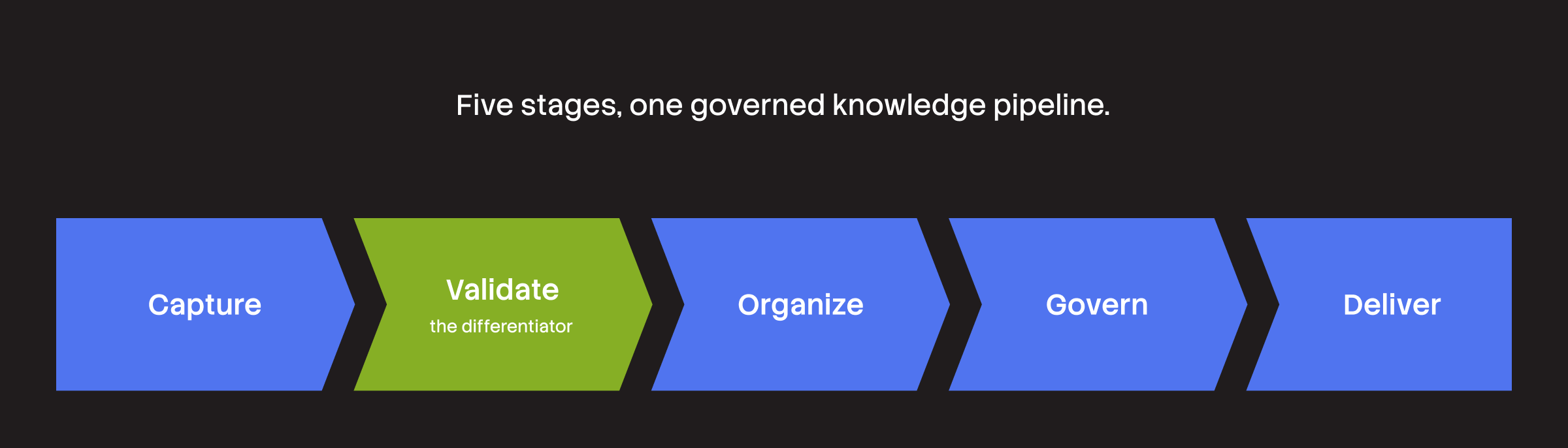
To successfully integrate AI into the corporate nervous system, engineering teams must move beyond simple ingestion. A robust knowledge pipeline is defined by five distinct, non-negotiable stages: Capture, Validate, Organize, Govern, and Deliver.
Each stage appears manageable in isolation, but the operational burden of keeping these stages synchronized is where most internal projects fail. The reality of maintaining these systems is starkly different from the initial "easy" implementation.
The Lifecycle of Knowledge Maintenance
| Stage | The Initial Assumption | The Production Reality |
|---|---|---|
| Capture | Connect to tools, pull data. | Constant API maintenance as vendor tools update; handling duplicate/conflicting records. |
| Deliver | Hook AI to the database. | Ensuring every agent provides a consistent, trustworthy answer across the enterprise. |
| Govern | Enable basic access controls. | Implementing audit trails, approval workflows, and compliance-grade security. |
| Organize | Sort content by team. | Building automated logic that promotes knowledge from "personal notes" to "source of truth." |
| Validate | Use simple upvote/flagging. | Establishing an automated trust system that loops in experts only when necessary. |
The Fallacy of the "Raw Ingestion" Approach
A common pitfall is the belief that connecting to a tool—like Slack or Jira—is sufficient. In practice, a connector is not a static bridge; it is a maintenance liability. As vendor APIs evolve, internal connectors break. Furthermore, simply copying raw data is insufficient for AI agents. When an agent skims a raw Slack thread, it often retrieves the correct document but fails to extract the relevant section or context, leading to "hallucinations" that are rooted in factual, albeit poorly parsed, data.
The solution is to move toward knowledge nodes. Instead of simple document storage, a node is a durable, living record. It tracks the substance of the information, its provenance, the designated owner, and a confidence metric. If the source tool is decommissioned, the knowledge node persists, ensuring that institutional memory remains intact regardless of the underlying software stack.
Establishing Trust: The Core Differentiator
Treating all captured content as equally trustworthy is perhaps the most significant error in enterprise AI. Within a company, some knowledge is authoritative (e.g., a finalized HR policy), while other data is exploratory or outdated (e.g., a discarded Slack discussion about a failed project). If an AI agent surfaces both with equal confidence, the system loses its utility and credibility.
The Architecture of a Trust Score
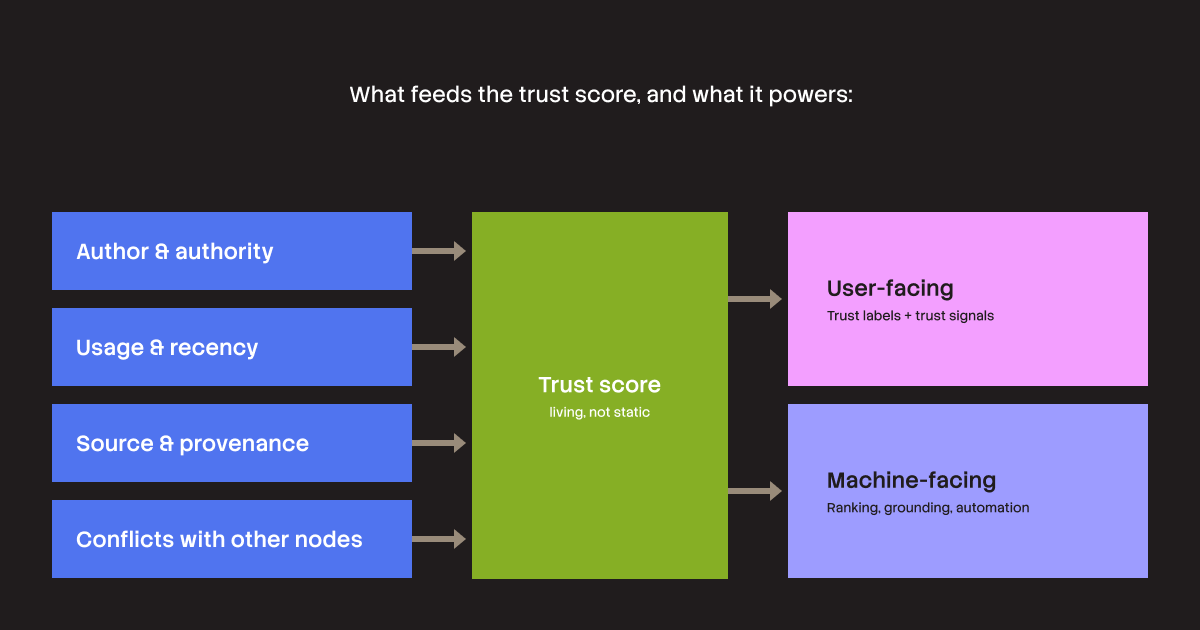
Validation must operate in two modes: Implicit Trust and Explicit Trust.
- Implicit Trust: The system automatically assigns a trust score based on signals such as authorship, usage patterns, recency, and cross-referencing against other authoritative sources. For instance, a merged pull request from a principal engineer inherently carries more weight than a casual comment in a team channel.
- Explicit Trust: This acts as a human-in-the-loop fallback. When the stakes are high—such as answering security compliance queries or sensitive product decisions—the system prompts a designated expert for verification.
The key performance indicator for this stage is the "human interruption rate." If a system is performing well, the frequency of manual interventions should trend toward zero. Every time an expert is pulled in to correct the AI, it is a signal that the automated trust layer needs further tuning.
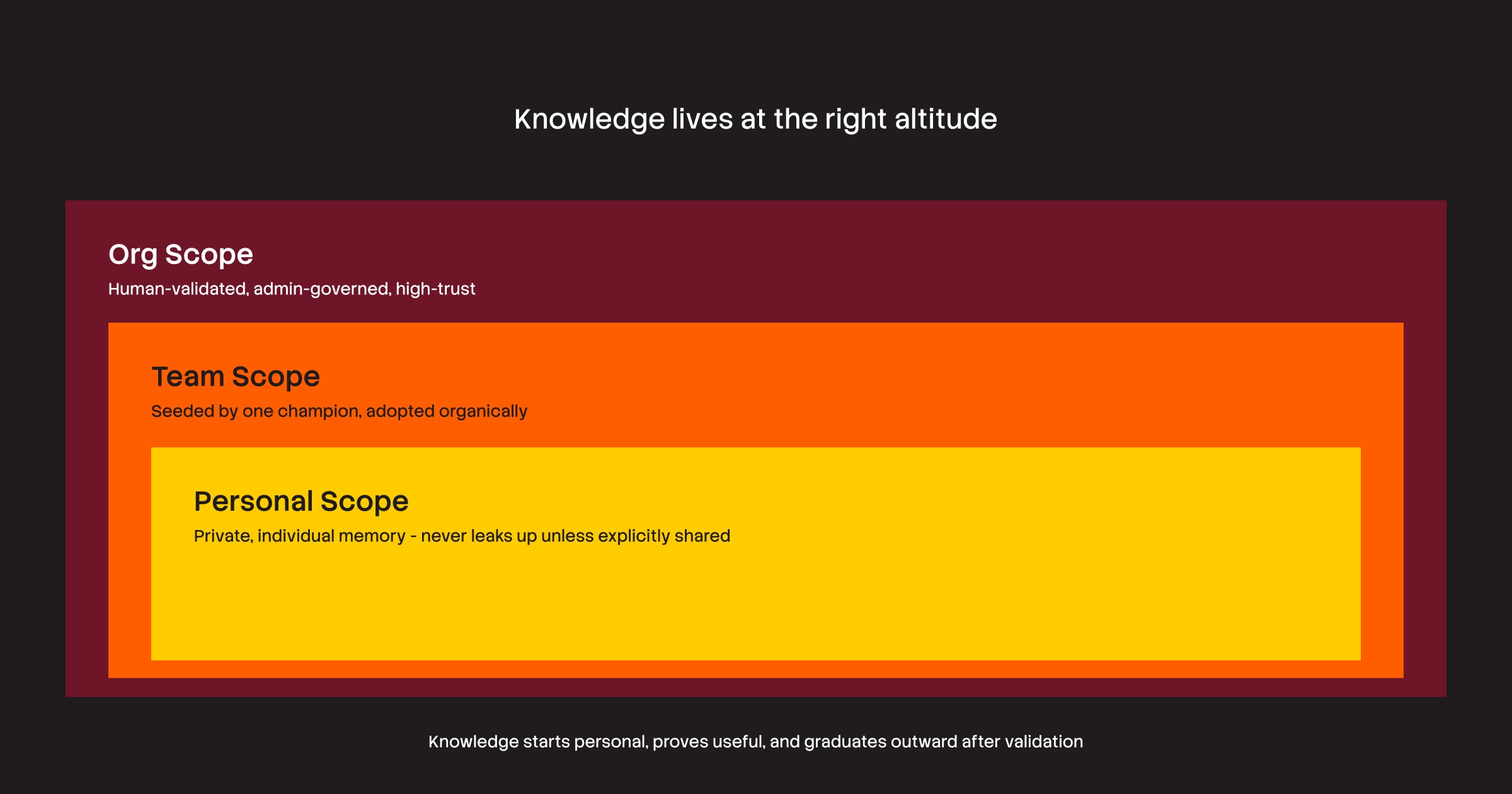
Organizing for Context: The "Altitude" Problem
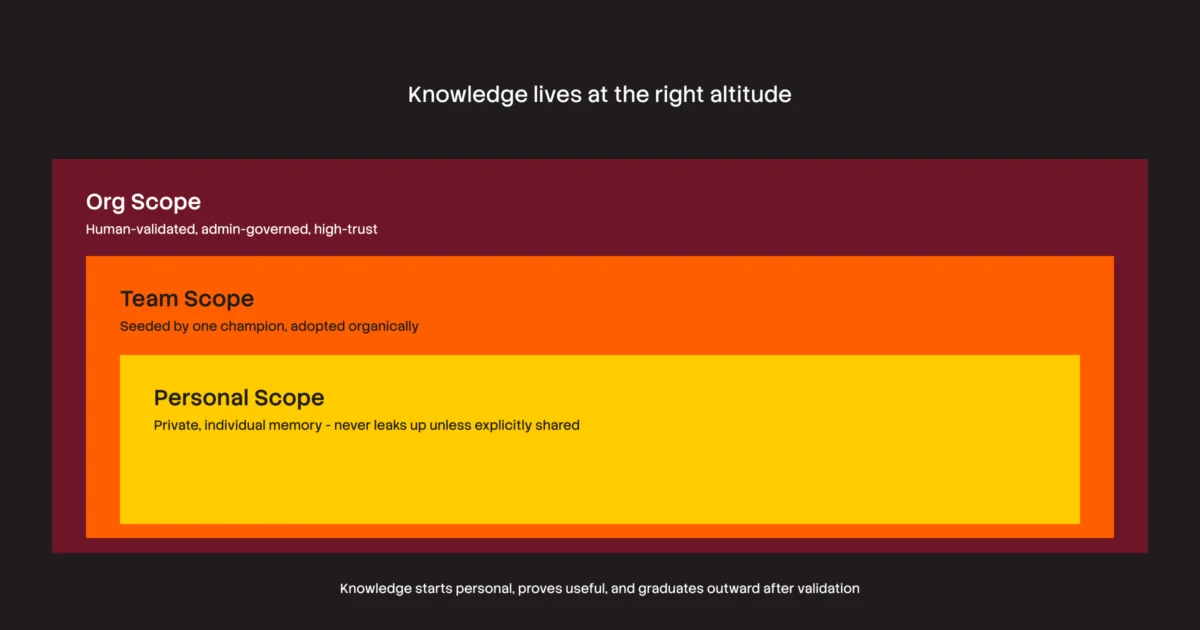
Information overload is the enemy of efficiency. A decision made by a single developer regarding a local service should not be surfaced to the entire organization as a company-wide architectural mandate.
By implementing scopes, organizations can define the context of knowledge. Knowledge should start in a personal or team-level scope and only graduate to the organizational level through validation. This ensures that agents respect permission boundaries automatically. When an agent queries the system, it inherits the context of the user; if a developer is working on a specific project, they receive project-specific knowledge without the risk of "leaking" information from disconnected departments.
Governance and the Audit Trail
For enterprises, AI governance is not merely about access control—it is about accountability. Security teams require proof of who accessed what data and why. As agents take on more significant roles, such as informing product strategy or providing technical support, the ability to trace an AI-generated output back to a specific piece of validated content becomes a regulatory requirement.
Governance must be integrated into the tools already used by IT and security teams. This means bulk provisioning, automated audit logs, and clear visibility into "knowledge health." When an auditor asks how an AI arrived at a specific recommendation, the system must be able to provide the provenance trail—a named reviewer, a date of validation, and the source of truth.
Delivering Value: The Model Context Protocol (MCP)
Knowledge that is locked away is useless. Delivery must be both explicit (answering user queries with provenance) and proactive (surfacing relevant documentation before a user even realizes they need it).
The adoption of the Model Context Protocol (MCP) is critical here. Rather than building bespoke retrieval integrations for every new agent, organizations should use a standardized interface. This allows the agent to query the current, validated state of the knowledge graph, ensuring that the AI is always operating on the most up-to-date data rather than a stale snapshot.
The Strategic "Build vs. Buy" Decision
The ultimate question for engineering leadership is one of focus: What is your organization actually for?
If building proprietary knowledge infrastructure is a core competitive advantage—if you are a company whose primary product is, in fact, an AI knowledge engine—then owning the entire pipeline is a legitimate strategic play. However, for the vast majority of product companies and developer platforms, the knowledge pipeline is infrastructure, not the product itself.
The costs of building this internally are rarely one-time expenditures. They compound as the AI stack matures. You are not just building a database; you are hiring for and managing:
- Maintenance teams to manage evolving vendor APIs.
- Data scientists to tune trust models and confidence thresholds.
- Compliance officers to audit the AI’s decision-making process.
- Infrastructure engineers to scale the delivery of context across the enterprise.
For most firms, these cycles are better spent on features that customers pay for. Platforms like Stack Internal are designed specifically to absorb these costs, providing a pre-built pipeline that handles capture, validation, organization, governance, and delivery natively. By offloading the "plumbing" of the knowledge layer, engineering teams can refocus their efforts on high-leverage work, confident that their AI agents are powered by trusted, governed, and highly relevant data.
In the race to integrate AI, the winners will not necessarily be the teams that built the most complex infrastructure from scratch. The winners will be the teams that successfully operationalized knowledge in a way that is secure, scalable, and—most importantly—trusted.

 Lina Hope

 Muslim

 Evan Lee Salim

 Basiran

 Reynand Wu

 Layla Zulfa

 Nana
