
 Lina Hope
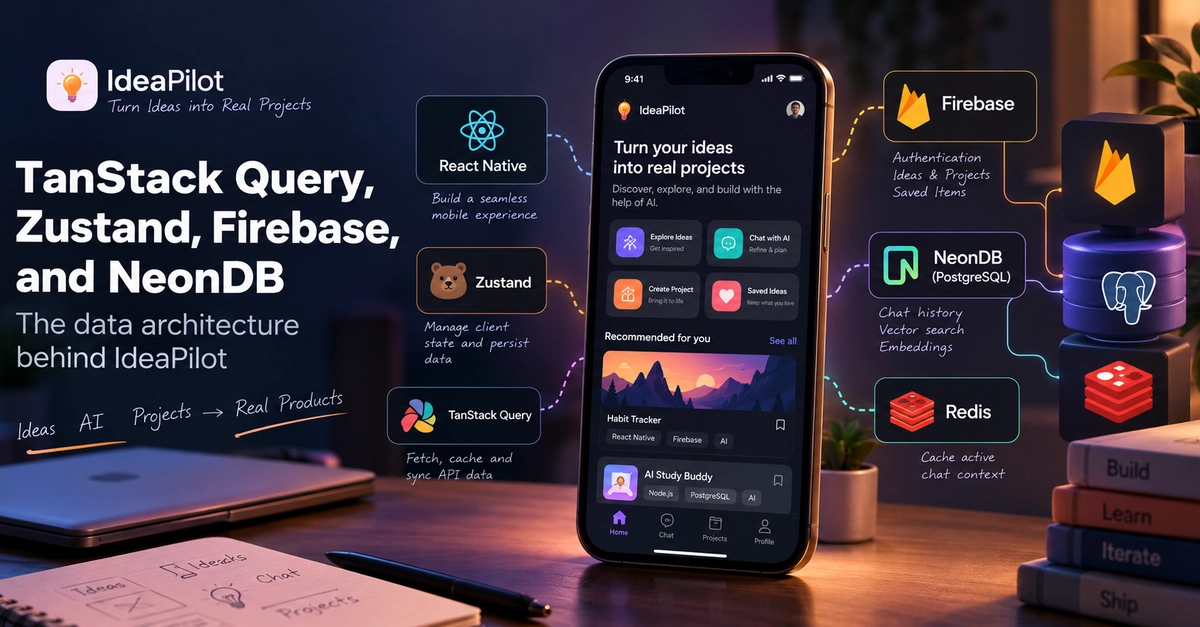
In the rapidly evolving landscape of AI-integrated mobile development, the challenge for engineers is no longer just "getting it to work"—it is defining the lifecycle of data in a system where artificial intelligence meets human interaction. IdeaPilot, a sophisticated React Native application designed for project discovery and AI-assisted creation, serves as a masterclass in modern full-stack architecture. By decomposing the application into distinct layers of ownership and responsibility, its developers have moved beyond simple library selection to create a robust, scalable ecosystem.
Main Facts: A Multi-Layered Tech Stack
At its core, IdeaPilot is a testament to the "right tool for the right job" philosophy. Rather than forcing a single database or state management solution to handle every interaction, the architecture treats data based on its volatility and purpose.
The application’s backbone consists of:
- Client-side: React Native and Expo, augmented by TanStack Query for remote API management and Zustand for localized client state.
- Identity: Firebase Authentication.
- Document Storage: Cloud Firestore for user-scoped, unstructured project data.
- Relational and Vector Storage: NeonDB (PostgreSQL) integrated with
pgvectorfor semantic conversational history. - Performance: Redis for caching active chat context.
The central thesis of IdeaPilot’s design is that data ownership must be explicit. When a developer understands whether data is "owned" by the server, the client, or a cache, they can effectively resolve the inevitable synchronization conflicts that arise in complex, real-time applications.
Chronology of Architecture Development
The evolution of IdeaPilot’s stack followed a logical progression, starting from basic connectivity and moving toward advanced AI-driven retrieval.
Phase 1: The Foundation of Identity and Remote State
The development began with the integration of Firebase. By using Firebase as the gatekeeper for user identity, the team established a secure handshake for all subsequent backend calls. Every request to the Express API is intercepted, with the client attaching a Firebase ID token. This immediately offloaded the burden of identity verification from the application’s business logic.
Phase 2: Defining the Remote Data Lifecycle
With a secure connection established, the team addressed the "loading state" problem. By deploying TanStack Query, they gained granular control over API interactions. Developers implemented stale-time and garbage-collection settings that ensured the UI remained responsive. As the application grew, the need to handle pagination became critical, leading to the use of useInfiniteQuery to manage chat threads without overwhelming the client memory.
Phase 3: The Introduction of Semantic Search
As the AI features matured, standard relational storage proved insufficient for "conversational memory." The transition to NeonDB with pgvector marked a turning point. By generating embeddings for chat messages, the developers allowed the application to perform semantic similarity searches. This moved the AI’s memory from simple "last message" tracking to "contextually relevant" retrieval.
Phase 4: Optimization and Caching
In the final phase, the introduction of Redis served to decouple the database from high-frequency read requests. By caching active conversational context, the system ensured that the most relevant data remained at the fingertips of the AI agent, minimizing latency in the response generation loop.
Supporting Data and Technical Implementation
The strength of IdeaPilot lies in its specific implementation of these technologies. Below is an overview of how these layers function in tandem.
TanStack Query: Handling the "Optimistic" UI
The application achieves a high-performance feel through optimistic updates. When a user deletes or renames a chat, the UI updates instantly via onMutate. If the server request fails, the application rolls back to the previous state. This ensures the user perceives zero latency while maintaining the server as the ultimate source of truth.
Zustand: Beyond Simple State
While TanStack Query manages data from the server, Zustand is the engine for the "client-owned" experience. Projects in progress, form drafts, and tab selections are managed through a centralized store. The use of persist middleware with AsyncStorage allows these drafts to survive application restarts, ensuring that a user’s creative flow is never interrupted by a system close.
NeonDB and Vector Search
The integration of pgvector is perhaps the most advanced component. By using an HNSW (Hierarchical Navigable Small World) index, the database can perform approximate nearest-neighbor searches in milliseconds. The backend generates a dual-context window for every user prompt:
- Semantic Context: The three most relevant historical messages based on vector distance.
- Temporal Context: The four most recent messages to maintain conversational flow.
This hybrid approach allows the AI to feel "smarter" and more aware of the project’s history than a standard LLM implementation.
Official Architectural Principles
The developers of IdeaPilot have codified their design philosophy into a set of core principles that guide every new feature implementation:
- Responsibility-Based Ownership: Data should be stored where it is most accessible to the service that needs it. Remote API data belongs in a cache (TanStack Query); local UI state belongs in a state store (Zustand).
- Explicit Synchronization: Never assume local state and server state are identical. Always provide a clear path for invalidation and reconciliation.
- Separation of Concerns: Keep identity, durable storage, and ephemeral cache as distinct, loosely coupled modules.
- Performance via Fallback: Use caching (Redis) for speed, but always design for the eventuality that the cache will miss, reverting to the primary database (NeonDB) as the source of truth.
Implications for the Industry
The success of the IdeaPilot architecture has significant implications for developers building AI-first applications. It demonstrates that the "monolithic database" approach is largely dead for modern, interactive apps.
The Rise of Hybrid Storage
Industry trends suggest that relational databases (like PostgreSQL) are evolving into the primary choice for AI applications, provided they support vector extensions. By using a single database for both structured relational data and unstructured vector data, companies can reduce the complexity of their data pipelines.
The Burden of Synchronization
The biggest risk in this multi-layered architecture is data drift—where the client, the cache, and the database hold conflicting versions of the truth. IdeaPilot’s approach suggests that developers must invest as much time in designing "invalidation strategies" (how to tell the UI that its data is old) as they do in the initial data fetch.
Scalability and Modularity
Because IdeaPilot separates its concerns so cleanly, the project is highly maintainable. If the team decides to replace their backend framework or move from Firestore to another document store, they only need to update the relevant "service" layer without rewriting the client-side state management or the core UI components.
Conclusion
IdeaPilot provides a clear roadmap for engineers tasked with building complex, AI-powered interfaces. By resisting the temptation to consolidate all data into a single bucket, the developers created a system that is performant, resilient, and, most importantly, understandable.
The overarching lesson for the software development community is that architectural excellence is found in the boundaries. When developers define exactly which layer owns a piece of data, they eliminate the "magic" that often causes bugs in complex applications. Whether it is using TanStack Query for the lifecycle of remote API calls or leveraging pgvector for semantic AI retrieval, the strategy remains the same: identify the requirement, choose the layer that best handles it, and maintain strict boundaries.
As we look toward the next generation of AI-integrated mobile tools, the IdeaPilot model—a blend of relational integrity, vector-based semantic search, and intelligent client-side caching—is likely to become the standard for high-performance applications. For those interested in exploring the practical implementation of these concepts, the project remains open-source, serving as a beacon for developers navigating the intersection of React Native and artificial intelligence.

 Ammar Sabilarrohman

 Muslim

 Evan Lee Salim

 Basiran

 Reynand Wu

 Layla Zulfa

 Nana
