
 Lina Hope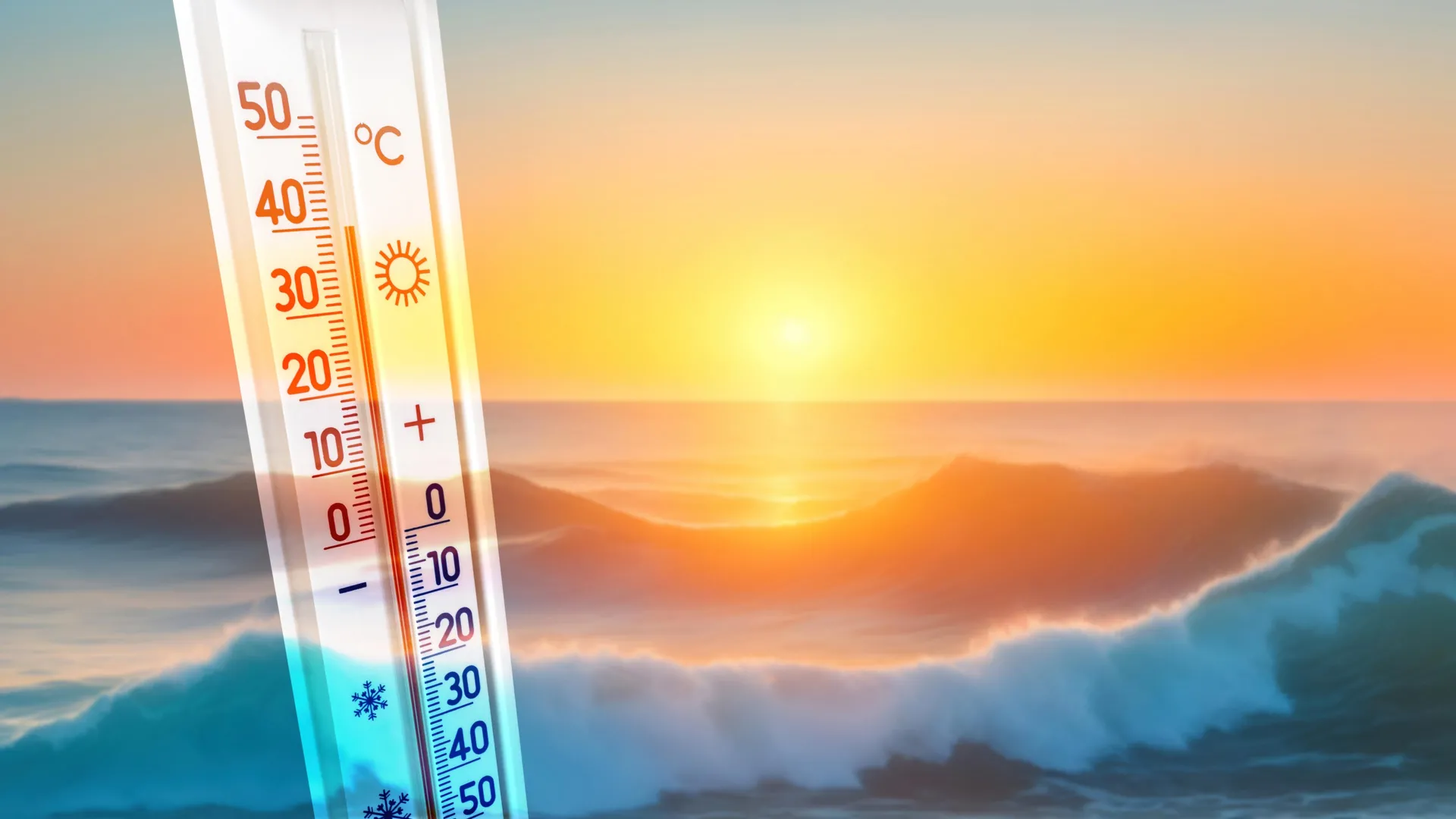
For decades, the scientific community has treated marine heatwaves (MHWs) like sudden, violent storms—events with a distinct beginning, a peak of intensity, and a definitive end. But much like a fever that lingers long after the initial crisis, the thermal stress experienced by our oceans is rarely so neatly contained.
A groundbreaking study led by researchers at William & Mary’s Virginia Institute of Marine Science (VIMS) and the Batten School of Coastal & Marine Sciences has fundamentally challenged this "isolated event" paradigm. By analyzing two decades of data from 20 U.S. estuaries, the team discovered that traditional methods of measuring marine heatwaves are missing a critical piece of the puzzle: the extended, smoldering periods of elevated water temperatures that precede and follow the heatwave itself. This oversight, the researchers argue, may be causing us to drastically underestimate the true toll of climate change on our coastal ecosystems.
The Cumulative Cost of Heat
The research, published in the journal Communications Earth & Environment, posits that marine heatwaves are not solitary anomalies, but rather the intense "peaks" embedded within much larger, more sustained warming episodes.
Lead author Ricardo Utzig Nardi, a research specialist at VIMS, draws a simple but powerful analogy to human biology: the sunburn. "Your risk of sunburn depends on both sunlight intensity and how long you’re exposed to it," Nardi explains. "A few minutes may cause little harm, but hours of exposure can take a toll. It’s similar for marine organisms. Their biological responses depend not only on how warm the water becomes, but on how long that warmth persists. If we only look at the ‘heatwave’ window, we ignore the cumulative fatigue that prolonged heat places on an ecosystem."
This framework of "cumulative exposure" changes everything. When scientists account for the weeks or months of warm water surrounding a recorded heatwave, the total thermal burden on a habitat is often significantly higher than previously assumed.
A Chronology of Thermal Stress
To understand the scope of the problem, the research team performed a comprehensive retrospective analysis of more than 2,580 marine heatwaves recorded across the United States over a 20-year period. By tracking the temperature anomalies leading up to and trailing off after each event, the researchers identified a consistent, previously ignored pattern.
The study categorized these warming events into two distinct groups, revealing the hidden complexity of ocean heating:
- Individual Events (Two-thirds of cases): These occur within a roughly 60-day window of elevated temperatures. While these are the "shorter" events, they still represent a significant departure from the baseline thermal profile of the estuary.
- Compound Events (One-third of cases): These are the most dangerous. Associated with longer periods of warming—often stretching to 90 days or more—these events generate more than three times the cumulative heat exposure of the heatwave peak itself.
The findings suggest that the warm-water anomalies surrounding these events are not just "noise" or secondary effects of the heatwave; they are often independent phenomena that exacerbate the overall stress on the marine environment.
Data-Driven Discrepancies
The statistical findings from the study are striking. By comparing their new "cumulative exposure" framework to the traditional "isolated event" methodology, the researchers found that conventional assessments underestimate total heat exposure by an average of more than 150%.
This is not merely a statistical discrepancy; it is a vital indicator of ecosystem health. The data suggests that many marine organisms are living through a state of "thermal exhaustion." By the time a "traditional" heatwave begins, an ecosystem may have already been stressed by weeks of elevated temperatures, leaving it with little resilience to survive the peak of the event.
Piero Mazzini, assistant professor at VIMS and the Batten School, emphasizes that this discovery has profound implications for how science is conducted. "Many laboratory experiments simulate marine heatwaves by cranking up the heat for a few days or weeks," Mazzini says. "While these experiments hold value, they often fail to capture the prolonged thermal exposure organisms actually experience in nature. Our research provides a new framework for designing experiments that reflect these reality-based, long-duration conditions."
Official Perspectives: Shifting the Paradigm
The implications of this research are being felt across the marine science community, as the findings force a re-evaluation of how environmental policy and conservation efforts are structured.
"We can no longer look at marine heatwaves in isolation," Mazzini states firmly. "We must acknowledge the larger framework in which they exist. This research provides a way to do just that."
The success of the study was largely attributed to the robust, long-term monitoring provided by NOAA’s National Estuarine Research Reserve System. "This study is an example of outstanding science born from a simple question about temperature’s relationship to water quality," Mazzini adds. "Comprehensive monitoring programs like these allow us to ask bigger questions and uncover patterns that would otherwise remain hidden."
For the researchers, this is part of a larger, ongoing mission to map the changing dynamics of the U.S. coast. Previous work by the team has successfully identified links between marine heatwaves and large-scale climate oscillations, such as El Niño and the Pacific Decadal Oscillation, as well as the phenomenon of "vertical marine heatwaves" that penetrate deep into the water column.
Implications for Ecosystem Management
The practical applications of this research are far-reaching, particularly for coastal communities and environmental resource managers tasked with protecting delicate habitats like seagrass beds and coral reefs.
1. Enhanced Vulnerability Assessments
Current models of how species respond to climate change may be overly optimistic because they do not account for the duration of heat stress. By incorporating pre- and post-heatwave data, managers can more accurately predict which regions are at the highest risk of "die-offs" or shifts in species composition.
2. Monitoring Environmental Synergies
Prolonged warming does not act in a vacuum. The study highlights that long periods of elevated water temperatures often exacerbate other environmental stressors, such as:
- Hypoxia: Warmer water holds less dissolved oxygen, creating "dead zones" that can persist for months.
- Harmful Algal Blooms: Extended warming cycles provide the perfect conditions for toxic blooms that can devastate local fisheries and tourism.
3. Conservation Strategy
If conservationists know that an ecosystem is entering a "compound event" cycle, they may be able to implement preemptive mitigation strategies—such as reducing nutrient runoff or protecting thermal refugia—long before the most intense part of the heatwave hits.
Conclusion: Looking Toward a Warmer Future
As global temperatures continue to rise, the frequency and intensity of marine heatwaves are expected to climb. The work led by Nardi and Mazzini serves as a wake-up call that our understanding of "heat" in the ocean has been dangerously narrow.
By widening the aperture to include the entire warming episode—rather than just the heatwave peak—scientists and policymakers can gain a clearer, more honest picture of the challenges facing our oceans. "I’m excited to discover what we may have missed before with this new perspective," says Nardi.
Ultimately, this shift in focus is about more than just better data; it is about better protection. As the climate continues to change, our ability to measure the full extent of the heat will be the first step in ensuring that the life within our estuaries and coastal waters has a fighting chance to adapt and survive. The "fever" of our oceans is not just the spike on the thermometer; it is the long, exhausting stretch of heat that we are only now beginning to fully understand.

 Laily UPN
 Layla Zulfa
 Iffa Jayyana
 Rifan Muazin
 Suro Senen
 Lina Irawan