
 Rifan Muazin
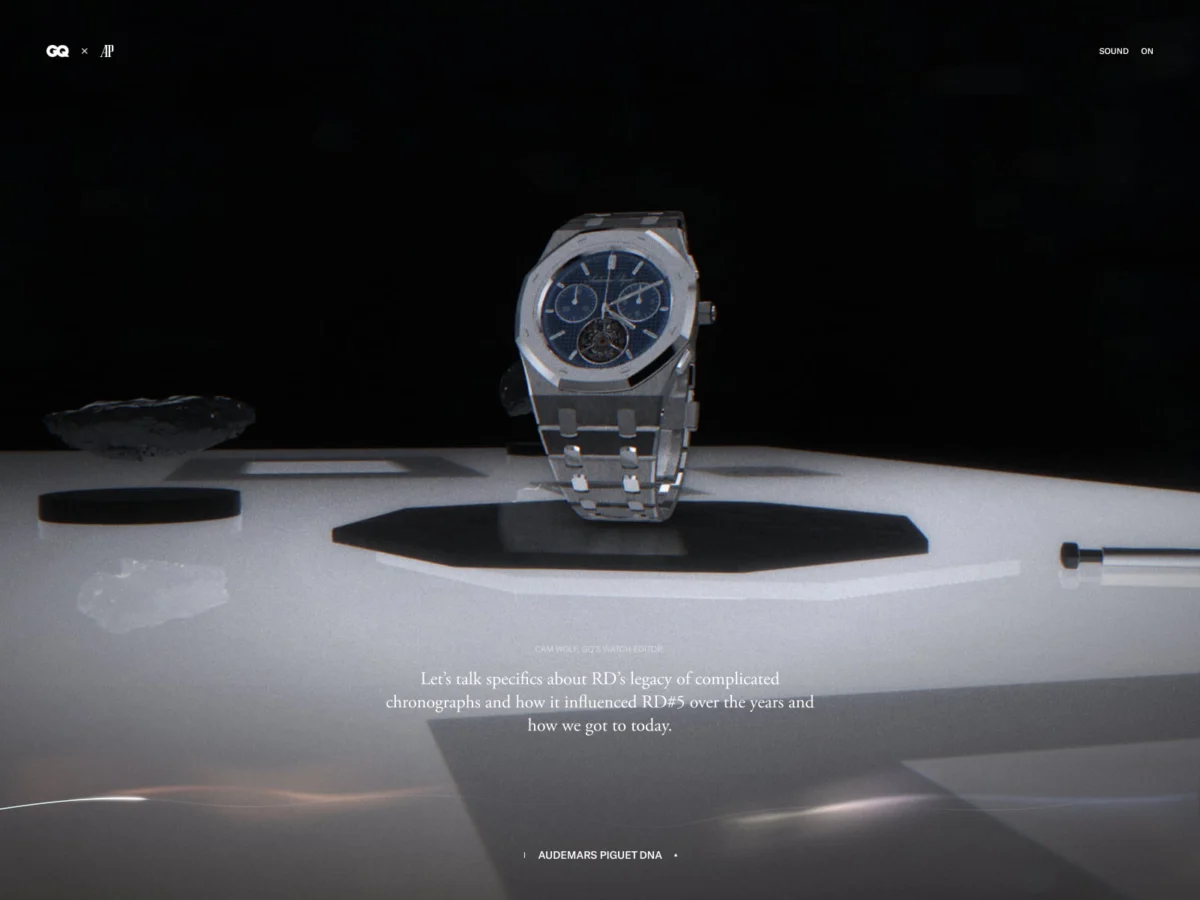
In the high-stakes world of luxury horology, the digital presentation of a timepiece is often as critical as the mechanical movement within its casing. When Audemars Piguet sought to unveil the RD#5, they did not look for a traditional website; they sought an immersive digital universe. The result, “The Extraordinary Lab,” developed in collaboration with Condé Nast for GQ, stands as a masterclass in WebGL development, cinematic storytelling, and real-time interaction. Designed by the acclaimed studio Immersive Garden, the project redefines the boundary between passive editorial content and interactive 3D environments.
The Genesis of an Immersive Mandate
The ambition behind The Extraordinary Lab was clear from its inception: to mirror the intense precision, craftsmanship, and technical mastery of Audemars Piguet’s watchmaking within a digital space. The project was never intended to be a simple product showcase. Instead, it was conceptualized as a living, breathing cinematic timeline.
For the creative team at Immersive Garden, the challenge was significant. Audemars Piguet maintains a brand identity defined by extreme polish, high-fidelity materials, and meticulous attention to lighting. Translating this physical luxury into a browser-based, real-time environment required a team of ten specialists—including technical directors, 3D artists, shader developers, and sound engineers—working in concert over a three-and-a-half-month development cycle.
A Chronology of Technical Evolution
The project’s development followed a rigorous, iterative path that favored continuous flow over segmented navigation.
Phase 1: Concept and Infrastructure
Early explorations toyed with the idea of a podcast-style interface, but the team quickly pivoted toward a continuous, scroll-based cinematic track. By treating the experience as a media player, users could navigate through the RD#5’s narrative, moving forward and backward with a fluidity that eliminated the "friction" typical of multi-page websites.
Phase 2: Orchestrating the Timeline with Theater.js
A cornerstone of the production was the integration of Theater.js. This tool allowed designers and developers to move away from rigid, hardcoded animations. By working within a shared, live environment, the team could adjust motion curves, camera transitions, and lighting compositions in real-time. This collaborative workflow meant that the "cinematic rhythm" of the experience could be fine-tuned to match the audio conversation between J Balvin and GQ Watch Editor Cam Wolf.
Phase 3: Real-Time Rendering and Optimization
The technical team faced the classic luxury paradox: the product had to be physically accurate and visually opulent, yet it had to render at a consistent 60 frames per second (FPS) across a spectrum of devices—including older mobile hardware. To achieve this, the team deployed a complex array of custom shaders, parallax mapping, and planar reflections. The goal was to ensure that the watch remained pristine in every lighting scenario, whether the user was viewing it on a high-end desktop monitor or an iPhone 12.
Supporting Data: The Anatomy of the Experience
The project’s success is built upon a foundation of "invisible engineering." While the user experiences a seamless, elegant flow, the browser is simultaneously managing several high-intensity tasks:
- Audio-Visual Synchronization: Unlike a video file where sound is locked to pixels, the audio in The Extraordinary Lab is a dynamic layer. The system manages fades, pauses, and playback continuity, ensuring that if a user scrubs through the timeline, the rhythm of the conversation and the animation remain perfectly aligned.
- Performance Metrics: To ensure accessibility across mobile devices, the developers utilized advanced optimization techniques, such as selective asset loading and GPU-accelerated rendering, which prevented the high-fidelity 3D assets from overwhelming browser memory.
- Generative Experimentation: The project served as a bridge between traditional production and AI-assisted workflows. The team utilized generative video tools to create abstract, projected silhouettes of the narrators, blending them into the 3D environments using alpha-mask workflows and sophisticated compositing.
Official Perspectives: The Philosophy of Immersive Garden
Immersive Garden’s approach is rooted in the belief that technology should be invisible. As the studio noted, the goal was not "3D for the sake of 3D," but rather the creation of a coherent emotional atmosphere.
"The ambition was to create an experience where technology disappears behind rhythm, atmosphere, interaction, storytelling, and emotion," the team stated. By prioritizing the user’s emotional journey, the studio transformed the digital product page into an extension of the brand’s physical heritage. The collaboration with Condé Nast and GQ was pivotal, ensuring that the editorial voice remained consistent with the visual extravagance of the 3D environment.
The Implications for Luxury Digital Marketing
The Extraordinary Lab serves as a blueprint for the future of digital luxury. It demonstrates that the consumer of today expects more than just static imagery; they expect an interactive, "living" narrative that rewards exploration.
1. The End of Static Campaigns
The success of this project indicates that static, scroll-through product pages are increasingly becoming obsolete for top-tier brands. Luxury buyers now look for environments that reflect the "electric, dark, and precise" identity of the products they purchase.
2. The Rise of Real-Time Interaction
By successfully delivering console-level visual fidelity directly within a web browser, Immersive Garden has set a new benchmark for web performance. This capability opens the door for brands to offer bespoke, interactive configurators and narratives that were previously restricted to native applications.
3. Collaboration as a Catalyst
The project underscores the necessity of interdisciplinary teams. The success of The Extraordinary Lab was not solely a feat of coding, but a feat of coordination. By breaking down the silos between the creative directors, the editorial staff at GQ, and the technical developers, the project achieved a level of cohesion rarely seen in digital marketing.
Conclusion: A New Standard of Craftsmanship
Winning "Site of the Month" on Awwwards was merely a reflection of the deep, invisible craftsmanship layered throughout the experience. The Extraordinary Lab is not a testament to the power of high-end hardware, but to the power of restraint and coherence.
In a digital landscape often cluttered with superficial bells and whistles, Audemars Piguet and Immersive Garden have proved that the most "extraordinary" experience is one that respects the user’s intelligence and the brand’s heritage. By blending the precision of a master watchmaker with the ingenuity of a software engineer, they have crafted a digital space that is as enduring as the RD#5 itself—a place where the boundaries of the physical and the digital blur into a single, seamless narrative.
Technical Specifications
- Front End Framework: HTML5, CSS3, ES6+ JavaScript.
- Core Rendering: WebGL powered by Three.js.
- Motion Architecture: Theater.js, GSAP.
- 3D Pipeline: Blender-based PBR (Physically Based Rendering) workflows with HDR environmental lighting.
- Advanced Rendering Techniques: Custom shaders, billboard reflection mapping, parallax mapping, and screen-space planar reflections.
- Audio Integration: Adaptive, behavior-responsive playback engine.
- AI Integration: Generative silhouette compositing and alpha-mask layering.

 Suro Senen
 Laily UPN
 Iffa Jayyana


 Pevita Pearce

 Basiran
 Azzam Bilal Chamdy
 Nila Kartika Wati
