
 Pevita Pearce
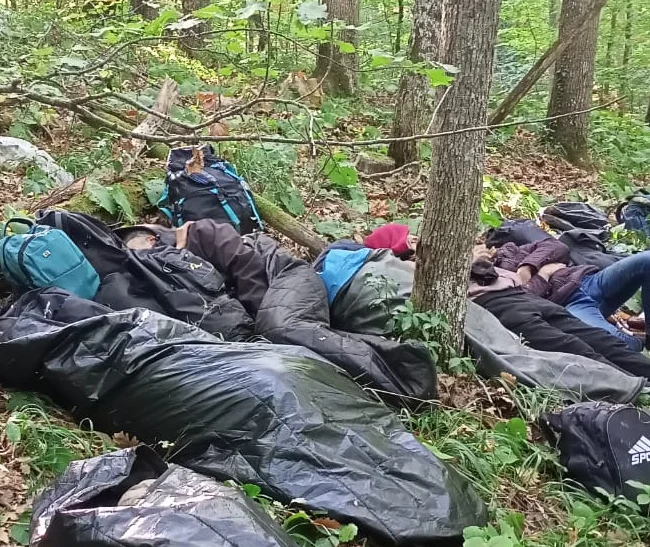
For Mohamed, the decision to risk his life was not a sudden impulse, but the final act of a long, exhausting negotiation with survival. Two months ago, he received a notification on his phone—a social media alert signaling that the border between Morocco and the Spanish enclave of Ceuta was, for a fleeting window of time, porous. With little more than 14 euros in his pocket and his smartphone, he drove four hours from his home in Tangier to the coastline. Under the cover of darkness, he waded into the cold Atlantic and began the harrowing swim around the breakwaters of Tarajel Beach.
He survived the crossing, but he did not find the sanctuary he sought. Today, Mohamed lives in a squalid shelter in Ceuta, one of thousands of migrants whose asylum claims have been systematically denied. "I’m so sad, I have no mood," he told me via WhatsApp. "All of our claims, they’re getting denied." His story is a singular thread in a much larger, increasingly volatile tapestry of human displacement, where the pressures of a warming planet and the hardening of global borders are creating a permanent state of crisis.
The Magnitude of the Crisis: A Border Under Siege
The events of last summer were unprecedented. In a 48-hour period, an estimated 80,000 people crossed from Morocco into Ceuta, marking the largest mass migration event ever recorded at a land border between Africa and the European Union. While previous incidents—such as the 8,000 who entered in May 2021 or the 2,000 who attempted to scale the fences of Melilla in June 2022—were considered significant, the July 2026 surge eclipsed them by an order of magnitude.
The human cost of this desperation was devastating. Humanitarian organizations, including No Name Kitchen, report that at least 141 people lost their lives during the attempt, either by drowning in the treacherous waters or being crushed in the frantic scramble to bypass the border infrastructure. While roughly 70,000 individuals eventually opted for voluntary return to Morocco, thousands remain trapped in a legal and physical limbo, languishing in overcrowded facilities with minimal resources. For those who remain, the daily reality is one of rejection and escalating uncertainty.
The "Mood Music" of Climate Change
While geopolitical tensions and economic instability are the most visible drivers of the Ceuta surge, there is a quieter, more pervasive force acting as a catalyst: the climate crisis. Experts are increasingly wary of drawing a direct line between a single heatwave and a mass border crossing, yet they emphasize that climate change is the "mood music" behind the migration.
Morocco, like much of the Middle East and North Africa, is warming faster than the global average. The country’s economy, deeply rooted in agriculture, is suffering from the combined effects of soil degradation, depleted groundwater, and a catastrophic seven-year drought that only recently saw a reprieve in the form of intense, destructive rainfall.

"Every story of human movement now is a climate story, whether we like it or not," explains Petra Molnar, a researcher and lawyer who specializes in the intersection of technology and border enforcement. She argues that what she calls "border necrotechnics"—the lethal combination of surveillance, law, and indifference—is failing to account for the environmental reality. Climate change puts a "proverbial thumb on the scales," amplifying existing economic stressors, such as youth unemployment and systemic inequality, to the point of collapse.
Chronology of Despair: From Rural Drought to Urban Migration
The path to the Ceuta breakwaters often begins years before a migrant reaches the sea. The typical trajectory of a climate-displaced person is a slow, agonizing process of internal displacement.
- The Rural Decline: Farmers and rural laborers, faced with failed crops and disappearing water sources, move from their ancestral villages to regional hubs.
- The Urban Bottleneck: As these cities become overwhelmed, the lack of infrastructure and job opportunities creates a secondary layer of misery. Mohamed, for instance, hails from Fez. Finding no future there, he moved to Tangier, only to encounter the same economic stagnation.
- The Final Leap: When the urban environment can no longer sustain them, the dream of Europe becomes the only viable path. As researcher Karolina Sobczak-Szelc notes, "The relationship between environmental change and aspirations to move is incredibly complex." By 2050, the World Bank estimates that 1.9 million people in Morocco will be forced to migrate internally due to climate impacts. When these individuals eventually reach the border, they aren’t just fleeing poverty—they are fleeing a landscape that no longer supports human life.
Official Responses: The Fortress Europe Strategy
As the scale of the migration became clear, the European political response was swift and focused almost exclusively on containment. Headlines from the period reflect a narrative of "invasion" rather than humanitarian catastrophe.
Italian Prime Minister Giorgia Meloni led the charge, calling for Spain’s temporary suspension from the Schengen Area, labeling the migration an "uncontrolled" threat to European security. This sentiment was echoed by officials in Finland, Sweden, and the Czech Republic. By late September, the European Commission had moved toward a militarized response, proposing that Frontex, the EU’s border agency, deploy rapid-response teams capable of activating within 24 hours. This "situational awareness" strategy involves the deployment of drones, satellites, and intensified patrols, further distancing Europe from the root causes of the migration.
Todd Miller, author of the Global Climate Wall report, points to a jarring discrepancy in funding: "Wealthy countries would rather spend 2.3 times more on arming their borders than on efforts to mitigate climate change." This approach, he argues, turns the border into a weapon rather than a point of entry, ensuring that the most vulnerable are met with violence rather than asylum.
Implications: The Ethics of the "Burning House"
The situation in Ceuta forces a difficult conversation about the limitations of international law. Currently, there is no legal category for a "climate refugee." Asylum status is predicated on political, religious, or ethnic persecution, leaving those fleeing environmental collapse in a legal blind spot.

Fatima Zahra Znioi, a researcher who emigrated from Morocco to Poland, offers a grim analogy for the current state of affairs: "There are two ways of dying—you can just burn to death, or jump out the window." The thousands who chose to jump into the sea at Ceuta were not making a political statement; they were acting out of a fundamental, biological instinct to survive a house that was no longer inhabitable.
The implications for the future are dire. As the planet continues to warm, the "push" factors in North Africa will only intensify. If the response from the global north remains restricted to fences, patrols, and asylum denials, the number of "climate-induced" crises will inevitably rise.
For Mohamed, the reality of the situation is stripped of academic analysis. After weeks of living in a forest on the edge of the city, dodging military patrols that he claims beat migrants and destroyed their phones, he is exhausted. He has been denied asylum, and he is preparing to return to the hopelessness of Tangier. Yet, when asked about his future, his answer is a testament to the sheer depth of his desperation.
"This isn’t the first time I’ve crossed into Ceuta," he says, his voice flat with resolve. "I’ll just try again."
In that sentence lies the ultimate failure of current border policies. When a person reaches a point where the risks of the sea and the violence of the border are preferable to remaining at home, the concept of "deterrence" loses all meaning. As long as the world ignores the climate factors fueling this movement, the cycle of despair will continue, one swim, one refusal, and one more desperate attempt at a time.


 Suro Senen

 Basiran

 Iffa Jayyana


 Azzam Bilal Chamdy

 Nila Kartika Wati
