
 Dwi Wanna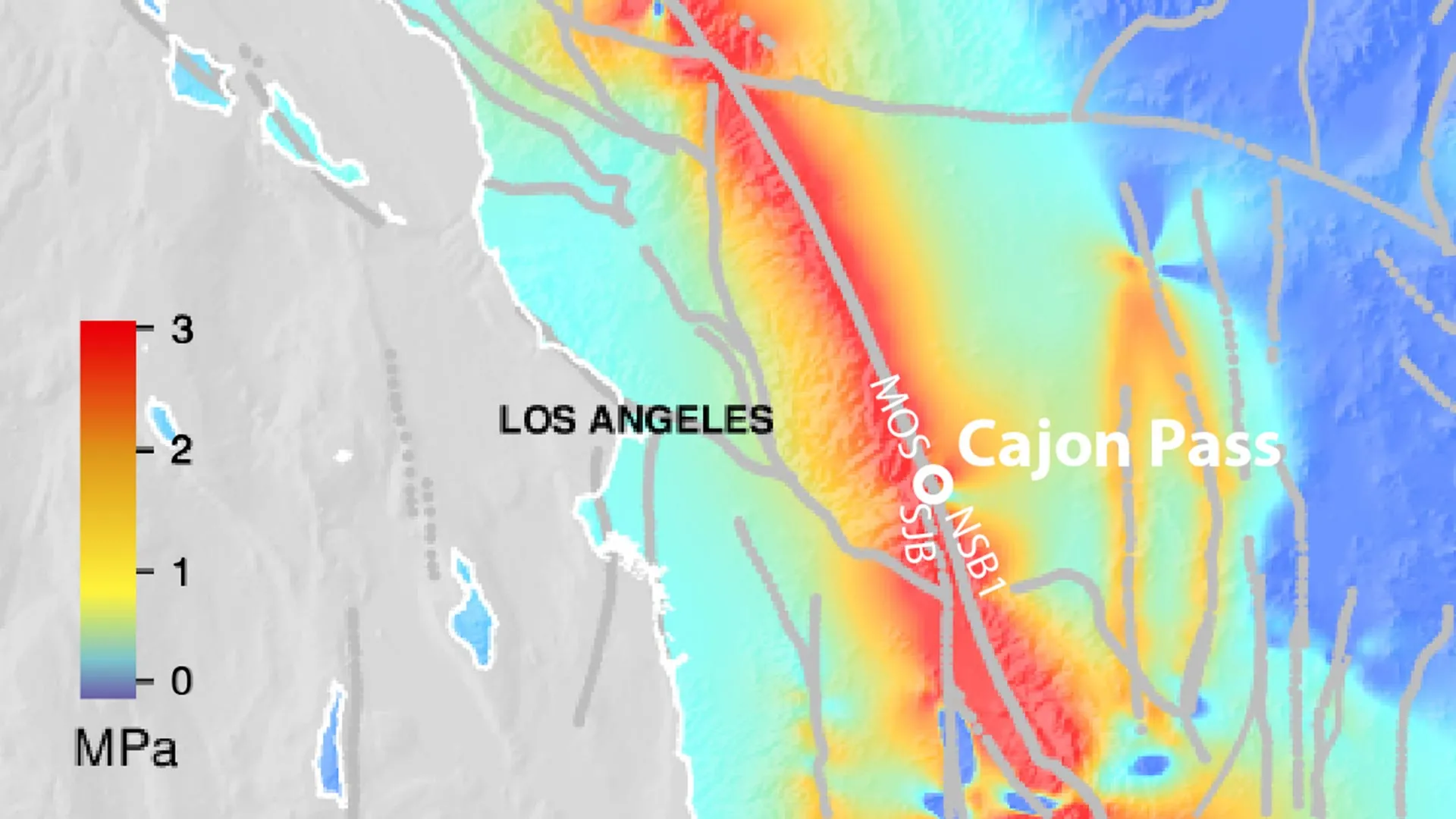
Southern California rests upon a volatile geological foundation, a complex web of tectonic fractures that have shaped the region’s topography for millions of years. At the heart of this activity lie the San Andreas and San Jacinto fault systems—two of the most significant and closely monitored tectonic boundaries in the United States. For decades, seismologists have grappled with a singular, pressing question: How do these colossal subterranean structures interact, and what happens when the stress they accumulate finally ruptures?
A groundbreaking study, recently published in the Journal of Geophysical Research: Solid Earth, offers a sobering answer. Led by Dr. Liliane Burkhard of the University of Bern’s Division of Space Research and Planetary Sciences, an international team of researchers has utilized a sophisticated four-dimensional model to reconstruct 1,000 years of seismic history. The findings suggest that the region is currently experiencing levels of tectonic stress that have not been seen in a millennium—and at the center of this geological pressure cooker is a site known as Cajon Pass.
The Mechanics of a Silent Threat: Main Facts
Earthquakes are the byproduct of planetary motion. As the Earth’s crustal plates grind against one another, friction prevents smooth movement, causing the edges of these faults to lock. Over years, decades, and centuries, elastic strain energy accumulates like a coiled spring. When that stored energy finally overcomes the frictional resistance, the crust snaps, releasing seismic waves that we experience as an earthquake.
In Southern California, the San Andreas and San Jacinto faults act as the primary conduits for this tectonic motion. Northeast of Los Angeles, these two systems converge at Cajon Pass, a geological junction that scientists now refer to as an "earthquake gate."
This "gate" is not merely a geographic point; it is a critical variable in seismic modeling. Depending on the stress distribution at the time of a rupture, Cajon Pass can either act as a barrier—halting a quake on one fault—or as a bridge, allowing a rupture to leap from one system to the other, potentially triggering a massive, multi-fault seismic event.
A Millennium in Review: The Chronology of Stress
To understand the current state of these faults, Dr. Burkhard’s team developed a physics-based, 4D earthquake cycle model. This model goes beyond simple spatial mapping; it incorporates the temporal dimension, tracking how the fault system evolves over centuries.
The research team, which included experts from the University of Hawai‘i at Mānoa, the U.S. Geological Survey (USGS) Earthquake Science Center, and the Scripps Institution of Oceanography, populated their model with a 1,000-year record of seismic activity. This data was harvested from a variety of proxies, including radiocarbon dating of sediment layers, the analysis of growth rings in ancient trees that were disturbed by past ground ruptures, and historical accounts of surface-breaking events.
Reconstructing the Past
The simulation tracks the life cycle of every major quake in the region’s history. It accounts for how a single earthquake redistributes stress onto neighboring segments, how that stress builds during "quiet" periods, and how the deeper, more ductile layers of the Earth’s crust slowly relax following a major event.
By running this millennium-long simulation, the team arrived at a startling conclusion: the tectonic stress currently concentrated around the Cajon Pass region has reached, and in some sectors exceeded, the highest values recorded in the entire 1,000-year history of the model.
Supporting Data: The Physics of the "Gate"
The significance of the Cajon Pass lies in its dual nature. It is neither a permanent stop sign nor a guaranteed highway for seismic energy. Its behavior is dictated by the specific "stress configuration" of the surrounding faults.
The 1812 and 1857 Comparison
The researchers point to historical evidence to demonstrate this variability. In 1857, the magnitude 7.9 Fort Tejon earthquake—one of the largest in California history—ripped through the San Andreas fault but stopped when it reached the Cajon Pass, sparing the San Jacinto fault from a direct continuation of the rupture.
Conversely, the 1812 Wrightwood earthquake tells a different story. In that event, the rupture successfully bypassed the junction, transferring energy from one fault to the other in a "through-going" event. The difference between these two outcomes, according to Dr. Burkhard, lies in the stress conditions present at the time.
Quantitative Indicators
The model provides concrete figures to illustrate this danger. The San Jacinto-Bernardino section is currently estimated to be under a stress load of 3.6 MPa (megapascals), while the Mojave South section of the San Andreas is at 2.8 MPa.
"Not only is it concerning that the stresses are reaching historic highs," Dr. Burkhard notes, "but also that the relative stress conditions between the two fault systems are approaching the range we associate with major ruptures crossing both faults simultaneously."
When both systems are highly stressed, the threshold for a "gate-opening" event—a rupture that propagates across both faults—drops significantly. This synchronized loading is what differentiates a standard large earthquake from a multi-fault "super-event" with potentially catastrophic consequences.
Implications for the Southern California Basin
The prospect of a joint rupture is the primary concern for emergency planners and seismologists alike. An earthquake that jumps the Cajon Pass would not be confined to a single fault line; it would release energy across a vastly larger geographic area.
Infrastructure and Population Vulnerability
The regions most at risk include the heavily populated corridors of greater Los Angeles, San Bernardino, Riverside, and the Coachella Valley. These areas are home to millions of people and house some of the most critical infrastructure in the United States.
Cajon Pass itself is a vital lifeline. It serves as a primary transit corridor for highways (such as the I-15), critical rail lines, and major energy infrastructure, including high-voltage power lines and petroleum pipelines. A rupture occurring at the junction would not only cause localized devastation but could also sever the logistical arteries that supply Southern California, hindering disaster relief and long-term economic recovery.
The Need for Proactive Planning
The "earthquake gate" concept provides a new framework for hazard assessment. By understanding that these junctions are dynamic, planners can move away from simplistic "worst-case scenarios" and toward a more nuanced, physics-based approach to preparedness.
"Our results provide a clearer, physics-based picture of the current stress state of the fault system," Dr. Burkhard says. "The framework we developed is not just applicable to California, but also for other complex fault junctions worldwide where similar conditions might exist."
Official Responses and Scientific Caveats
While the findings of the study are dramatic, the scientific community—including the researchers themselves—is careful to temper the potential for public alarm. A fundamental limitation of seismic science remains: the inability to predict the time of an earthquake.
"Critically Stressed" vs. "Imminent"
Dr. Burkhard emphasizes that reaching historic stress levels does not mean a massive earthquake is imminent tomorrow, next week, or even next year. The Earth’s crust is incredibly complex, and there are many variables that govern the precise timing of a fracture.
"The study is not a prediction of when an earthquake will occur," she clarifies. "What we can say is that the system is critically stressed and that physics-based models like ours give a clearer picture of the range of scenarios we should be prepared for."
The study is intended to be used as a tool for hazard assessment and infrastructure planning rather than a crystal ball. By identifying the physically plausible scenarios, scientists and policymakers can better allocate resources for retrofitting buildings, strengthening power grids, and developing robust early-warning systems.
A Call for Continued Vigilance
The U.S. Geological Survey continues to advocate for the "ShakeOut" mindset: that residents in high-risk zones should always be prepared, regardless of whether a study indicates high stress or a quiet period. The Southern California fault network is in a state of constant, slow-motion evolution, and the "earthquake gate" at Cajon Pass is a constant reminder that the ground beneath our feet is never truly at rest.
As we look to the future, the integration of 4D modeling into seismic policy represents a significant leap forward. By moving beyond the static views of the past and embracing the complex, time-dependent nature of fault mechanics, scientists are providing a clearer map of the risks. While the "Big One" remains an elusive and unpredictable threat, the work of Dr. Burkhard and her team brings us one step closer to understanding the mechanisms of the planet—and, ultimately, to surviving them.


 Laily UPN
 Lina Hope
 Iffa Jayyana
 Rifan Muazin
 Suro Senen
 Lina Irawan