
 Lina Hope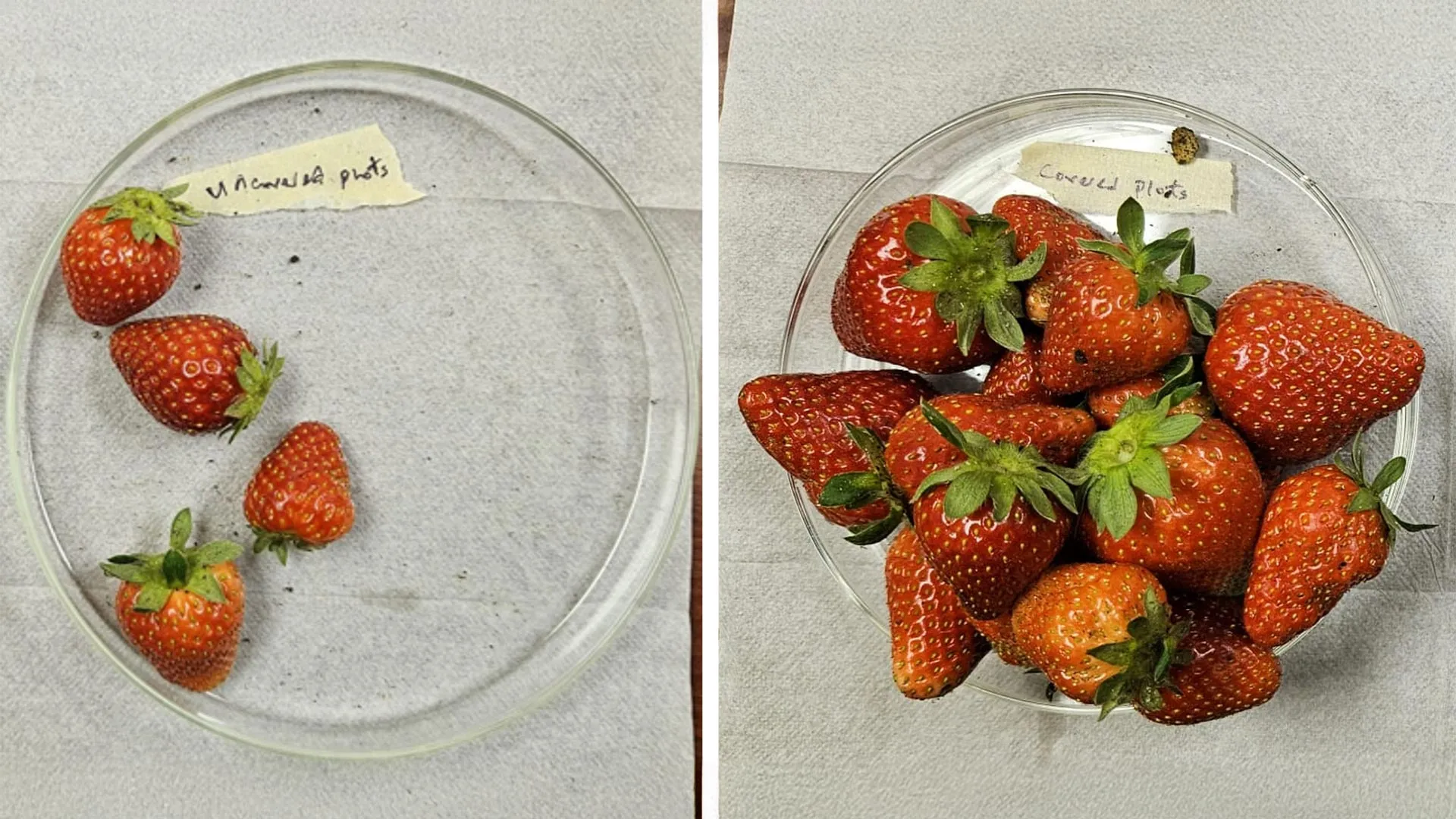
In a breakthrough that bridges the gap between military defense and agricultural productivity, researchers at North Carolina State University (NC State) have unveiled a revolutionary textile covering capable of more than tripling strawberry yields. The material, aptly named "Plant Armor," represents a paradigm shift in how we approach crop protection, offering a sustainable, non-chemical alternative to traditional pest management while simultaneously accelerating plant maturation.
Main Facts: The Triple-Yield Breakthrough
The core innovation of Plant Armor lies in its sophisticated, three-dimensional porous structure. Unlike traditional plastic row covers, which often create a "greenhouse effect" that can trap excessive heat or block vital sunlight, Plant Armor is engineered to function as a selective barrier. It allows the essential elements of plant life—sunlight, rain, and air—to permeate the fabric, while physically obstructing the path of insects that would otherwise feed on or damage the crop.
The results from tunnel field trials have been nothing short of transformative. Strawberries protected by the fabric produced yields as much as 3.56 times higher than their uncovered counterparts. Perhaps most significantly, these gains were achieved without sacrificing plant health. The fabric does not interfere with light availability or relative humidity, ensuring the strawberries grow under optimal, rather than artificial, conditions. By fostering a more stable microclimate, the material allows farmers to bypass the typical environmental stressors that often curtail production, resulting in a more robust and bountiful harvest.
Chronology: The Unlikely Evolution of an Agricultural Marvel
The journey of Plant Armor is a masterclass in the value of interdisciplinary scientific exploration. Its origins were not rooted in soil, but in the high-stakes environment of military logistics.
The Military Origins
The project began with a mandate to enhance the comfort and utility of military uniforms. Researchers were tasked with creating specialized textiles that could make body armor more tolerable for soldiers in extreme conditions while simultaneously providing protection against mosquito-borne pathogens. The goal was to engineer a fabric that could withstand the rigors of combat while maintaining breathability and comfort.
The Pivot to Agriculture
As researchers refined the material’s structural density and pore size, the potential applications began to expand beyond the military sector. Recognizing that the same properties required to deter mosquitoes from soldiers—breathability coupled with an impenetrable physical barrier—could be applied to crop protection, the team pivoted their focus.
Through a rigorous, multi-year process of trial and error, the team adapted the technology for agricultural use. They transitioned from laboratory-scale prototypes to real-world tunnel field testing across three distinct growing seasons. Each cycle allowed the researchers to refine the fabric’s density, ensuring that it could withstand agricultural environmental variables while maximizing the thermal benefits for the plants.
Supporting Data: Why It Works
The success of Plant Armor is grounded in two primary biological mechanisms: the optimization of "growing degree-days" and the mitigation of pest-related stress.
The Warming Effect and Phenology
Plants rely on cumulative thermal energy, known as "growing degree-days," to transition through their life cycles, from germination to flowering and fruiting. Gabriel Olawuyi, a graduate research assistant at NC State and lead author of the study, explains that the fabric creates a consistent, steady warming effect.
"The plants were in a condition whereby the warmth they need to go through each phenological stage to their production was given to them optimally," Olawuyi noted. By maintaining this steady state, the covered plants reached their fruiting stage significantly faster than those exposed to the fluctuating temperatures of the open field. This acceleration is crucial for farmers aiming to maximize harvest windows and improve market availability.
Defying the Shade-Avoidance Response
One of the researchers’ primary concerns was the "shade-avoidance response." Many plants, when deprived of optimal sunlight, will divert their energy away from fruit production and toward vegetative growth (stems and leaves) in a desperate attempt to reach higher light levels.
"We expected that Plant Armor’s seemingly opaque fabric would lead to an increase in vegetative biomass at the expense of fruiting," Olawuyi admitted. However, the data told a different story. The fabric’s 3D structure was engineered with such precision that it did not impede light penetration, effectively tricking the plant into feeling protected without triggering the negative physiological response associated with shading. The plants invested their energy into the fruit, leading to the unprecedented 3.5-fold increase in yield.
Official Responses and Collaborative Vision
The development of Plant Armor is a testament to the collaborative ecosystem at NC State, involving the College of Natural Resources, the Wilson College of Textiles, and the College of Agriculture and Life Sciences.
R. Michael Roe, a William Neal Reynolds Distinguished Professor at NC State and co-author of the study, views the project as a highlight of institutional cooperation. "The path to Plant Armor started with trying to make a cloth to go on a soldier’s chest to make body armor more comfortable," Roe said. "Then, through trial and error, we arrive at a product which could triple the output of strawberry farms here in North Carolina. We couldn’t have predicted that when we started. Without all these people here doing research and following the science, we wouldn’t have arrived at this product."
The researchers emphasize that this is not just a win for strawberry farmers, but a blueprint for how diverse scientific disciplines—textile engineering, entomology, and plant physiology—can solve complex global problems.
Implications: A Greener Future for Farming
The implications of the Plant Armor technology extend far beyond the immediate increase in crop yield. As the global population grows and the pressures of climate change threaten traditional agricultural practices, the need for sustainable, high-efficiency farming solutions has never been more urgent.
Reducing Pesticide Reliance
One of the most promising aspects of the technology is its potential to significantly reduce the use of chemical pesticides. Because the fabric acts as a physical barrier that prevents insects from reaching the plant, the need for prophylactic chemical spraying is greatly diminished. This not only lowers costs for farmers but also reduces the chemical runoff that can contaminate surrounding ecosystems and water tables.
Water Conservation and Sustainability
Beyond pest management, the microclimate created by the fabric has the potential to improve water use efficiency. By reducing the rate of soil moisture evaporation—due to the barrier’s effect on wind and ambient temperature—the fabric may allow for more precise irrigation, helping farmers conserve water in regions facing increasing drought conditions.
Commercial Viability
The technology has already been patented (US Patent No. 11,582,968 B2) and is currently being licensed for commercial development. The successful transition from a government-funded military research project to a commercially viable agricultural tool highlights the importance of sustained investment in research and development.
The paper, titled "Knitted 3-D, Porous Textile Cover to Enhance Strawberry Fruit Production and Prevent Insect Feeding," was published in the journal Agriculture. It represents the culmination of efforts by an extensive research team, including James Clothier, Matthew Bertone, Grayson Cave, Reuben Garshong, Andre West, Loganathan Ponnusamy, and Clyde Sorenson.
As the agricultural industry faces a future defined by volatile weather patterns and the need for more efficient food production, innovations like Plant Armor provide a glimpse into a more resilient future. By repurposing the tools of the past to protect the resources of the future, NC State researchers have provided a compelling case for the power of interdisciplinary innovation to reshape the global food landscape. Whether this technology can be adapted for other crops—such as blueberries, raspberries, or even leafy greens—remains the next frontier of this promising study. For now, the strawberry industry stands at the threshold of a new era of productivity.


 Dwi Wanna
 Iffa Jayyana
 Raul Delapena Setiawan
 Muslim
 Nana Wu

 Rifan Muazin