
 Nila Kartika Wati
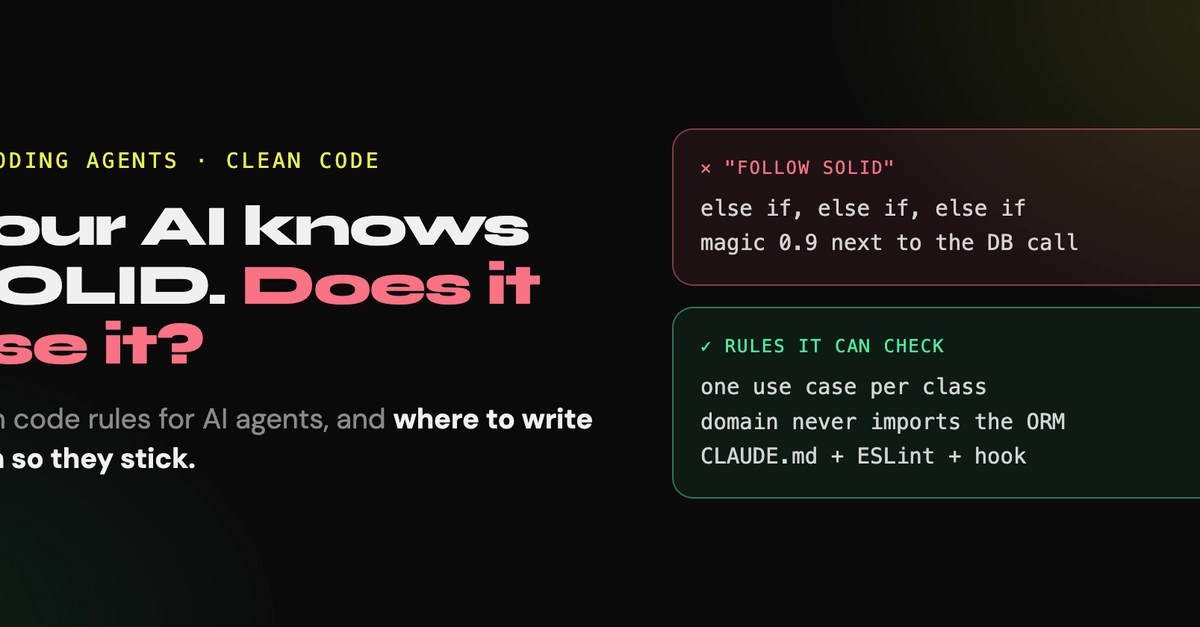
Ask any contemporary Large Language Model (LLM) to define the Strategy design pattern, and you will receive an impeccable response. It will provide the theoretical intent, a clean UML diagram, a robust TypeScript implementation, and a nuanced explanation of the trade-offs involved. However, if you pivot in the same session and ask that same model to implement a simple feature—such as adding a 10% discount for VIP customers at checkout—the result is often a stark departure from the principles it just articulated.
Instead of a clean, decoupled implementation, you are likely to receive a bloated function featuring hard-coded logic, magic numbers, and an escalating chain of if-else statements. This phenomenon is not the result of AI ignorance; rather, it highlights a fundamental disconnect between theoretical knowledge and automated application. As AI coding agents become staples in the software development lifecycle, bridging this "architecture gap" has become the primary challenge for engineering teams.
The Anatomy of the Failure
When an AI agent generates code, it is not merely retrieving stored patterns; it is performing a contextual prediction. The issue arises because the model is hyper-sensitive to the immediate signals in its environment.
In a typical scenario, the agent encounters:
- The Request: "Add a 10% discount." The agent interprets this as a mandate for the path of least resistance—the smallest possible change that satisfies the requirement.
- The Context: The existing codebase. If the agent sees a 300-line function, it will likely follow that established pattern of high-complexity code.
- The Validation: Passing tests. To an AI, "done" is defined by green checkmarks, not by long-term maintainability or architectural integrity.
When these signals are stronger than the latent knowledge of design patterns, the agent defaults to procedural, "spaghetti" code. Consequently, the very principles that the agent can explain—SOLID, DRY (Don’t Repeat Yourself), and Separation of Concerns—become optional.
Turning Principles into Verifiable Rules
The root cause of this failure is the reliance on vague instructions. Telling an agent to "follow SOLID principles" is effectively giving it a "vibe" rather than a directive. To achieve consistent, high-quality output, developers must translate abstract engineering philosophy into concrete, verifiable constraints.
Concrete Rules vs. Vague Intent
The shift from vague to concrete is essential for agent reliability. Consider the difference between the following instructions:
- Vague: "Write clean code."
- Concrete: "Functions must do one thing, accept a maximum of three parameters, and utilize named constants instead of magic numbers."
By defining rules that can be programmatically verified in a code review—or by the agent itself—you move from subjective quality to objective compliance. This methodology relies on "Object Calisthenics," a set of constraints that force cleaner design by limiting the scope of what a function or class is allowed to do.
The Hierarchy of Implementation
Effective control of an AI agent requires a multi-layered approach to documentation and enforcement. It is not enough to have a single "rules" file; you must organize them by scope to ensure they are applied appropriately.
1. Personal Global Standards
At the top level, developers should maintain a ~/.claude/CLAUDE.md or equivalent global file. This acts as the baseline for all projects, housing core engineering standards such as naming conventions, comment styles, and the preference for guard clauses over else blocks.
2. Project-Specific Conventions
Project-level files, such as AGENTS.md or CLAUDE.md in the root directory, define the architecture. This is where you specify the layering—Domain, Application, Infrastructure, and Presentation—ensuring that the agent understands where dependencies are allowed to flow.
3. Path-Scoped Rules
The most sophisticated implementations use path-specific rules (e.g., .claude/rules/*.md). For instance, you can mandate that the src/domain folder remains entirely free of framework code, ORM imports, or HTTP client logic. By scoping these rules, you prevent the agent from applying unnecessary ceremony to simple scripts while ensuring strict rigor in the core business logic.
The Role of Automated Enforcement
Instructions provide context, but linters provide law. An agent’s adherence to standards is always probabilistic; a long, complex task may cause it to "forget" a guideline. To solve this, automated tools must act as a hard barrier.
The Linter as a Gatekeeper
Tools like ESLint and dependency-cruiser should be configured to enforce the measurable symptoms of poor design. If a function exceeds a certain cyclomatic complexity or a specific line count, the build should fail. By integrating these tools into the agent’s workflow via hooks (e.g., PostToolUse), the agent receives immediate feedback on its edits. If the agent writes code that violates a linter rule, it is prompted to correct the error while the context is still fresh in its memory, rather than discovering the failure during a later CI run.
Case Study: The VIP Discount Refactor
When these rules are in place, the outcome of the requested VIP discount feature changes dramatically. Instead of burying logic inside a massive checkout function, the agent is compelled by the architecture rules to:
- Extract the logic: Create a pure, testable domain function.
- Use Value Objects: Use a
Percentageobject rather than a raw number. - Ensure Precedence: Implement the discount logic in a way that respects the original order of operations, using guard clauses to maintain clarity.
If the requirement eventually evolves to include multiple, complex discount campaigns, the agent is now positioned to suggest a "Strategy" pattern—not because it is a default, but because it is the logical, maintainable solution to a growing problem. The agent can then explicitly state its reasoning, providing a paper trail for the human reviewer.
Implications for the Future of Development
The transition toward AI-augmented development is not just about faster coding; it is about managing the quality of the output at scale.
- Maintainability for Agents: We must accept that modern code is often read by another agent. Code that is structured to be easily understood by a human is, by extension, easier for an AI to parse and refactor without introducing regressions.
- The End of "Vibe-Based" Coding: Developers who rely on verbal instructions to guide AI agents will find themselves bogged down in technical debt. Those who invest in explicit, scoped instruction files and automated CI enforcement will see a massive leap in developer velocity.
- The Human-in-the-Loop: Even with perfect rule sets, human judgment remains paramount. Rules can catch magic numbers and deep nesting, but they cannot judge the strategic necessity of a specific architecture. The developer’s role has shifted from "writer of code" to "architect of constraints."
Final Recommendations
To effectively manage AI coding agents, engineering teams should:
- Standardize Early: Consolidate your standards into a
CLAUDE.mdorAGENTS.mdfile immediately. - Automate Everything: Use linters as the primary enforcement mechanism for your rules. If it can be measured, it should be enforced by the build pipeline.
- Review the Diff, Not the Idea: Train your agents to provide a self-review of their diff against the project’s standards before marking a task as complete.
- Embrace Pragmatism: Ensure your instructions contain an "escape hatch." Rules that are too rigid will inevitably lead to over-engineering. Always prioritize clarity over theoretical purity.
Ultimately, the goal of these systems is to foster a symbiotic relationship where the AI handles the heavy lifting of implementation while the developer defines the boundaries of the system. By turning "Clean Code" from a vague concept into a set of machine-readable constraints, you stop fighting your tools and start leveraging them to build more resilient, maintainable software.


 Jia Lissa


 Basiran
 Nana Muazin
 Iffa Jayyana

 Sagoh
 Ali Ikhwan
 Rifan Muazin
