
 Neng Nana
As the 2026 Brazilian presidential election approaches, the fate of the Amazon rainforest hangs in the balance. New analysis from Carbon Brief suggests that the leadership of President Luiz Inácio Lula da Silva has been a decisive factor in preventing the destruction of an area of forest roughly the size of the U.S. state of New Jersey. However, with polls showing a neck-and-neck race between the incumbent and Flávio Bolsonaro—the son of the former president—the environmental progress achieved over the last four years faces a precarious future.
The Pivotal Shift: From Bolsonaro to Lula
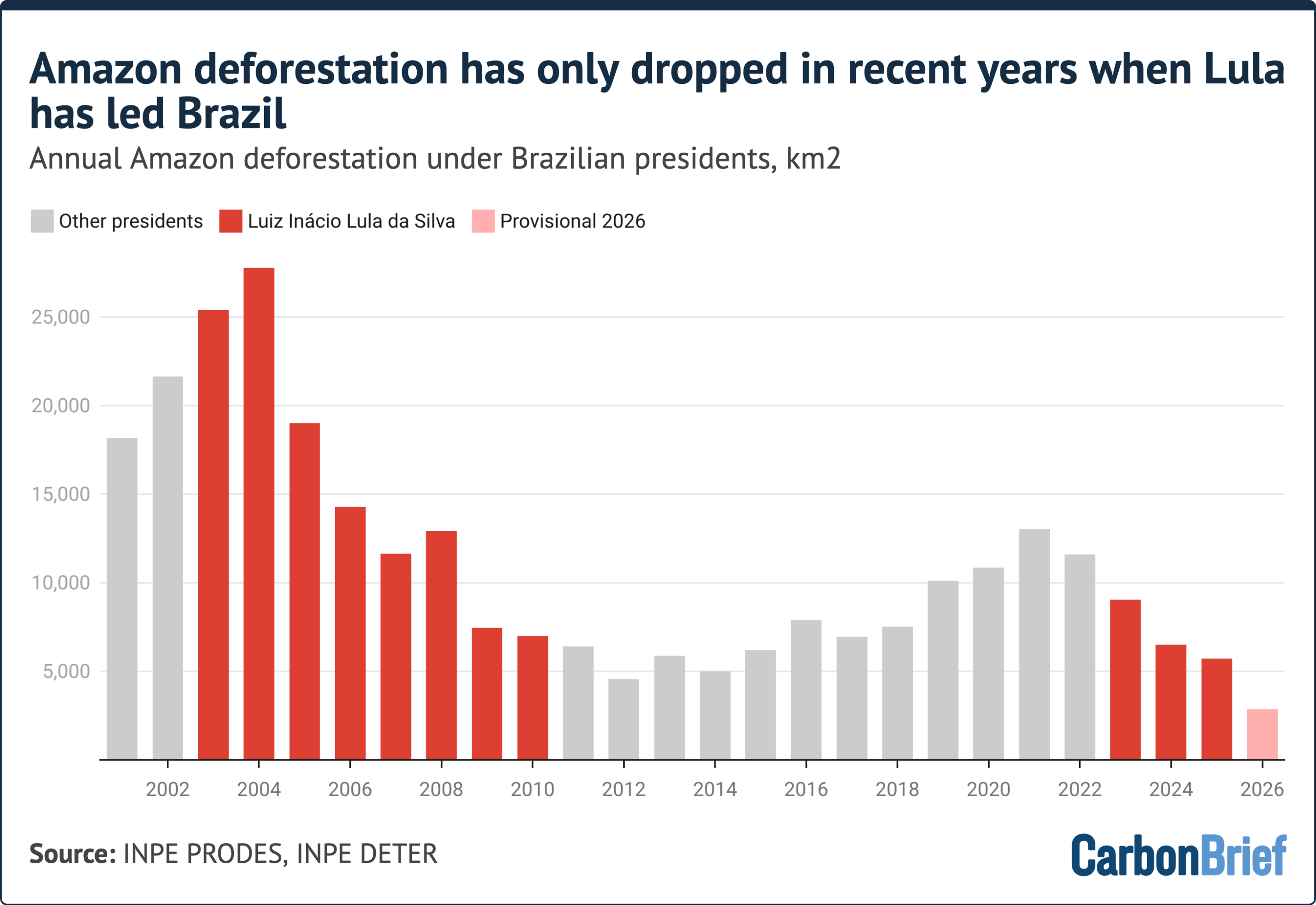
The 2022 Brazilian election was a watershed moment for global climate stability. Under the administration of Jair Bolsonaro (2019–2022), the Amazon faced an era of unprecedented deregulation. Bolsonaro, who prioritized the expansion of the agribusiness sector, systematically weakened environmental oversight, slashed the budgets of federal agencies like IBAMA, and frequently antagonized Indigenous groups.
The result was a surge in deforestation that drew international condemnation. By contrast, upon taking office in 2023, President Lula da Silva pledged to return Brazil to the global stage as an environmental leader, famously declaring at the COP27 summit that "Brazil is back."

Under the guidance of Environment Minister Marina Silva, the government reinstated the Action Plan for the Prevention and Control of Deforestation in the Legal Amazon (PPCDAM). The results were immediate and measurable: annual deforestation rates plummeted from 11,594 square kilometers in 2022 to 5,731 square kilometers by 2025. Preliminary satellite data for 2026 suggests the country is on track to record its lowest level of forest loss since monitoring began in 1988.
Chronology: A Tale of Two Policies
To understand the current stakes, one must look at the stark contrast in governance between the two administrations:
- 2019–2022: The Bolsonaro years were marked by a "war on the environment." Legislative efforts aimed at dismantling the Forest Code—the bedrock of Brazilian land-use law—gained momentum. Illegal land-grabbing, wildcat mining, and logging flourished as federal enforcement mechanisms were deliberately hollowed out.
- 2023: Lula’s inauguration signaled an immediate pivot. The administration began the difficult task of rebuilding environmental monitoring and restoring the authority of federal inspection agencies.
- 2024–2025: Enforcement intensified, leading to a consistent decline in deforestation. However, the administration also faced significant pushback from a conservative-leaning congress, which successfully pushed through controversial measures like the "devastation bill," complicating the path to zero deforestation.
- 2026 (The Current Context): As Brazil heads to the polls, the "soy moratorium"—a voluntary pact that prevented the sale of soy grown on deforested land—has been undermined by the withdrawal of major grain traders. This, combined with the upcoming election, has created an atmosphere of extreme uncertainty.
Supporting Data: The Cost of Inaction
The Carbon Brief analysis, which utilizes the GLOBIOM-Brazil model from researchers at the University of Oxford and the International Institute for Applied Systems Analysis (IIASA), quantifies the impact of political will.
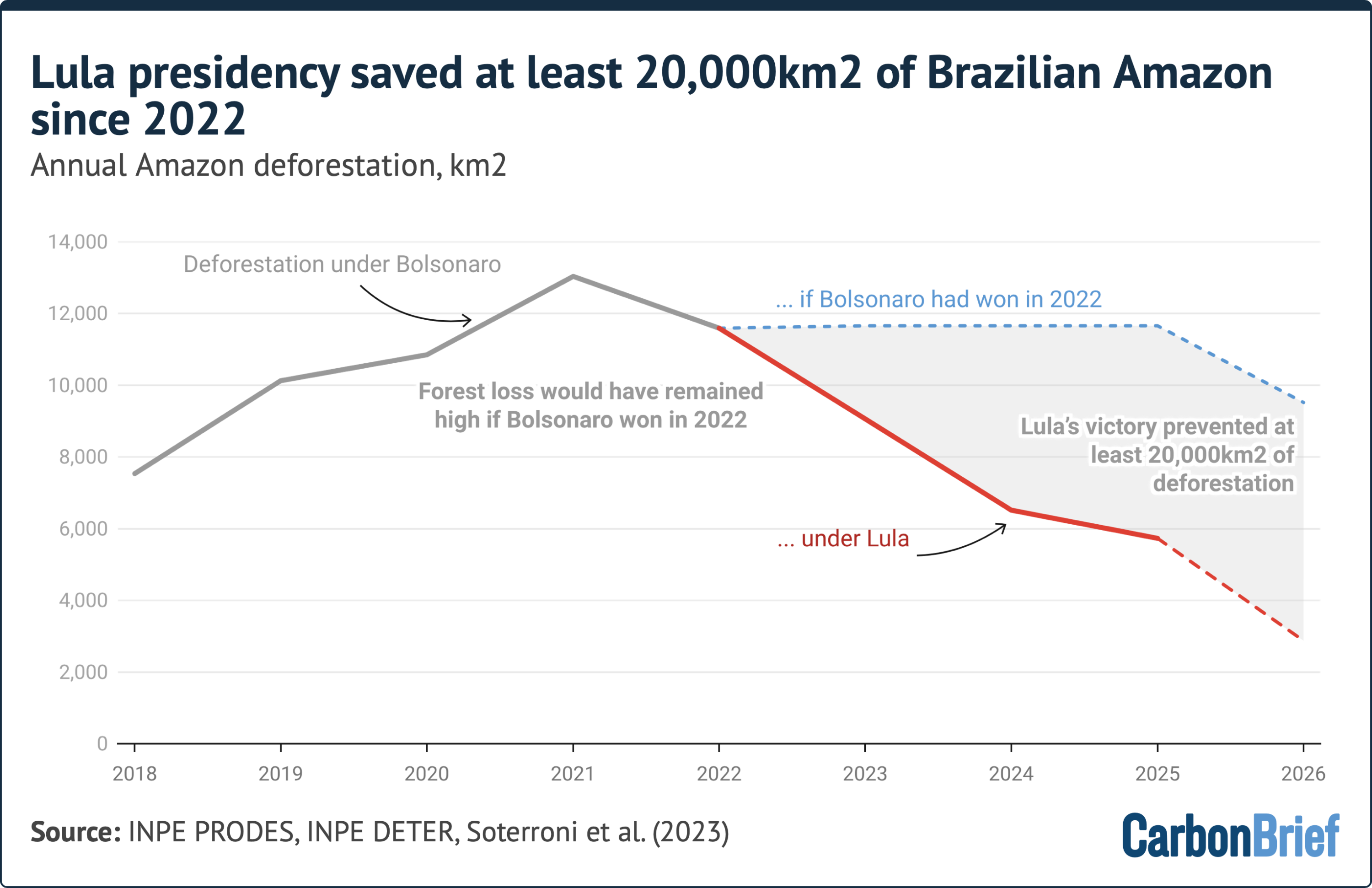
By comparing the current administration’s performance against a "business-as-usual" scenario where the Forest Code remained unenforced, the data indicates that at least 20,000 square kilometers of primary rainforest have been saved. Dr. Aline Soterroni, who led the 2023 analysis, notes that this estimate is "conservative." In a scenario where illegal activity was actively encouraged by the state—as it was during the Bolsonaro era—the actual destruction could have been significantly higher.
The data further shows that when Brazil’s environmental laws are enforced, deforestation reacts almost immediately to the signal sent from the top. Conversely, the destruction of institutional capacity can be achieved in a matter of months, as seen in the early days of the 2019 administration.
The Impending Choice: A Divergent Path
The upcoming election is not merely a political contest; it is a referendum on the Amazon.
Flávio Bolsonaro, representing the right-wing Liberal Party, has framed his campaign around a return to his father’s policies. While he has made vague pledges regarding "illegal" deforestation, environmental experts remain deeply skeptical. Claudio Angelo of the Climate Observatory notes that such pledges are functionally meaningless if the underlying legal framework—the Forest Code—is dismantled.
If Flávio Bolsonaro wins, he would likely lead a nation that favors extractive industries over conservation, potentially joining a growing bloc of right-wing governments across South America, including those in Colombia, Peru, and Ecuador. Experts warn that this could result in up to 95% of the Amazon falling under the control of administrations that prioritize short-term economic gains from mining and industrial farming over the long-term survival of the biome.
Official Responses and Expert Warnings
The scientific community in Brazil has been vocal about the danger of a policy reversal. Dr. Patricia Pinho, deputy science director at the Amazon Environmental Research Institute (IPAM), describes the prospect of a new far-right administration as a "tremendous disaster." She emphasizes that the nation cannot afford another four years of escalating violence against Indigenous peoples and unchecked deforestation.

Dr. David Lapola, an ecologist at the University of Campinas, warns that the environmental goals Brazil has spent decades building could be "thrown in the trash bin" in a matter of months. He argues that environmental protection is not a political preference, but a fundamental necessity for human survival in the 21st century.
Broader Implications: Climate, Economy, and Global Standing
The significance of this election extends far beyond Brazil’s borders. As the world’s fourth-largest greenhouse gas emitter, Brazil’s emissions trajectory is dictated by its land-use policies. Lula’s commitment to a 59-67% reduction in emissions by 2035 rests entirely on his ability to keep the forest standing.
Furthermore, the collapse of the Amazon soy moratorium earlier this year highlights the role of the private sector in this crisis. Without the cooperation of international commodity traders, the burden on the Brazilian government to police the vast, remote regions of the Amazon becomes exponentially harder.
The election also highlights the ongoing tension between the executive branch and a conservative-dominated congress. Regardless of who wins the presidency, the legislative landscape remains hostile to aggressive environmental regulation. The "devastation bill" of 2025 serves as a stark reminder that even with a climate-conscious president, the structural barriers to progress are significant.
Conclusion: A Turning Point
The 20,000 square kilometers of saved forest represent more than just trees; they represent a lifeline for the global climate and a testament to the power of governance. As Brazilian voters prepare to cast their ballots on October 4th, they are deciding whether to continue the difficult work of restoration or return to a path of systematic dismantling.
For the international community, the message is clear: the Amazon is no longer a localized issue. It is a critical component of the global climate machine. The outcome of this election will determine if the "Brazil is back" narrative continues or if the world’s most important carbon sink enters another era of peril. With the candidates in a dead heat, the future of the rainforest—and perhaps the climate targets of the entire planet—remains on a knife’s edge.


 Dwi Wanna
 Asro
Asro
 Nila Kartika Wati
 Jia Lissa
 Basiran
 Sagoh
Sagoh

 Lina Hope