
 Asro
Asro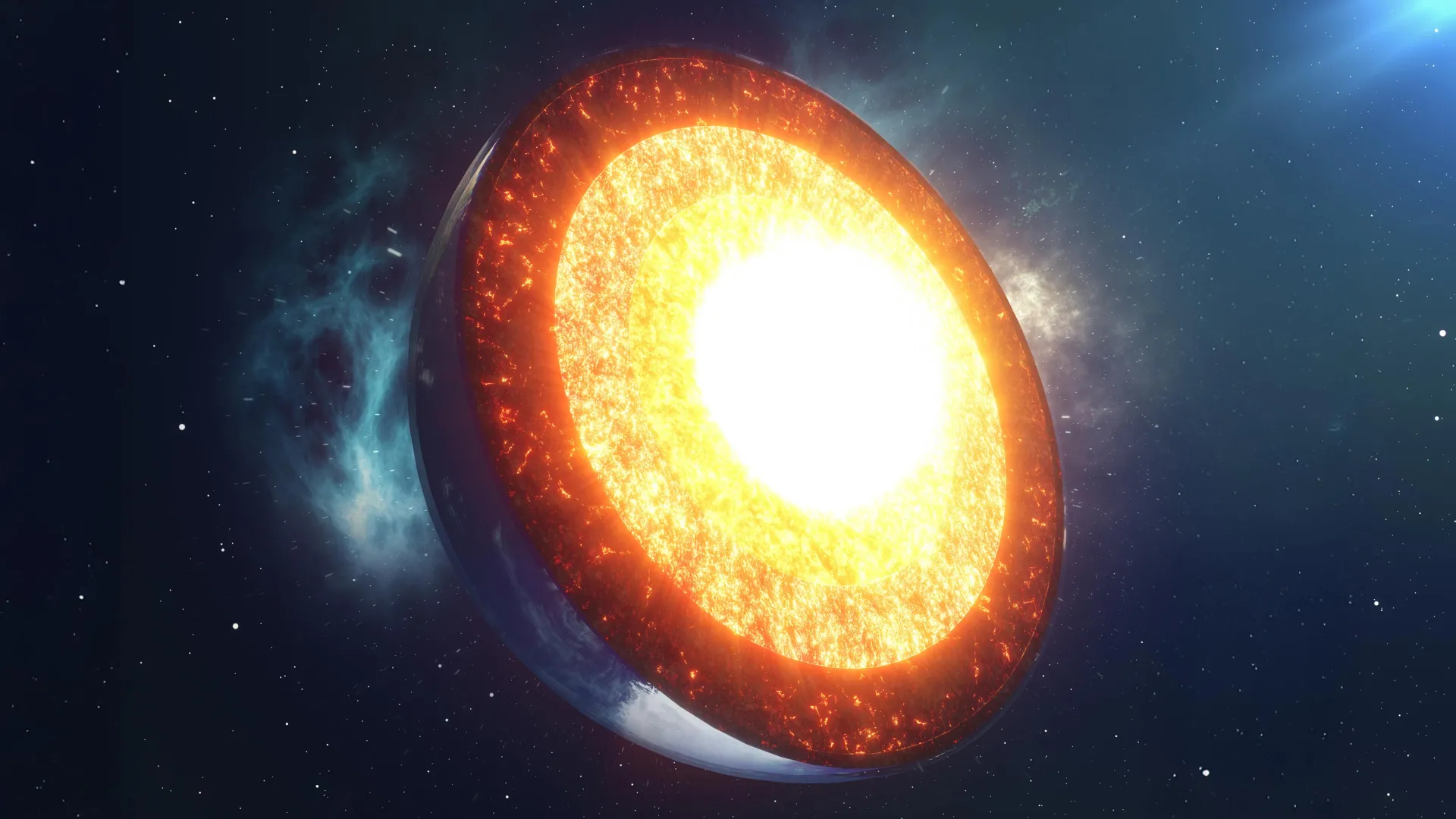
For most of humanity, the day is an immutable constant—a rigid 24-hour cycle around which we anchor our global economy, our biological clocks, and our history. Yet, beneath the serene appearance of a planet spinning with clockwork precision lies a far more chaotic reality. Earth’s rotation is not a fixed, rhythmic beat; it is a stuttering, fluctuating dance influenced by the turbulent, metallic fluids churning thousands of miles beneath our feet.
Recent scientific breakthroughs are finally illuminating why our days occasionally lengthen or shorten by mere milliseconds. By peering into the Earth’s core, researchers have discovered a complex, high-stakes trade of momentum between the planet’s solid inner core and its rocky mantle, a discovery that challenges our understanding of the deep interior’s structural integrity.
Main Facts: The Illusion of Constant Time
The fundamental principle governing this phenomenon is the conservation of angular momentum. In a closed system, total angular momentum must remain constant. If one part of the Earth speeds up, another must necessarily slow down to compensate.
For decades, geophysicists have understood that the Earth’s liquid outer core does not rotate in perfect synchronicity with the crust and mantle. Instead, fluctuations in the planet’s magnetic field have provided a window into this hidden engine. We now know that the liquid core undergoes decadal cycles of acceleration and deceleration. As the core speeds up, the mantle—the 3,000-kilometer-thick layer of rock that includes our crust—experiences a compensatory slowdown.
These shifts are infinitesimal, measured in mere milliseconds, but they are measurable. To the average human, a change of a few thousandths of a second is imperceptible; to the atomic clocks that regulate GPS, telecommunications, and financial trading platforms, these discrepancies are significant enough to require occasional "leap seconds" to keep our digital world in sync with the physical one.
Chronology: A Three-Decade Mystery
The scientific quest to map these rotational anomalies began in earnest during the late 20th century, when high-precision instrumentation first allowed researchers to track the length of a day (LOD) with unprecedented accuracy.
- The 1990s: Scientists confirmed that the Earth’s rotation speed was not constant. Initial theories pointed toward atmospheric winds and ocean currents as the primary culprits. While these play a role in short-term variations (seasonal changes), they could not account for the decadal fluctuations observed over 30-year periods.
- The 2000s: Attention shifted toward the core-mantle boundary. It became widely accepted that the mantle and core were trading momentum, but the mechanism of that exchange remained elusive. How does a solid mantle interact with a fluid core to exchange rotational energy?
- September 2024: A definitive study published in Nature by University of Alberta researchers Huifeng Zhang and Professor Mathieu Dumberry provided the missing link. By modeling the gravitational interactions between the inner core and the mantle, the team proposed a mechanism that finally explains how this rotational momentum is transferred.
Supporting Data: The Physics of Gravitational Torque
The core of the new discovery lies in the interplay between mass and gravity. The Earth’s inner core is not a perfect sphere; it possesses an uneven distribution of mass—a topography of sorts.
Zhang and Dumberry’s research posits that this lack of spherical symmetry is the key. As the inner core’s rotational speed shifts, its irregular shape creates a "gravitational torque." This torque acts like an invisible tether, exerting a pulling force on the mantle. Because the mantle also features uneven mass distributions, the gravitational interaction between the two layers results in a transfer of momentum.
However, this is not a one-way street. The researchers identify a secondary force: the core-mantle boundary (CMB) torque. This force acts as a counterweight, involving friction and electromagnetic drag at the interface between the molten outer core and the rocky mantle.
The length of our day, therefore, is the result of a delicate, ongoing tug-of-war between these two competing forces. The gravitational torque tries to force the mantle to follow the core’s rhythm, while the CMB torque—driven by magnetic and frictional resistance—resists this influence. The subtle variations we observe in the length of a day are the residual "noise" of this invisible struggle.
Official Responses and Theoretical Shifts
The implications of the Zhang-Dumberry study extend far beyond the mere adjustment of clocks. The scientific community has greeted the findings as a pivotal step in understanding planetary geodynamics.
"For years, we have treated the mantle as a relatively static shell," notes one independent geophysicist familiar with the study. "But the data suggests that the deep Earth is far more responsive than our models previously allowed for."
Professor Dumberry and Huifeng Zhang emphasize that their findings rely on the assumption that the inner core is not entirely rigid. Their model suggests that the inner core "deforms viscously" over roughly decade-long intervals. This implies that the very center of our planet—an area previously assumed to be a dense, unchanging solid—is actually capable of changing shape in response to rotational forces. This "viscous deformation" is a game-changer; it suggests that the deep Earth is a dynamic, shifting environment rather than a static iron ball.
Implications: A New Lens on the Planet
1. Re-evaluating Planetary Composition
If the inner core is capable of viscous deformation over decadal timescales, our current models of the planet’s internal temperature and mineral composition may require revision. If the core is softer or more malleable than previously thought, it changes the way we calculate the cooling rate of the Earth’s interior, which in turn influences our understanding of the geodynamo—the process that generates Earth’s magnetic field.
2. Precision Timekeeping and Navigation
As our reliance on satellite-based navigation systems grows, the need to understand these millisecond fluctuations becomes a matter of national security and economic stability. Understanding the "why" behind these shifts allows scientists to develop better predictive models, enabling us to anticipate changes in the Earth’s rotation before they occur, rather than simply reacting to them after they have already disrupted timekeeping standards.
3. The Deep Earth’s "Memory"
Perhaps most intriguing is the possibility that Earth’s rotation holds a long-term "memory" of its internal state. By tracking the length of a day over centuries, researchers might be able to reconstruct the historical behavior of the Earth’s core. This could provide clues into how the magnetic field has flipped in the past and whether we are approaching a period of instability.
4. A Dynamic Interior
The realization that the Earth’s interior is a highly coupled system forces us to view the planet as a living, breathing entity. The crust we walk upon is merely the skin of a complex machine, where the rotation of the core and the shape of the mantle are locked in an eternal, gravitational embrace.
Conclusion: Looking Ahead
The study by Zhang and Dumberry serves as a profound reminder of how much we still have to learn about the ground beneath our feet. We live on the surface of a planet that is constantly rearranging its momentum, a planet where the core and the mantle engage in a subtle, decades-long conversation that dictates the length of our days.
As we continue to refine our ability to observe these minute variations, we move closer to a comprehensive model of Earth as an integrated system. The next decade of research will likely focus on confirming these viscous deformations and mapping the gravitational interactions with even greater precision. For now, we are left with the fascinating realization that every time we check our watches, we are checking the pulse of a planet whose heart—the inner core—is beating to a rhythm set by forces we are only just beginning to comprehend.
The 24-hour day is a convenience of human civilization, but in the grander, geological scale of the Earth, it is merely a fluctuating average in a universe of constant change. We remain, as ever, passengers on a planet that is as dynamic and unpredictable as the stars it orbits.


 Dwi Wanna
 Neng Nana
 Nila Kartika Wati
 Jia Lissa
 Basiran
 Sagoh
Sagoh

 Lina Hope