
 Azzam Bilal Chamdy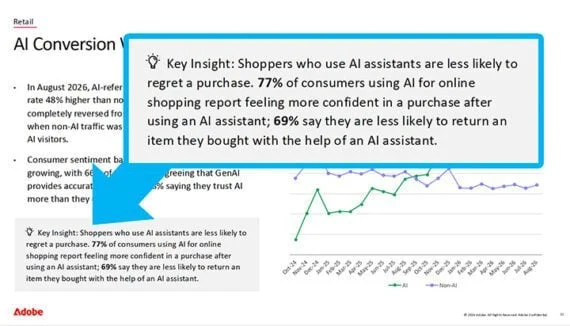
For years, the "return epidemic" has been the silent killer of ecommerce profitability. As retailers grappled with the logistical nightmare of reverse logistics, mounting shipping costs, and the devaluation of returned inventory, the industry searched for a structural solution. New evidence suggests that the answer may not lie in stricter return policies, but in the rise of AI-aided shopping.
According to the August 2026 "AI Traffic Trends Report" from Adobe—a comprehensive analysis based on over one trillion visits to U.S. retail sites and 100 million SKUs—AI is fundamentally altering the consumer decision-making process. By shifting the burden of research from the shopper to the algorithm, AI is fostering a new class of "informed consumers" who are significantly less likely to send items back.
Main Facts: The AI-Driven Shift in Consumer Behavior
The core finding of the Adobe report, which includes survey data from 5,000 U.S. consumers, is that AI is acting as a filter for purchase uncertainty. The data highlights a stark contrast between traditional browsing—often characterized by "window shopping" and impulsive, poorly researched clicks—and AI-assisted discovery.
Key metrics from the report underscore this transition:
- Confidence Correlates to Retention: A substantial 77% of consumers who utilized AI assistants during their shopping journey reported feeling more confident in their final purchase.
- The Returns Mitigation Effect: Among those who leveraged AI tools, 69% indicated they were less likely to return the items they purchased.
- Conversion Power: AI-referred traffic is not just higher quality; it is higher performing. In July 2026, visitors arriving at retail sites via AI referrals converted at a rate 60% higher than non-AI-referred traffic.
- Revenue Efficiency: AI-referred consumers generated 53% more revenue per visit, suggesting that AI tools effectively steer shoppers toward higher-value or more suitable products.
Chronology: The Evolution of AI in the Shopping Lifecycle
The integration of AI into the consumer path-to-purchase did not happen overnight. To understand the current landscape, one must look at the trajectory of digital commerce:
2020–2022: The Era of Static Search
Retailers focused on SEO and internal site search. Shoppers were largely responsible for their own discovery, often tab-switching across a dozen different browser windows to compare specs, pricing, and reviews. This manual labor was prone to error and fatigue, leading to "satisficing"—making a "good enough" purchase that often resulted in disappointment upon delivery.
2023–2024: The Rise of Generative AI
With the explosion of Large Language Models (LLMs), retailers began experimenting with chatbots. Initially, these were simple customer service tools, but they soon evolved into product discovery agents. Retailers realized that AI could process vast amounts of unstructured data (reviews, FAQs, manuals) to answer specific user queries.
2025: The Agentic Web
We moved from simple chatbots to "agentic" shopping. Tools like Meta’s Muse began utilizing autonomous web browsers to traverse the live web on behalf of the user. Instead of the user visiting five sites, the AI visits the sites for them, aggregates the data, and presents a curated list of recommendations.
2026: The "Informed Shopper" Paradigm
As highlighted by the August Adobe report, we have reached a point where the AI-referred shopper is no longer a passive browser. They are "pre-qualified" consumers. The AI has already checked for compatibility, compared dimensions, and vetted user reviews. By the time the user lands on the retailer’s product page, the "consideration" phase of the marketing funnel has effectively been completed by the machine.
Supporting Data: Why Accuracy is the New Currency
The Adobe report suggests that the efficacy of AI in reducing returns is directly proportional to the quality of the data provided by the merchant. AI is only as good as the product information (PIM) it is fed.
For an AI assistant to successfully match a product to a consumer, it requires more than a simple product title and price. It needs "high-fidelity" data, including:
- Granular Specifications: Exact dimensions, material composition, and technical compatibility requirements.
- Comparative Context: How a product stacks up against competitors or previous iterations.
- Dynamic Reviews: AI agents can synthesize thousands of reviews to highlight common sizing complaints or durability issues that a human might miss.
- Operational Details: Real-time inventory status, specific shipping delivery windows, and detailed return policy nuances.
When a merchant provides this level of detail, the AI acts as a sophisticated digital concierge. It doesn’t just sell a product; it vets it against the shopper’s specific constraints. If the data is missing or inaccurate, the AI may inadvertently recommend a product that doesn’t fit the user’s needs, leading to a return—the very outcome retailers are trying to avoid.

Official Responses and Industry Implications
The retail industry’s reaction to the Adobe report has been one of cautious optimism. While the data suggests a path toward lower return rates, industry experts caution that we are still in the early stages of this technological transition.
"We are seeing a shift from ‘search-based’ commerce to ‘intent-based’ commerce," says one industry analyst. "Retailers who view their product pages as mere marketing copy are going to fall behind. The new SEO is ‘AI-O’—optimizing your product information so that an AI agent can read it, understand it, and recommend it to the right person."
However, some retailers have expressed concerns regarding the loss of brand control. If a third-party AI assistant, such as Meta’s Muse, is the primary interface between the customer and the product, how does the retailer maintain their brand voice? How do they ensure that their unique value proposition is not lost in a generic, algorithm-generated summary?
Furthermore, there is the question of the "black box" effect. If an AI recommends a product that ultimately results in a return, who is to blame? Is it the merchant for providing inaccurate specs, or the AI platform for a failure in its recommendation logic?
The Future: Implications for the Retail Ecosystem
If the trends identified by Adobe continue, the implications for the future of ecommerce are profound:
1. The Death of the "Window Shopper"
The traditional retail funnel is being compressed. The time spent on-site may decrease, but the quality of that time will increase. Retailers will need to adjust their analytics platforms to account for the fact that a large portion of the "research" is happening off-site within an AI interface.
2. PIM as a Strategic Asset
Product Information Management (PIM) systems will move from the back-office to the front-line. A retailer’s ability to win in the AI era will depend on their ability to structure data in a way that is easily consumable by Large Language Models. This means moving away from legacy databases and toward AI-ready, machine-readable formats.
3. A Shift in Return Logistics
If AI successfully reduces returns by 10% to 20%—a realistic target based on the Adobe survey data—the savings for major retailers would be in the billions. This capital could be reinvested into product innovation, lower prices, or improved shipping logistics.
4. New Metrics for Success
Retailers will need to stop obsessing over "Time on Site" as a primary success metric. Instead, they should focus on "Conversion Accuracy." A short visit that results in a successful, kept purchase is infinitely more valuable than a long, meandering session that leads to a return.
Conclusion
The "AI Traffic Trends Report" for August 2026 serves as a wake-up call for the ecommerce industry. We are witnessing the end of the "spray and pray" model of digital marketing. The future belongs to the "precision commerce" model, where AI assistants curate the world’s inventory to match the specific needs of the individual shopper.
While it is too early to declare the return crisis solved, the correlation between AI assistance, consumer confidence, and retention is undeniable. For the forward-thinking merchant, the path forward is clear: invest in the quality of your product data, embrace the rise of AI agents, and prepare for a future where the customer who lands on your site is already an expert on what they are about to buy. In this new ecosystem, the best way to make a sale is to ensure the customer never feels the need to return it.


 Rifan Muazin
 Nana Muazin
 Laily UPN
 Iffa Jayyana

 Suro Senen
 Lina Hope
 Lina Irawan