
 Nila Kartika Wati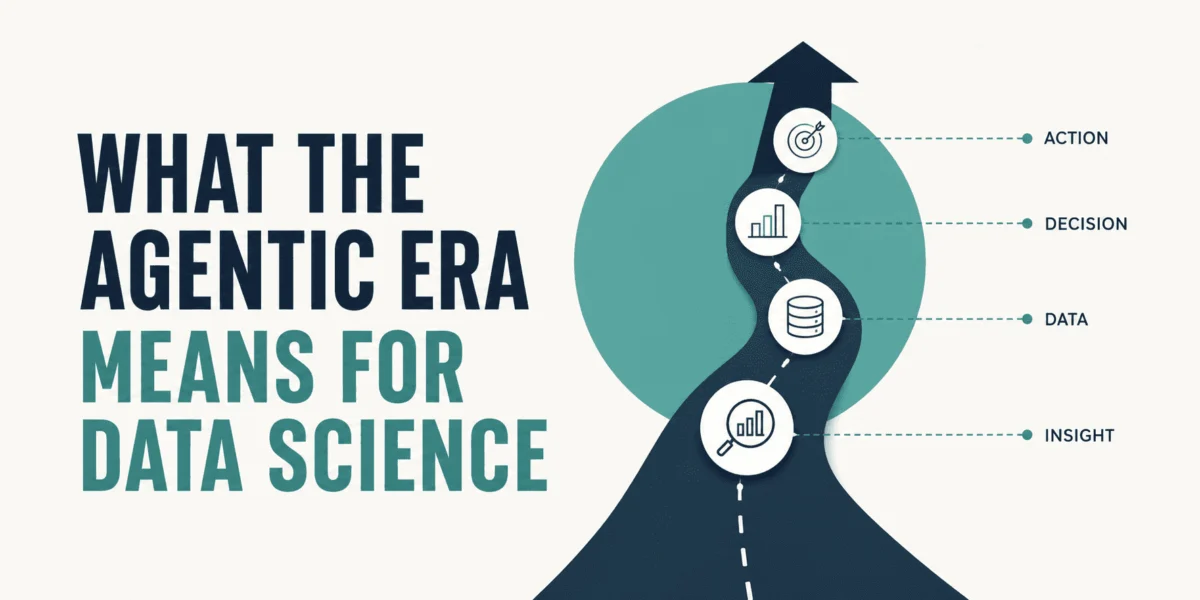
Introduction
The landscape of data science is undergoing a seismic transformation. For years, the discipline was defined by the manual craftsmanship of code—writing scripts, cleaning datasets, and iteratively tuning hyperparameters. Today, that procedural paradigm is being dismantled by the rise of agentic AI.
We have moved beyond the era of static Large Language Models (LLMs) that simply generate text. We are now firmly in the "Agentic Era," a period defined by systems that plan, execute multi-step tasks, interface with external tools, and practice self-correction. For the modern data scientist, this is not merely a new tool in the kit; it is a fundamental shift in the definition of the profession. To thrive in this environment, practitioners must pivot from being individual contributors of code to becoming architects of autonomous systems.
The Chronology of Autonomy: From Chatbots to Agents
To understand the current state of data science, one must trace the rapid evolution of AI capability:
- 2022 – The LLM Awakening: The release of ChatGPT introduced the world to generative AI. Data scientists began using LLMs as "co-pilots" for writing boilerplate code or explaining complex documentation.
- 2023 – The Integration Phase: Tools like LangChain emerged, allowing models to connect to external APIs and databases. The focus shifted to RAG (Retrieval-Augmented Generation), enabling AI to interact with proprietary corporate data.
- 2024 – The Rise of Agency: The introduction of "Agentic Workflows" changed the game. Instead of one-shot prompts, researchers developed systems capable of recursive reasoning—if an agent’s code failed to run, it could read the error message, rewrite the script, and try again.
- 2025-2026 – The Production Maturity: We are currently seeing the standardization of agentic frameworks. The transition from experimental prototypes to robust, enterprise-grade orchestrators is complete, making agentic behavior a baseline requirement for competitive data science teams.
Redefining the Baseline: How Agents Operate
An AI agent is essentially a system that perceives its environment, reasons about its objectives, and takes discrete actions to achieve a goal. Unlike a static prompt-response model, an agent operates in a continuous feedback loop.
The Mechanics of an Agentic Loop
- Goal Setting: The human provides a high-level objective (e.g., "Analyze the Q3 churn rate and suggest three mitigation strategies").
- Reasoning/Planning: The agent decomposes the goal into sub-tasks (e.g., fetch data, validate schemas, perform regression, visualize findings).
- Tool Use: The agent calls external Python functions, SQL queries, or visualization libraries.
- Observation & Correction: If a library returns a
KeyErroror an unexpected null value, the agent observes the output and pivots its strategy. - Final Synthesis: The agent aggregates the findings into a structured report.
In this model, the data scientist becomes an "Orchestrator." The procedural burden of cleaning, formatting, and standardizing is offloaded to the agent, allowing the human to focus on the validity of the underlying data and the strategic impact of the findings.
The Orchestration Ecosystem: Frameworks for 2026
The maturation of orchestration frameworks has enabled developers to move beyond ad-hoc scripts. Below are the primary pillars of the current ecosystem:
| Framework | Design Philosophy | Primary Use Case | 2026 Industry Context |
|---|---|---|---|
| LangGraph | Graph-based state management | Complex, multi-agent workflows | The industry standard for production-grade, cyclical logic. |
| AutoGen | Multi-agent conversation | Collaborative "Debate/Review" cycles | Essential for quality control via agentic "Critic" roles. |
| smolagents | Minimalist, code-first execution | Deep integration with the Python stack | The preferred tool for rapid prototyping and scientific tasks. |
Implications: The Shift from Procedural to Evaluative
The most significant impact of this transition is the redistribution of cognitive load. Historically, a data scientist might spend 80% of their time on "data plumbing"—the tedious work of wrangling datasets—and 20% on insights. Agentic AI flips this ratio.
The New Data Science Workflow
- Automation of Routine: Exploratory Data Analysis (EDA) is now largely automated. Agents can generate histograms, correlation matrices, and outlier reports in seconds.
- The Rise of Evaluative Judgment: As agents handle the "how," the human role evolves into the "should." Data scientists must now act as quality auditors, ensuring that the agents’ logic is sound, their tool usage is secure, and their conclusions align with business strategy.
- Productivity Compounding: By delegating repetitive tasks, a single data scientist can oversee a fleet of agents, effectively acting as an engineering manager for a team of autonomous digital workers.
The 2026 Skill Stack: What Practitioners Need
Technical proficiency remains the bedrock, but the "Agentic Era" demands a specialized tier of competencies:
- System Design for AI: Understanding how to structure prompts so that agents don’t hallucinate or enter infinite loops.
- Evaluation Engineering: Proficiency in setting up "evaluation harnesses" to test agentic performance before deployment.
- Tooling Proficiency: Expertise in creating secure, robust toolsets (APIs, Python functions) that agents can interact with reliably.
- Security & Governance: Understanding the security implications of giving autonomous systems access to enterprise data environments.
Official Responses and Industry Perspectives
Leading voices in the AI space, including those within the Microsoft and Hugging Face ecosystems, emphasize that this is not a trend of replacement, but one of augmentation. The consensus among CTOs and Chief Data Officers is that "the ceiling has been raised."
Organizations that have integrated agentic workflows are reporting a 3x to 5x increase in the speed of model deployment. However, they also caution that the "human-in-the-loop" is more critical than ever. As systems become more autonomous, the risk of "automated errors" increases, making the role of the senior data scientist—as a supervisor of AI output—a high-stakes necessity.
The Evolution of Roles
We are witnessing a clear bifurcation in the industry:
- The Builder: Data scientists who are moving into AI engineering, focusing on building the agents, managing state, and defining the toolsets.
- The Consumer: Data scientists who are mastering the use of these agents to perform complex, multi-layered analysis at unprecedented speeds.
Both roles are vital, but both require a departure from the "manual coder" mindset.
Practical Steps: How to Keep Pace
For those feeling the pressure to adapt, the key is to avoid the "everything at once" trap. The recommended path forward is as follows:
- Start Small: Choose a repetitive task you perform weekly. Build a single-agent script using smolagents to automate that task.
- Define Success Criteria: Before running the agent, document what "success" looks like (e.g., "The model must correctly clean the CSV without dropping columns X and Y").
- Iterate on Feedback: Use LangGraph to add a "critic" layer. If the agent fails, analyze the reasoning logs to see where the logic broke down.
- Standardize: Once a process is stable, document it as a template for other team members.
Conclusion
The agentic era is not a distant future; it is the current reality of the data science profession. The tools that once seemed like experimental novelties have become the infrastructure of modern analytical work. While the fundamental requirements of statistics, programming, and domain knowledge remain, the way those skills are expressed has changed forever.
By embracing autonomous systems, data scientists can shed the burden of repetitive, low-value work and ascend to the role of strategic orchestrators. Those who ignore this shift risk obsolescence, while those who master it will find themselves capable of achievements that were unimaginable only a few short years ago. The future of data science is autonomous, but it still requires the human eye to navigate the destination.

 Neng Nana
 Evan Lee Salim
 Raul Delapena Setiawan
 Reynand Wu
 Sagoh
Sagoh

 Azzam Bilal Chamdy
 Ali Ikhwan