
 Laily UPN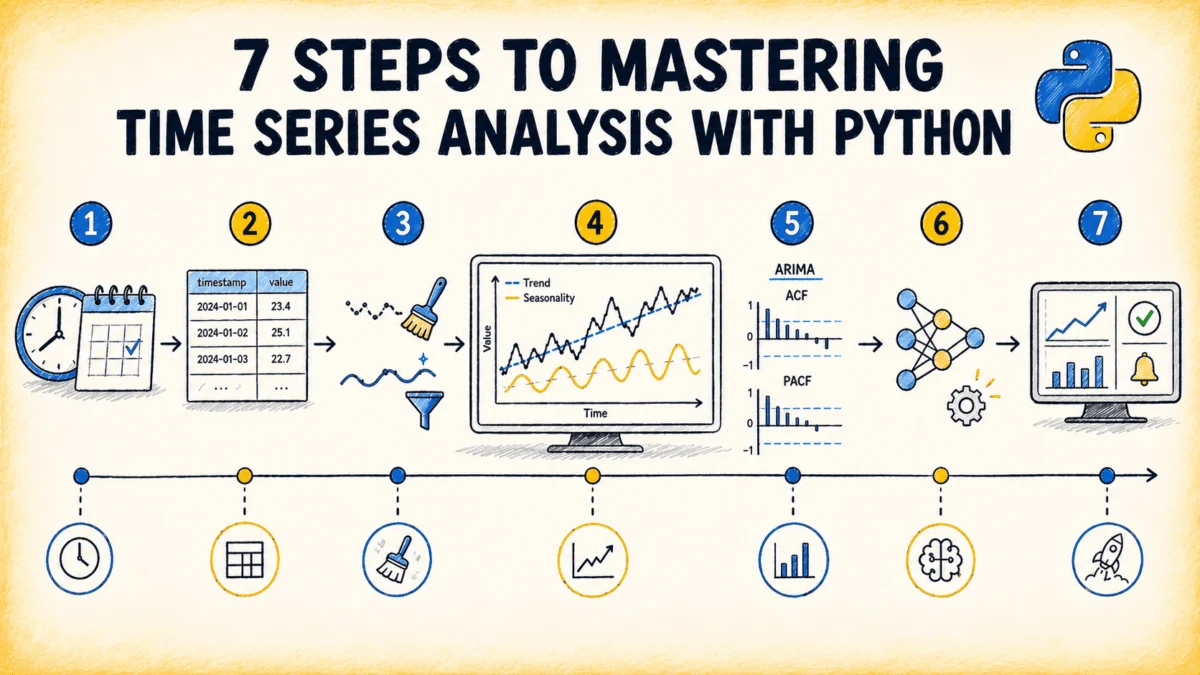
Time series data serves as the pulse of the modern digital economy. From the millisecond-precision of high-frequency trading platforms to the hourly energy consumption logs of smart grids and the longitudinal tracking of patient vitals in intensive care units, temporal data is ubiquitous. Yet, despite its prevalence, time series analysis remains one of the most misunderstood and challenging domains within the broader field of data science.
Unlike static tabular data, where rows are often treated as independent observations, time series data is defined by its inherent temporal ordering. This article explores the seven critical steps required to move from a novice practitioner to a proficient time series analyst, providing a roadmap for those looking to harness the power of Python to model, forecast, and extract insights from the dimension of time.
1. The Paradigm Shift: Why Time Series Demands a New Mental Model
Many data scientists approach time series analysis with the "general machine learning" toolkit, often leading to flawed conclusions. In standard supervised learning, the assumption of independent and identically distributed (i.i.d.) data is foundational. Time series, however, systematically violates this assumption.
Core Structural Properties
To succeed, a practitioner must internalize three structural pillars:
- Temporal Dependence: Observations are inherently linked. What occurred yesterday is a primary predictor of what will happen today. Ignoring this leads to models that fail to capture the "memory" of the process.
- Stationarity: A process is stationary if its statistical properties—mean, variance, and autocorrelation—are constant over time. Most real-world data is non-stationary, exhibiting wandering trends that require mathematical transformation (such as differencing) before modeling.
- Seasonality and Trend: The ability to decompose a signal into its directional movement (trend) and its repeating cycles (seasonality) is the hallmark of a skilled analyst.
Expert Insight: For those building a professional foundation, Forecasting: Principles and Practice by Rob Hyndman and George Athanasopoulos remains the gold-standard reference. Understanding the theory before writing code is not optional; it is the prerequisite for avoiding "garbage-in, garbage-out" modeling.
2. The Python Ecosystem: Mastering Time-Aware Data Structures
Python’s pandas library is the workhorse of time series manipulation. However, proficiency goes beyond simple dataframe operations. It requires a deep understanding of DatetimeIndex and PeriodIndex.
Critical Operations
- Resampling: This is where many analysts encounter "silent" errors. Converting data from a high-frequency (e.g., minute-by-minute) to a low-frequency (e.g., daily) format requires careful selection of aggregation functions. A simple mean might mask critical outliers that a median or max aggregation would expose.
- Rolling and Expanding Windows: These primitives are essential for creating lag features and calculating cumulative statistics. Analysts should practice implementing these manually—using
.rolling()and.expanding()—before relying on higher-level library abstractions. This manual approach builds an intuitive grasp of data leakage, a common pitfall where information from the future "leaks" into the training set of a model.
3. The Sanitation Pipeline: Cleaning and Preprocessing
Real-world time series data is notoriously "dirty." It arrives with sensor dropouts, missing timestamps, and irregular sampling intervals. In the temporal domain, a missing timestamp is not merely a null value; it is a structural hole.
Strategies for Robust Cleaning
- Frequency Alignment: Before imputation, data must be mapped to a canonical frequency grid. If your data is expected every hour, you must enforce that grid to identify precisely which hours are missing.
- Imputation Techniques: Never apply a global mean for missing values. For short, continuous gaps, linear interpolation is often sufficient. For step-function variables (like equipment on/off states), a "forward fill" approach is more logical.
- Outlier Detection: In time series, outliers must be evaluated locally. A value that looks normal in a global context might be an anomaly when viewed against the immediate preceding window.
4. Exploratory Data Analysis: Decoding the Signal
You cannot model what you do not understand. Before fitting a single line of code to a model, the analyst must decompose the data.
Diagnostic Tools
- Decomposition (STL): Utilizing Seasonal-Trend decomposition using LOESS (STL) allows you to peel back the layers of a time series. By isolating the residual (the "noise"), you can determine if your signal contains enough predictable structure to warrant further modeling.
- Autocorrelation (ACF/PACF): The Autocorrelation Function (ACF) and Partial Autocorrelation Function (PACF) plots are the "X-rays" of a time series. They reveal the lag at which past values influence the present, guiding the selection of parameters for classical models like ARIMA.
- Stationarity Testing: The Augmented Dickey-Fuller (ADF) and the Kwiatkowski–Phillips–Schmidt–Shin (KPSS) tests provide the statistical rigor needed to confirm if a series is ready for classical modeling.
5. The Baseline: Classical Statistical Forecasting
Before jumping into complex neural networks, a professional analyst builds a baseline using classical statistical models. These models are not just "old"—they are robust, interpretable, and often outperform deep learning models on smaller, cleaner datasets.
The Model Hierarchy
- Exponential Smoothing (ETS): By assigning exponentially decaying weights to past observations, ETS models provide an excellent starting point for capturing trend and seasonality.
- ARIMA/SARIMA: These models address the autocorrelation structure explicitly. SARIMA (Seasonal ARIMA) is particularly powerful for datasets with cyclical behavior.
The Golden Rule of Evaluation: Never use standard random cross-validation. Because time series is ordered, you must use Walk-Forward Validation. This involves training the model on a historical window, predicting the next point, and then expanding the training window to include that point, thereby simulating the actual production deployment of the model.
6. Scaling Up: Machine Learning and Deep Learning
Once classical baselines are established, the path is clear to introduce machine learning (ML) and deep learning (DL).
When to Pivot to ML/DL
- Tree-Based Models: Algorithms like LightGBM and XGBoost excel when you have a rich set of external features (e.g., weather data, holidays, promotional calendars).
- Global Modeling: If you are managing thousands of individual time series (e.g., inventory management across a global supply chain), training a single, global model using architectures found in libraries like NeuralForecast often beats training individual models for each series.
- Deep Learning: Modern architectures, such as Transformers or N-BEATS, handle complex multi-seasonality and long-horizon forecasting with unparalleled precision. However, these should be viewed as the "final boss"—if your data is insufficient or your problem is simple, the complexity of DL often brings more risk than reward.
7. Operational Discipline: Deployment and Monitoring
A model is not a product until it is deployed, monitored, and maintained. Unlike static machine learning, time series models are in a constant battle against concept drift.
Maintaining Production Systems
- Automated Monitoring: Establish alerts for when your forecast error (MAE, RMSE, MAPE) exceeds a defined threshold.
- Versioning: Store not just the model, but the predictions alongside the actuals. This allows for retrospective analysis of model performance at different horizons.
- Backtesting as a Gate: Before any update reaches production, it must pass a rigorous backtest that simulates the entire deployment lifecycle. If a model fails here, it is not ready for the real world.
Implications and Future Outlook
The field of time series is currently witnessing a paradigm shift. The emergence of Foundation Models—pre-trained on massive corpora of diverse temporal data—is beginning to redefine the boundaries of what is possible. While these models offer incredible "zero-shot" capabilities, they do not replace the need for fundamental analysis.
As the volume of temporal data continues to explode, the ability to clean, analyze, and deploy forecasting systems will remain one of the most vital technical skills in the global economy. By adhering to these seven steps, practitioners can move beyond basic trend-following and build resilient, production-grade systems that turn temporal uncertainty into actionable insight.

 Neng Nana
 Evan Lee Salim
 Raul Delapena Setiawan
 Reynand Wu
 Sagoh
Sagoh

 Azzam Bilal Chamdy
 Ali Ikhwan