
 Nana Muazin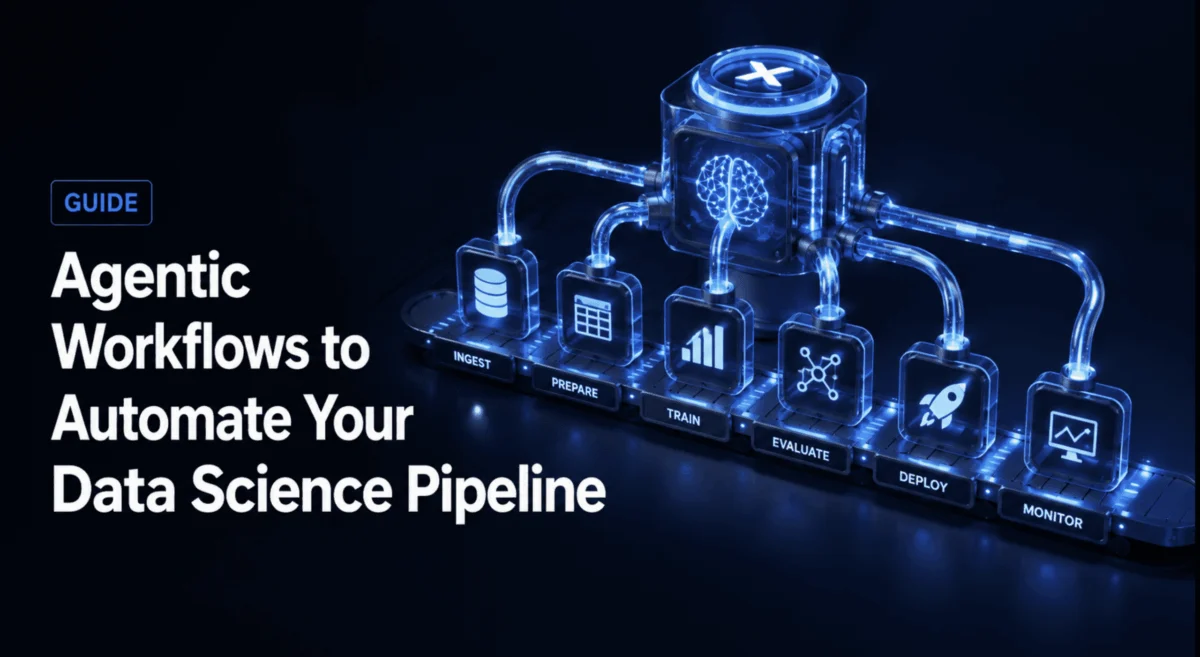
The modern data scientist is currently facing an existential paradox. Despite being billed as the "sexiest job of the 21st century," the daily reality for most practitioners is significantly less glamorous. According to industry surveys, roughly 45% of a data scientist’s working time is consumed by repetitive, procedural labor: cleaning null values, running identical exploratory data analysis (EDA) scripts, grid-searching hyperparameters, and writing maintenance checks for model drift.
This formulaic drudgery does not require high-level judgment; it requires repetition. However, the emergence of "agentic workflows"—autonomous AI systems capable of executing complex, multi-step tasks—is set to reclaim this time. By shifting the procedural burden to intelligent agents, data scientists can finally pivot back to the evaluative work that generates true business value: determining model ethics, validating business logic, and architecting innovative solutions.
The Agentic Shift: Moving Beyond Simple Automation
The industry is moving toward a model where agents act as "force multipliers" rather than replacements. Platforms like Databricks are already integrating agentic frameworks into their core infrastructure, aiming to compress the timeline from "business question" to "data-driven insight."
An agentic workflow is distinct from traditional automation (like a simple CRON job) because it incorporates reasoning. While a script blindly executes a hardcoded task, an agent evaluates the results, assesses its own performance, and decides whether to proceed, refine, or escalate.
Workflow Chronology: The Five Pillars of an Agentic Pipeline
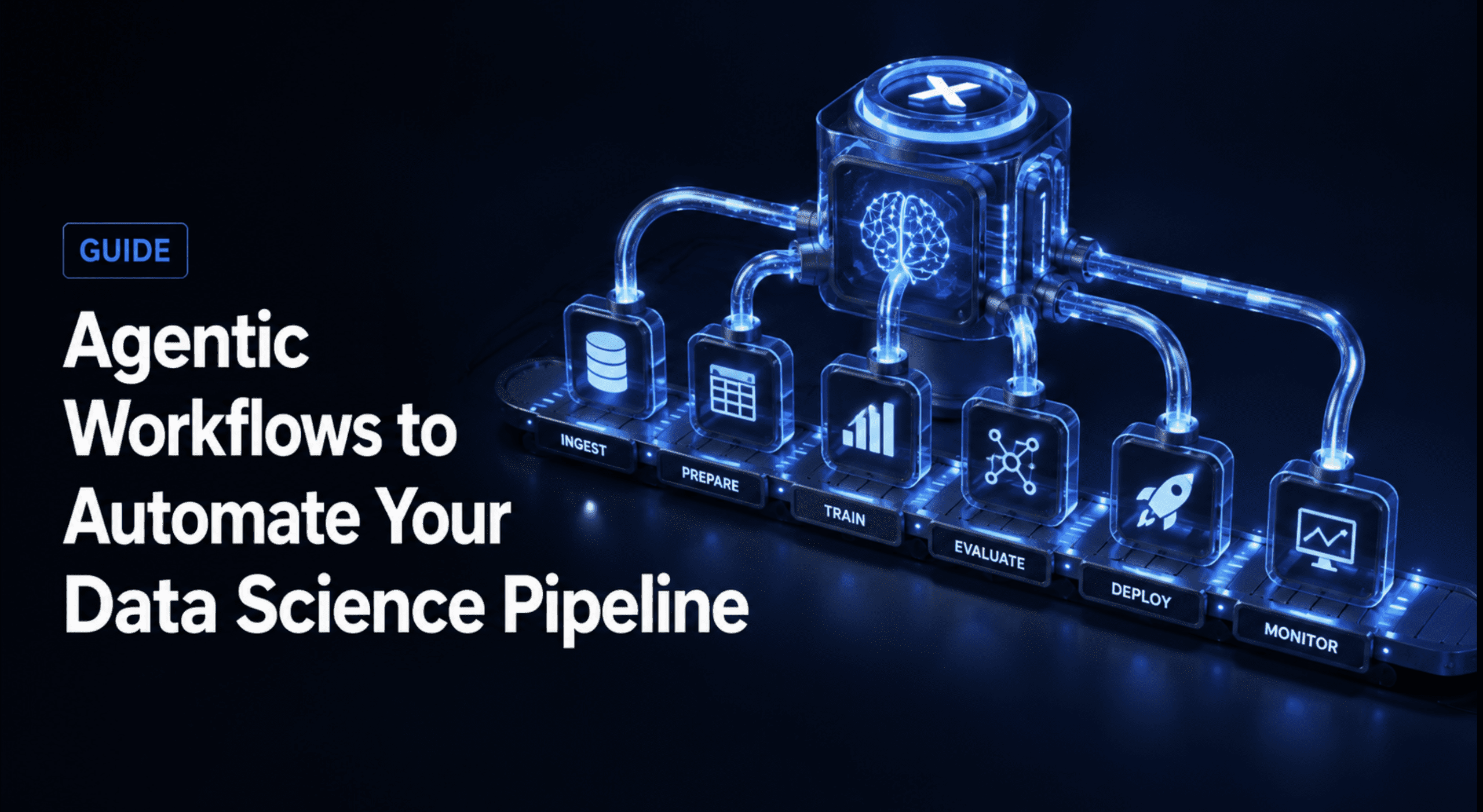
For data teams looking to implement these systems, the transition should be modular. The following five workflows represent the end-to-end lifecycle of a machine learning project, reimagined through the lens of agentic intelligence.
1. Automated Exploratory Data Analysis (EDA)
The first stage of any project is profiling. Traditionally, this involves manually writing scripts to compute summary statistics and visualize distributions. An EDA Agent uses a Reasoning and Acting (ReAct) loop to load data, perform statistical profiling, and classify issues by severity. Rather than providing a massive, unreadable data dump, the agent synthesizes findings into a structured Markdown report that highlights high-priority issues, such as extreme skew or data leakage, allowing the human lead to make an informed decision in minutes.
2. Feature Engineering and Selection
Brainstorming features and pruning non-contributory variables is arguably the most creative—and most time-consuming—aspect of modeling. The Agentic Feature Engineer proposes candidate features based on domain context, generates the transformation code, and evaluates them using LightGBM and SHAP (SHapley Additive exPlanations) values. The agent doesn’t just rank features; it explains the "why" behind them, such as identifying complex interactions that might otherwise go unnoticed.
3. Hyperparameter Optimization
Grid and random search are blunt instruments. An Agentic Hyperparameter Optimizer treats the tuning process as a reasoning task. By analyzing trial history, the agent learns which parameters drive performance and dynamically adjusts the search direction. Research indicates that LLM-guided search can outperform traditional Bayesian optimization on mid-sized tasks by 5–12% while using significantly fewer computational resources.
4. Continuous Model Monitoring and Drift Detection
Machine learning models degrade the moment they touch production data. An Agentic Monitor runs on a schedule, utilizing metrics like the Population Stability Index (PSI) and the Kolmogorov-Smirnov (KS) test to detect distribution shifts. The agent’s brilliance lies in its branching response: it ignores stable noise, flags mild drift for review, and, in cases of severe drift, autonomously triggers a retraining pipeline via REST APIs or CI/CD integration.
5. Self-Healing Pipeline Orchestration
When an Airflow or Prefect task fails at 2 a.m., the cost is measured in developer burnout and downtime. A Self-Healing Agent acts as a meta-layer over the orchestration stack. It parses stack traces, determines if an error is "auto-fixable" (such as a simple schema mismatch), applies a patch, and retriggers the task. If the error is complex, it generates a full incident report, sparing the on-call engineer from initial triage.
Supporting Data and Technical Architecture
These workflows are not purely theoretical; they rely on a robust technical foundation. To implement these, practitioners generally require:
- Core Stack: Python 3.10+, Pandas, Scikit-Learn, and LightGBM.
- Orchestration: Pydantic for schema validation, ensuring the LLM returns data structures that code can actually ingest.
- LLM Integration: Access to high-reasoning models (like GPT-4o) via API or local endpoints (Ollama/vLLM) to ensure the agent’s logic remains consistent.
The "reasoning" capability of these agents is gated by temperature settings. By keeping the temperature low (e.g., 0.1 to 0.2), agents provide the deterministic, structured output required for engineering production-grade systems.
Official Industry Perspectives
Leading industry figures have noted that the goal of these agents is not to remove the "human in the loop," but to change the nature of their participation. As organizations shift toward these workflows, the role of the data scientist is evolving into that of a "Systems Architect."
In an official capacity, teams at companies like Databricks have noted that compressing the "time to insight" is the primary competitive advantage for the next decade. By reducing the "procedural weight" of data science, organizations can scale their ML operations without linearly increasing their headcount, solving the persistent talent bottleneck in the AI sector.
The Implications for Data Science Teams
The implications of adopting agentic workflows are profound:
- Consistency: Agents don’t have bad days. They apply the same rigor to every dataset, preventing the "human error" that leads to inconsistent model performance across different business units.
- Scalability: A single data science team can maintain dozens of models simultaneously if agents handle the monitoring and maintenance, allowing for a broader deployment of AI across the enterprise.
- The Shift in Value: The "value" of a data scientist will no longer be measured by their ability to code a complex feature, but by their ability to evaluate the agent’s work. The human becomes the final judge of validity and ethics.
Conclusion: A New Division of Labor
The future of data science is a clear division of labor: agents handle the procedural weight, while humans retain the evaluative weight. By implementing these five workflows—EDA, Feature Engineering, Hyperparameter Optimization, Monitoring, and Self-Healing—teams can build pipelines that are not only faster but inherently more resilient.
Start by deploying the monitoring agent; it requires the least amount of change to your existing code but provides immediate, high-impact feedback. Once the "guardrails" are in place, the path to automating the rest of the pipeline becomes clearer. The era of the data scientist as a glorified data cleaner is coming to an end. In its place, we are seeing the rise of the data scientist as an architect of intelligent, self-sustaining systems.


 Azzam Bilal Chamdy
 Lina Irawan
 Ammar Sabilarrohman
 Reynand Wu
 Iffa Jayyana
 Sagoh
Sagoh
 Suro Senen