Azzam Bilal Chamdy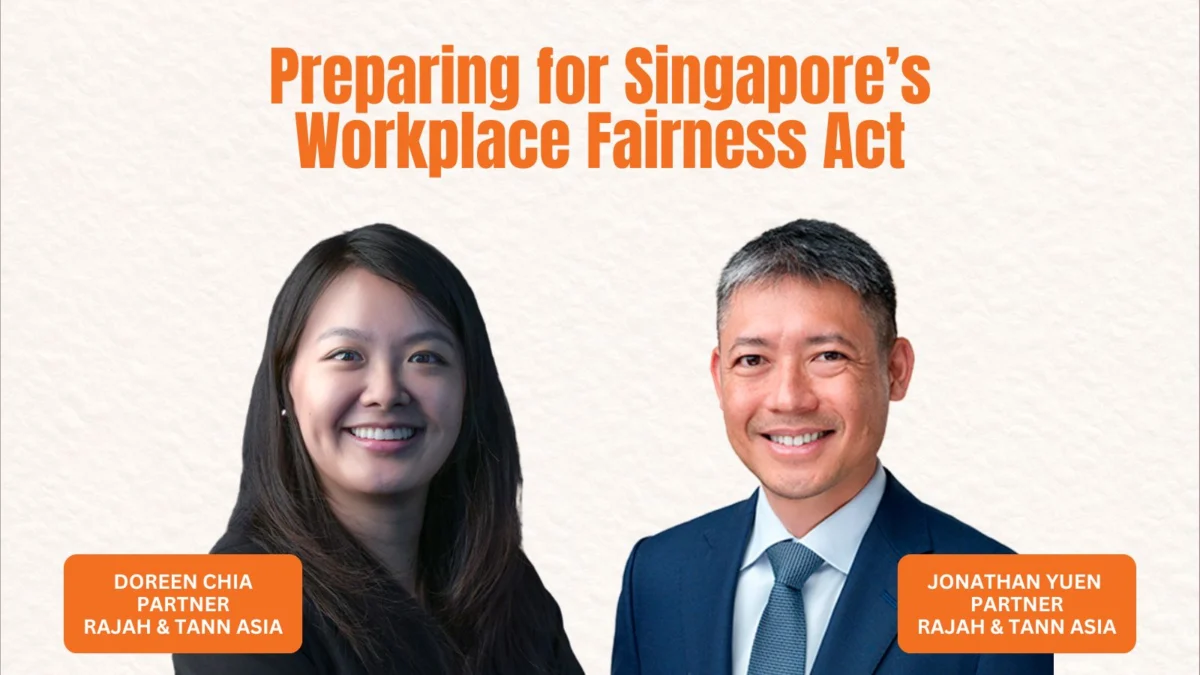
As Singapore prepares for a landmark shift in its employment landscape, the impending enactment of the Workplace Fairness Act (WFA) at the end of 2027 marks a definitive transition from advisory-led guidelines to statutory enforcement. For decades, the city-state has relied on the Tripartite Guidelines on Fair Employment Practices (TGFEP) to maintain social cohesion and meritocracy in the workplace. However, the introduction of the WFA signifies a hardening of these expectations into legal obligations, granting employees and jobseekers a formal, legislated pathway to seek redress for discrimination.
Legal experts Jonathan Yuen and Doreen Chia, Partners at Rajah & Tann Asia, emphasize that while the 2027 deadline may seem distant, the complexity of aligning internal HR ecosystems with the new law necessitates immediate action. Organizations are being urged to use this four-year window to overhaul their people practices, moving beyond "check-box" compliance toward a culture of documented, objective decision-making.
Main Facts: The Three Pillars of the WFA
The Workplace Fairness Act is built upon three fundamental pillars designed to ensure that merit remains the primary driver of employment in Singapore. These pillars expand the scope of liability for employers and introduce specific procedural requirements that were previously encouraged but not legally mandated.
1. Protection of 11 Defined Characteristics
The WFA prohibits employment decisions—ranging from recruitment and promotion to training and dismissal—based on 11 protected characteristics. These include:
- Demographics: Age, nationality, sex, marital status, and race.
- Social & Family: Pregnancy and caregiving responsibilities.
- Health & Beliefs: Religion, disability, and mental health conditions.
- Communication: Language ability.
Crucially, the law applies to the entire employment lifecycle. This means that a discriminatory job advertisement is as much a violation as a biased performance appraisal or an unfair dismissal based on an employee’s mental health status.
2. Tightening Foreign Work Pass Requirements
To reinforce the Fair Consideration Framework (FCF), the WFA mandates that employers must follow prescribed steps before applying for a foreign work pass. This includes advertising the role for a specific duration in a prescribed manner (typically via the MyCareersFuture portal) and demonstrating that all applicants were considered in good faith. The WFA gives the authorities sharper teeth to penalize those who bypass local talent without objective justification.
3. Mandated Grievance Handling Processes
Perhaps the most significant operational change is the requirement for every employer to establish a formal internal grievance handling process. Under the WFA, companies must:
- Inquire into and review grievances in a timely manner.
- Keep the complainant’s identity and the inquiry details confidential.
- Maintain written records of all reviews and outcomes.
- Communicate the outcome of the review to the employee in writing.
Chronology: The Evolution of Workplace Fairness in Singapore
The journey toward the WFA has been a decade-long evolution of Singapore’s labor policy, reflecting the maturing of its workforce and the increasing complexity of its social fabric.
- 2006: The Birth of TAFEP. The Tripartite Alliance for Fair & Progressive Employment Practices (TAFEP) was established to promote the adoption of fair practices via the Tripartite Guidelines on Fair Employment Practices (TGFEP). At this stage, compliance was largely voluntary, though non-compliance could lead to administrative penalties by the Ministry of Manpower (MOM).
- 2014: Introduction of the Fair Consideration Framework (FCF). To address concerns regarding the displacement of local professionals, the FCF was introduced, requiring employers to advertise vacancies to Singaporeans before hiring foreign professionals on Employment Passes.
- 2021: National Day Rally Announcement. Prime Minister Lee Hsien Loong announced that the government would enshrine the TGFEP into law, creating the Workplace Fairness Act to provide a more robust legal framework for tackling discrimination.
- 2023: Release of the Tripartite Committee Report. The committee released its final recommendations, detailing the scope of the protected characteristics and the proposed dispute resolution framework.
- 2027: Expected Commencement. The WFA is slated to take full effect, giving the legal system the power to adjudicate claims and award financial damages for workplace discrimination.
Supporting Data: The Cost of Non-Compliance
The WFA introduces a structured dispute resolution framework that emphasizes mediation but allows for significant financial penalties if cases reach adjudication.
The Financial Stakes
Under the proposed framework, claims for workplace fairness will follow a specific hierarchy:
- Internal Resolution: The first step must be the company’s internal grievance process.
- Mediation: If internal resolution fails, the claim moves to the Tripartite Alliance for Dispute Management (TADM).
- Adjudication: If mediation is unsuccessful, the claim is heard by the Employment Claims Tribunals (ECT).
For claims heard at the ECT, the maximum compensation limit is expected to be S$25,000 for non-union members and S$35,000 for union members. However, the WFA does not cap the potential for higher-value claims to be heard in the High Court, where damages could exceed S$250,000, particularly in cases involving high-earning executives or systemic discrimination that results in significant loss of career progression.
The Reach of the Law
The WFA is intended to cover all employers, though some exemptions may apply to very small firms (e.g., those with fewer than 25 employees) for a transitional period. This ensures that the vast majority of the Singaporean workforce—approximately 3.5 million people—will be protected under the new statute.
Official Responses and Expert Insights
Legal practitioners Jonathan Yuen and Doreen Chia highlight that the transition to the WFA requires a fundamental shift in management philosophy. Their analysis points to several "danger zones" where organizations frequently stumble.
Moving Beyond "Check-Box" Compliance
"It is a common misconception that the WFA only requires organisations to have written policies," the Rajah & Tann partners explain. They argue that a policy sitting in a digital drawer is useless if it is not followed on the ground. Many legal risks arise from "poorly documented decisions" where an employer might have a fair reason for a dismissal but fails to record the objective evidence, leaving them vulnerable to a claim of discrimination.
Challenging Unconscious Bias
The experts also warn against the "HR-only" trap. Compliance is not merely the responsibility of the Human Resources department; it rests on the shoulders of every line manager and supervisor.
"WFA issues may arise even when employees believe they are acting in good faith," Yuen and Chia note. Examples include assuming a mother cannot travel for work (caregiving discrimination) or assuming an older worker is uninterested in learning new software (age discrimination). Training must be disseminated throughout the entire corporate hierarchy to mitigate these risks.
The Role of TAFEP Post-2027
The Tripartite Alliance for Fair & Progressive Employment Practices (TAFEP) has clarified that the WFA is a "baseline," not an exhaustive list. While the WFA covers 11 specific characteristics, the TGFEP will continue to exist as a broader set of guidelines. This means that if an employer discriminates based on a characteristic not in the WFA (such as sexual orientation or political opinion), TAFEP can still take administrative action, even if a statutory claim cannot be filed under the WFA.
Implications: Preparing for the New Legal Reality
The implementation of the WFA will fundamentally change how businesses operate in Singapore. The "window of readiness" between now and late 2027 is a critical period for structural reform.
The Necessity of a WFA Readiness Audit
Organizations are advised to conduct a comprehensive audit of their full employment lifecycle. This includes:
- Recruitment: Reviewing job descriptions and interview scorecards to ensure they focus solely on competencies.
- Performance Management: Ensuring that appraisals are based on measurable KPIs rather than subjective "cultural fit" assessments that could mask bias.
- Promotion and Training: Auditing who is selected for high-potential programs to ensure parity across protected groups.
Documentation as a Shield
In a post-WFA world, documentation becomes the primary defense against litigation. Employers must be prepared to prove why a candidate was not hired or why an employee was passed over for promotion. If the records show a clear, merit-based rationale, the risk of a successful WFA claim is significantly reduced. Conversely, a lack of documentation will be interpreted as a lack of fairness.
Cultural Transformation
Ultimately, the WFA aims to move fairness from a "policy statement" to a "lived management practice." For the Singaporean labor market, this means a more inclusive environment where talent is utilized to its fullest potential regardless of personal background. For businesses, it means higher retention rates and a stronger employer brand, as fairness is a key driver of employee trust and engagement.
As Jonathan Yuen and Doreen Chia conclude, those who start their preparation early will not only avoid the legal pitfalls of the WFA but will also emerge as leaders in the regional race for talent. The end of 2027 may seem far away, but the cultural and procedural shifts required are vast, and the time to act is now.


 Lina Hope
 Reynand Wu
 Nila Kartika Wati
 Jia Lissa
 Basiran
 Sagoh
Sagoh