
 Dwi Wanna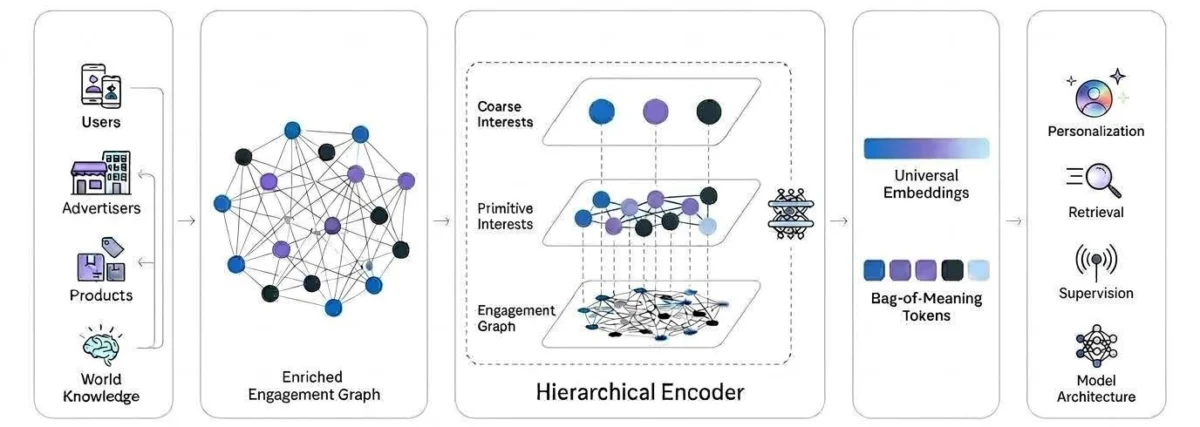
In the complex, high-stakes world of digital advertising, the ability to predict exactly what a user wants—before they even search for it—is the "holy grail" of machine learning. Meta, the parent company of Facebook and Instagram, has recently unveiled a sophisticated architectural leap known as Hierarchical Interest Representation. This upstream representation layer is designed to fundamentally overhaul how the platform connects billions of users with millions of advertisers, effectively solving the perennial industry struggle of "signal scarcity" in deep-funnel ad optimization.
By integrating multi-modal world knowledge with graph-structured engagement data, Meta’s engineers are building a system that doesn’t just track what a user clicked on, but understands the underlying "latent intent" behind that behavior.
The Core Facts: Bridging the Gap Between Intent and Discovery
At its heart, Hierarchical Interest Representation acts as a foundational "central brain" for Meta’s broader recommendation ecosystem. It is engineered to feed critical intelligence into Meta’s existing heavyweights: the Generative Ads Model (GEM), the Andromeda retrieval engine, and the Adaptive Ranking Model.
The fundamental challenge the system addresses is the "sparse connection" problem. While Meta’s network is one of the largest in existence, direct conversions—the "deep funnel" actions like purchasing a product—are relatively rare compared to the total volume of daily scrolls. When signals are scarce, traditional models often struggle to make accurate predictions. Hierarchical Interest Representation overcomes this by distilling massive, disparate engagement datasets into "unified interest clusters."
Instead of relying solely on sparse, intermittent clicks, the system creates a "super-graph" where user-ad relationships are mapped onto stable, learned interest primitives. This allows the system to maintain a high degree of relevance even when explicit user feedback is thin on the ground.
A Chronology of Innovation: From Engagement to Latent Reasoning
Meta’s journey toward this architecture is a reflection of the evolution of recommendation AI.
- Phase 1: Explicit Engagement. Historically, platforms relied on explicit feedback—likes, comments, and clicks. While effective, these signals are noisy and often fail to capture the "why" behind a user’s behavior.
- Phase 2: Graph-Structured Learning. As the scale of social platforms grew, Meta transitioned to graph-based modeling, where users and ads were treated as nodes in a massive network. However, the sheer size of these graphs created computational bottlenecks.
- Phase 3: Hierarchical Integration. The current era, marked by the rollout of Hierarchical Interest Representation, represents a paradigm shift. By moving away from flat representations and adopting a multi-layered hierarchical structure, Meta can now navigate between high-level, stable interest "anchors" and the granular, specialized signals of immediate intent.
This development is not an overnight occurrence but the result of years of iterating on memory-efficient attention kernels and high-performance learning algorithms capable of processing Meta’s graph at an unprecedented scale.

Supporting Data: Solving for Complexity
The technical sophistication of Hierarchical Interest Representation lies in its four primary design pillars:
1. Dimension Reduction and Super-Graphs
By projecting raw, messy interaction data into a "primitive interest graph," the system stabilizes the "vocabulary" of the ads business. What were once sparse, fleeting connections become dense, meaningful latent interest nodes. This stability allows the system to remain robust even as the dynamic nature of the ad market fluctuates.
2. Multimodal Knowledge Enrichment
The system goes beyond simple behavioral tracking. By integrating multimodal features—such as text, images, and videos from advertiser catalogs—the model gains a semantic understanding of what a product actually is. This means that even for new or niche products with limited historical engagement data, the system can infer relevance based on its "world knowledge."
3. Unified Relational Representation
Hierarchical Interest Representation operates in a single, unified metric space. This allows for complex "affinity" calculations. The system can determine the proximity of a user to specific interest primitives and map the relationships between different products and advertisers, essentially building a map of the entire digital marketplace.
4. Multi-Hierarchical Granularity
The system acknowledges that "interest" is not one-dimensional. It utilizes multiple hierarchical layers to balance the trade-off between stable, long-term interests (e.g., a love for outdoor gear) and fleeting, short-term intent (e.g., searching for a specific brand of hiking boots).
Technical Challenges: Navigating the Graph
The implementation of this architecture was met with three significant hurdles that define the current state of industrial AI:
- User Inferred Signal Dynamics: Balancing explicit feedback (like "Not interested" buttons) with inferred, subconscious signals remains a delicate act. The system must weigh these factors to ensure the user experience remains personalized without feeling intrusive.
- The Sparsity Trap: With millions of advertisers and billions of users, the "vocabulary" of potential interactions is massive. The system must condense this vast space into actionable intelligence without losing the nuance required for high-conversion deep-funnel ads.
- Long-Range Global Relationships: Capturing these relationships across a graph of this size is computationally expensive. Meta’s adoption of FlexAttention—a method that computes bias terms on the fly rather than materializing full matrices—has been crucial in maintaining memory efficiency without sacrificing model accuracy.
Official Perspective: The "Bag-of-Meaning" Approach
In the words of the research team, one of the most transformative elements of this project is the shift toward "Bag-of-Meaning" (BoM) tokens. While continuous embeddings are ideal for complex machine learning models, they are notoriously difficult to interpret or use for traditional inverted-index retrieval.
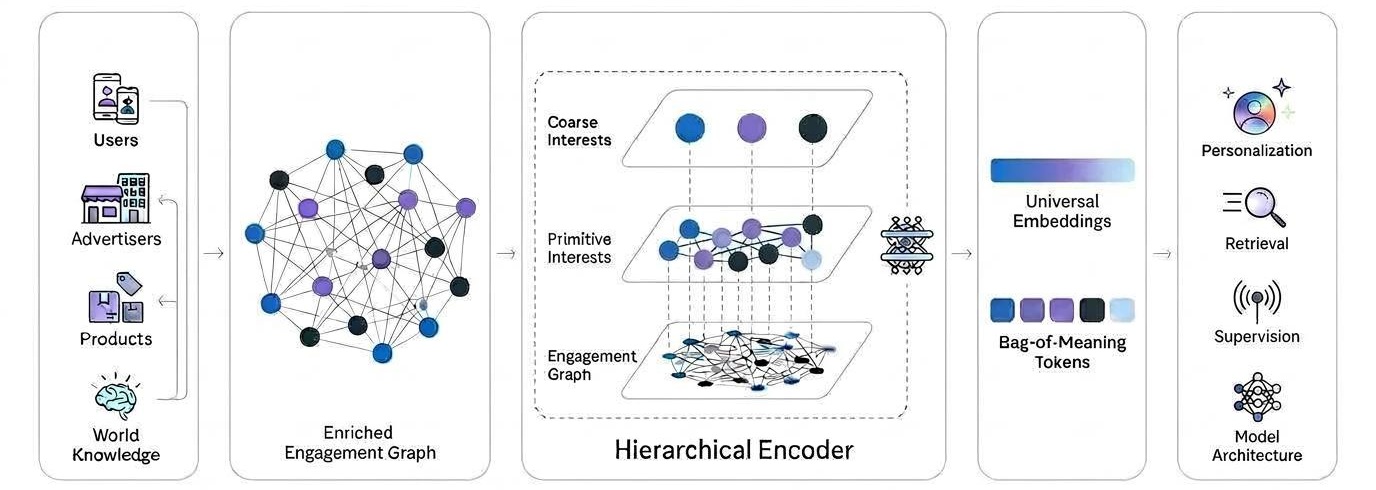
By discretizing these complex embeddings into a compact, unordered vocabulary of "meaning tokens," Meta has bridged the gap between raw AI output and practical, high-speed retrieval systems. This allows for a hybrid approach: the system can use deep, latent intelligence for ranking, while simultaneously utilizing BoM tokens for rapid, large-scale indexing.
Implications: The Future of Advertising
The implementation of Hierarchical Interest Representation carries significant implications for the future of digital advertising, both for the platform and the businesses that rely on it.
For Advertisers: Precision at Scale
The most immediate impact for businesses will be an improvement in "deep funnel" performance. By understanding the "latent" interests of users, Meta can place ads in front of the people most likely to convert, even if those users have not previously interacted with that specific brand. This reduces waste and increases the ROI of ad spend by ensuring that discovery-oriented ad experiences are grounded in a deep, semantic understanding of user intent.
For Meta: A Resilient Ecosystem
By decoupling the "interest primitives" from the dynamic, constantly changing landscape of specific ads, Meta has created a more resilient system. The model is less prone to "catastrophic forgetting" or performance drops when the ad catalog changes rapidly. Furthermore, the use of self-distillation—where a "teacher" model guides a "student" model—ensures that the system is constantly learning from its own successes, creating a virtuous cycle of performance gains.
The Path Forward
Looking ahead, Meta has indicated that its research will focus on "objective conditional fine-tuning." This suggests a future where the base representation layer could be fine-tuned for specific, niche objectives (such as high-value retail purchases versus brand awareness campaigns) without requiring a full retraining of the massive underlying model.
Furthermore, the emphasis on causality—ensuring that the model only learns from data available at the time of an event—marks a maturing of the field. By strictly enforcing temporal boundaries, Meta is moving away from "leakage-prone" models toward architectures that reflect real-world, causal human behavior.
Conclusion
Hierarchical Interest Representation is more than just an update to a recommendation algorithm; it is a fundamental redesign of how a digital platform interprets the human experience. By transforming raw, sparse engagement data into a structured, hierarchical map of latent interests, Meta is setting a new benchmark for how AI can navigate the vast, noisy, and rapidly changing landscape of the modern internet. As the system continues to scale and integrate deeper into Meta’s delivery stack, it promises to make the experience of digital discovery more relevant, more accurate, and ultimately, more human.


 Lina Hope
 Nila Kartika Wati
 Suro Senen
 Jia Lissa
 Evan Lee Salim

 Ali Ikhwan