
 Ali Ikhwan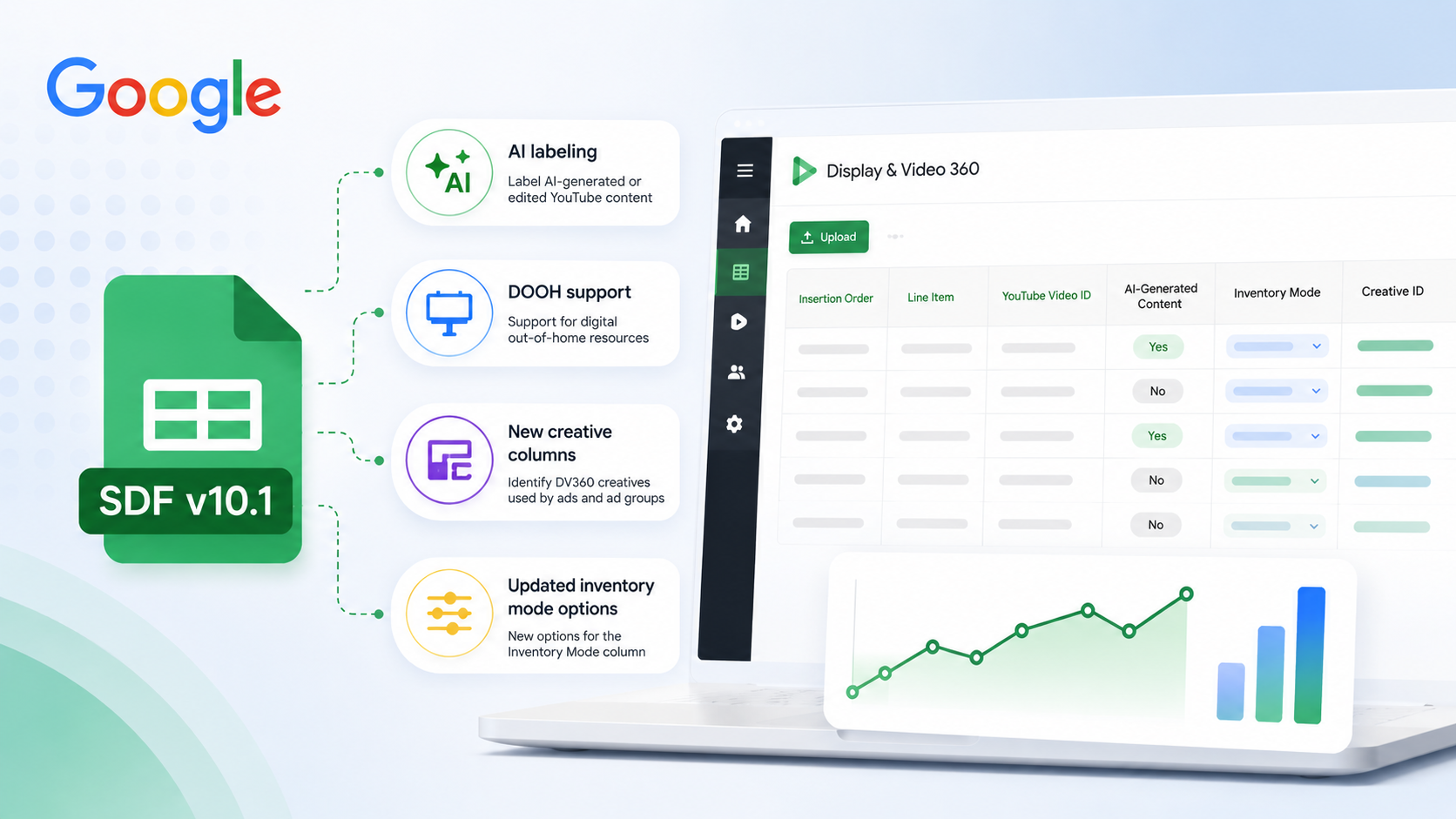
Google has officially rolled out Structured Data Files (SDF) v10.1 for Display & Video 360 (DV360), marking a significant evolution in how advertisers manage, audit, and scale their programmatic campaigns. This update introduces critical infrastructure support for AI-generated content labels and digital out-of-home (DOOH) advertising, while simultaneously formalizing the sunsetting of legacy SDF versions older than v10.
For enterprise-level marketing teams and programmatic developers, this transition is not merely a routine software update; it is a fundamental shift in how Google integrates transparency and emerging ad formats into its bulk-management ecosystem.
The Core Update: What’s New in SDF v10.1
The Structured Data Files system is the backbone of programmatic efficiency within DV360. By allowing users to upload and download campaign settings in bulk via CSV or structured files, it enables large-scale operations that would be impossible through the standard user interface. The move to v10.1 brings several high-impact features to this workflow:
1. AI Transparency Labeling
As Generative AI becomes an increasingly standard tool in creative production, the industry faces mounting pressure to ensure disclosure. SDF v10.1 introduces dedicated fields for AI transparency labels. This allows advertisers to systematically tag assets that have been created or altered by artificial intelligence. By incorporating this into the bulk-upload workflow, Google is streamlining the compliance process, ensuring that transparency is baked into the campaign setup rather than treated as an afterthought.
2. Digital Out-of-Home (DOOH) Integration
DOOH has long been a siloed segment of the advertising world. With v10.1, Google has moved to integrate DOOH management more deeply into the programmatic flow. Advertisers can now manage DOOH campaigns—a high-growth area for programmatic buyers—directly through their structured data workflows. This change allows for more precise control over bids, location targeting, and budget allocation for digital billboards and other place-based media.
3. Expanded Creative Mapping and Reporting
The update introduces new reporting fields that provide deeper granularity into creative performance and mapping. This is designed to reduce the "black box" nature of complex campaigns, giving developers and campaign managers better tools to audit how specific creatives are performing across different audience segments or inventory types.
Chronology: The Path to v10.1
The progression of the Structured Data Files reflects Google’s broader strategy of deprecating legacy technical debt to prioritize modern, scalable architecture.
- The Foundation: For years, SDF served as the primary interface for power users of DV360. As the platform grew in complexity, the need for a more robust, version-controlled API became evident.
- The v10 Milestone: The release of v10 marked a clean break from older, less efficient iterations. By setting v10 as the new baseline, Google effectively pushed the entire developer ecosystem toward a more consistent standard.
- The Current Transition: With the launch of v10.1, Google has confirmed that all versions prior to v10 are now officially deprecated. Developers are currently in a mandatory migration window, where legacy scripts and automation tools must be updated to maintain functionality within the DV360 environment.
Supporting Data and Technical Implications
For the uninitiated, the shift to a new version of SDF is not just a cosmetic change—it involves structural shifts in CSV schemas. When a version is deprecated, the data structures that the API or bulk upload tools expect change.
If a team continues to use an older version, they risk:
- Data Mismatches: Uploads may fail because the system no longer recognizes the headers or field formats of the deprecated version.
- Loss of Functionality: Newer features, such as the AI disclosure flags, will be unavailable to teams using legacy versions, potentially causing them to fall behind on compliance standards.
- Increased Error Rates: As the platform moves forward, legacy versions become increasingly prone to "silent failures," where the system accepts a file but fails to process it correctly due to backend architectural updates.
Google’s migration guide serves as the essential roadmap for these technical teams. It highlights specific changes in column headers, required fields for DOOH, and the syntax for AI labels. Industry analysts suggest that teams should allocate at least two to four weeks for regression testing of their internal scripts and middleware to ensure a seamless transition.

Official Responses and Industry Context
While Google has not released a singular "statement" outside of the technical release notes, the move is widely viewed by industry experts as a response to the "Transparency Mandate."
"As the digital advertising ecosystem matures, the focus has shifted from simple reach to brand safety and transparency," says Anu Adegbola, Paid Media Editor at Search Engine Land. "By integrating AI labeling directly into the bulk management tools, Google is signaling that it wants to lead the charge on creative accountability. If you are a brand using AI in your creative process, these tags are going to be your new best friend—or your biggest headache if you don’t incorporate them into your workflow."
Furthermore, the expansion into DOOH is a clear signal that Google views physical-world digital inventory as a critical pillar of its future growth. By bringing DOOH into the same bulk-management framework as traditional display and video, Google is making it easier for large agencies to consolidate their omnichannel buys under a single roof.
Implications for Advertisers and Developers
The implications of this update extend beyond simple technical maintenance. There are three key areas where advertisers and developers will feel the impact:
1. Operational Efficiency
Teams that manage thousands of line items across multiple regions will see the most benefit. The ability to manage DOOH and AI labels in bulk means that a campaign manager can update hundreds of assets across different formats simultaneously. This reduces manual labor and lowers the risk of human error, which is crucial when operating at scale.
2. Compliance and Brand Safety
The inclusion of AI transparency labels is not just a feature—it is a preparation for a future where creative disclosure may be legally mandated in various jurisdictions. By adopting these fields early, advertisers are "future-proofing" their accounts against regulatory changes.
3. Workflow Harmonization
For developers, the deprecation of pre-v10 versions is a nudge to clean up their internal tech stacks. Many agencies operate on legacy automation scripts that have been patched over for years. This forced migration is an opportunity to audit these scripts, improve their performance, and align them with the latest best practices for programmatic management.
The Bottom Line: Adapting to the New Standard
The release of SDF v10.1 is a quintessential example of how Google balances innovation with platform stability. By introducing advanced features like AI labeling and DOOH support, Google is evolving with the market. By deprecating older versions, it is ensuring that the platform remains fast, secure, and reliable.
What should your team do now?
- Review the Documentation: Consult the official Google developer blog and migration guide immediately.
- Audit Current Scripts: Identify which of your automation tools or middleware services are currently hitting older SDF endpoints.
- Plan the Migration: Schedule a testing window for your developers to ensure that the new schema for v10.1 does not break your existing automation.
- Adopt the New Fields: Start integrating AI labeling into your creative production workflow now, even if it is not yet a hard requirement for all your campaigns. Early adoption will save you from a last-minute scramble if and when disclosure requirements become mandatory.
As the programmatic landscape grows more complex, the tools we use to manage that complexity must also evolve. SDF v10.1 is the latest step in that evolution, reinforcing the necessity of staying agile in an increasingly automated advertising world. Whether you are a brand advertiser looking to optimize your DOOH spend or a developer managing thousands of line items, the message is clear: upgrade now, or risk being left behind by the pace of programmatic innovation.


 Pevita Pearce
 Reynand Wu
 Ammar Sabilarrohman
 Suro Senen
 Jia Lissa
 Evan Lee Salim