
 Basiran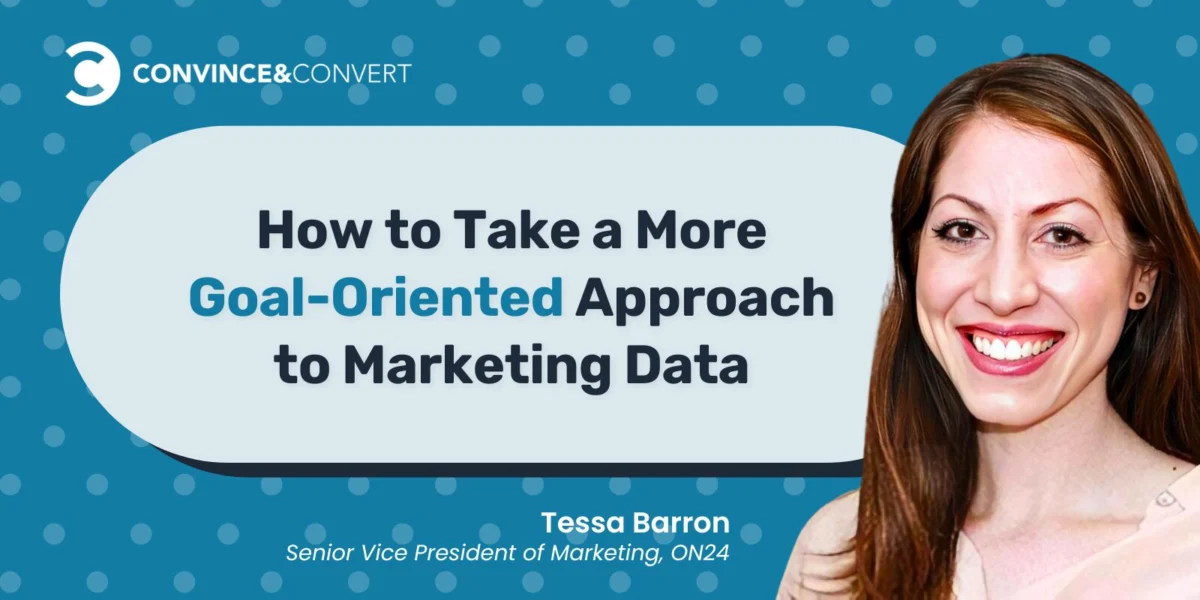
In the modern marketing landscape, the phrase "do more with less" has become a source of professional fatigue. For many, it feels like a paradoxical mandate: budgets are shrinking, resources are being pruned, yet pipeline targets continue to climb. For years, the industry’s knee-jerk reaction has been to double down on volume—more webinars, more whitepapers, more emails, and more noise.
However, Tessa Barron, the former Senior Vice President of Marketing at ON24, argues that the solution is not to do more, but to fundamentally change the nature of the work. By shifting from a tactic-oriented mindset to a goal-oriented one, marketers can stop chasing activity and start driving outcomes. In a recent appearance on the Data-Driven Decisions podcast, Barron unveiled a framework for aligning specific marketing actions with high-impact revenue targets.
The Evolution of the Marketing Mindset
The post-pandemic economy has permanently altered buyer behavior, yet many marketing departments remain anchored in 2019 execution models. Barron posits that if a marketing team is still executing the same playbook they used four years ago, they are effectively betting on diminishing returns.
"We as marketers have to check in with ourselves and say, ‘Have we changed? Are we still doing what we were doing three years ago?’" Barron explains. "If the answer is yes, that is the first sign that we need to stop expecting that if we execute the same way, we’re going to get more in return."
The trap, according to Barron, is starting with the tactic. A team might decide to host four webinars in Q1 simply because they did four in the previous quarter. This is "tactic-first" thinking. A "goal-first" approach begins with a specific business objective—such as a 10% uplift in pipeline or reaching a set number of target accounts—and then identifies the tactics necessary to achieve that specific outcome.
Chronology of a Data-Driven Shift
To transition from a legacy model to a high-conversion strategy, teams must undergo a three-stage transformation:
- Objective Setting: Instead of planning content calendars, teams define the "conversion gap." For example, if the goal is to increase first-meeting conversion rates by 10%, the marketing team must identify the specific friction points preventing that transition.
- Signal Identification: Marketers often suffer from "data obesity"—having too much information and not enough insight. Barron suggests moving away from vanity metrics and focusing on "signals"—the behavioral markers that indicate a buyer is primed to move to the next stage.
- Strategic Capture: Once the signals are identified, the marketing team designs interactions (webinars, polls, or Q&A sessions) specifically to "trap" or harvest that data.
Supporting Data: Turning Engagement into Intelligence
The power of this framework lies in the ability to convert passive content consumption into actionable intelligence. Barron points to two distinct case studies from the ON24 ecosystem that illustrate how strategic data capture impacts the bottom line.
Case Study A: The Technology Sector
A tech company struggling to regain market share identified that their most profitable clients were those utilizing a specific cloud provider. The conversion rate for these prospects was 10 times higher than for those using other infrastructure.
Instead of broad-spectrum lead generation, the marketing team integrated a simple, targeted question into their webinar registration and live interaction flows: "What cloud provider are you currently using?" By identifying these high-intent prospects in real-time, the sales team was able to prioritize outreach to the segments most likely to convert, effectively bypassing lower-quality leads.
Case Study B: The Pharmaceutical Sector
In the pharmaceutical industry, the challenge was to identify which doctors were treating patients with the highest clinical needs. By hosting educational sessions on breakthrough drug therapies, the company included a diagnostic question: "How would you rate the risk of your patient base: High, medium, or low?"
Doctors who flagged their patient base as "high-risk" provided an immediate, quantifiable signal that they required urgent follow-up. This data allowed the company to move from a "one-size-fits-all" communication style to a highly personalized, needs-based engagement strategy.
Aligning with the Front Lines: The Sales-Marketing Nexus
One of the most critical elements of Barron’s framework is the radical alignment with sales teams. Too often, marketing departments design their data collection based on what they think makes content good, rather than what makes a lead qualified.
"Salespeople sit at the front lines of the prospect’s communication with a company," Barron notes. "They can tell you much more about the client’s needs, their hesitations, their doubts, and their expectations—insights that should inform every piece of marketing material you produce."
Barron emphasizes that while marketers develop the "net" to catch prospects, it is the sales team that actually creates the pipeline. The role of the marketer is to provide the salesperson with a "clear picture" of the prospect before the first call is even placed. By sitting down with sales leadership to determine exactly which questions qualify a lead, marketing can stop acting as a silo and start acting as a pipeline-acceleration engine.
Implications for Organizational Success
The shift toward a goal-oriented model has profound implications for how marketing departments communicate with C-suite stakeholders. In an environment where every dollar is scrutinized, the ability to present data in a clear, linear fashion—linking a specific tactic to a specific conversion milestone—is invaluable.
Eliminating the Noise
For many, the biggest hurdle is "noisy data." To combat this, Barron advocates for a simplified reporting structure. Stakeholders do not need to see every open rate or click-through metric; they need to see if the strategy is moving the needle on the core goal. If the goal is a 10% pipeline increase, the report should focus exclusively on the conversion rates and behavioral signals that directly correlate with that objective.
Optimizing the "In-Between"
Barron highlights that many marketing teams focus on the "top" of the funnel (brand awareness) or the "bottom" (sales closing), while ignoring the critical space in between. These "in-between" stages—where a lead becomes a qualified opportunity—are often where outdated lead forms, generic messaging, or lack of nurturing causes the pipeline to leak.
By applying the framework of "identifying the gap, capturing the signal, and aligning with sales," organizations can:
- Reduce Friction: Shorten lead forms and improve user experience based on actual prospect behavior.
- Enhance Personalization: Use signals to tailor messaging, ensuring that content is relevant to the prospect’s specific pain points.
- Increase Efficiency: By focusing on high-intent prospects, the sales team spends less time on cold leads and more time on high-probability opportunities.
Conclusion: A New Era of Intentionality
The "do more with less" mandate is not a call for exhaustion; it is a call for precision. By moving away from the "tactic-first" mentality that has plagued the industry for years, marketers can reclaim their role as primary drivers of revenue.
As Tessa Barron illustrates, when data is no longer treated as a collection of vanity metrics but as a tool for uncovering buyer intent, the entire organization benefits. Marketing becomes more than just a support function—it becomes a strategic partner to sales, a navigator of buyer journeys, and a disciplined engine for sustainable growth.
For those looking to refine their approach, the mandate is clear: Stop asking how to do more, and start asking which signals matter most. In the current economic climate, the winners will not be those who make the most noise, but those who best understand the signals of their audience.
For more deep dives into the strategies mentioned in this article, you can listen to the full episode of the Data-Driven Decisions podcast here.


 Pevita Pearce
 Reynand Wu
 Lina Irawan
 Ammar Sabilarrohman
 Nana Wu

 Suro Senen
 Jia Lissa