
 Ammar Sabilarrohman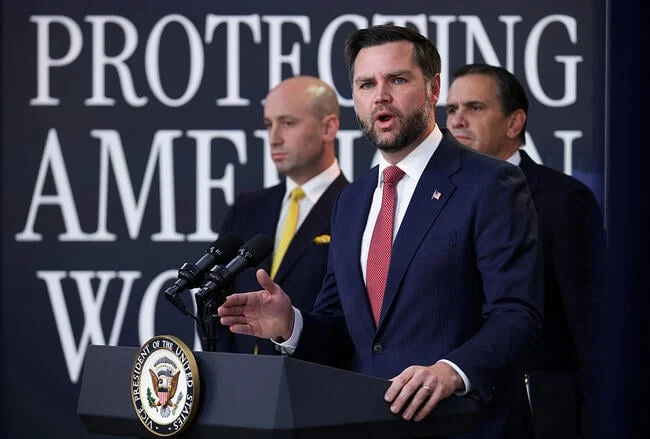
By Editorial Staff
In a major escalation of federal oversight into higher education, the Department of Labor has initiated a sweeping investigation into nine of the nation’s most prestigious universities regarding their alleged abuse of the J-1 visa program. Vice President JD Vance, who chairs the administration’s Task Force to Eliminate Fraud, announced the investigation on Thursday, signaling a robust shift in how the federal government monitors the employment of international scholars and researchers on American campuses.
The probe, described by officials as a "historic" effort to ensure the integrity of federal research funding, centers on the assertion that these institutions are systematically utilizing J-1 visa holders to suppress wages for American graduate students and researchers.
The Core Allegations: "Something Weird is Going On"
At a press conference held Thursday, Vice President Vance took aim at a group of elite institutions, accusing them of prioritizing lower-cost foreign labor over the domestic workforce. The institutions named in the probe include Arizona State University, Brown University, Harvard University, Yale University, Stanford University, the California Institute of Technology (Caltech), the Massachusetts Institute of Technology (MIT), the University of California, Davis, and the University of Pittsburgh.
"Something weird is going on at these universities," Vance stated, pointing to internal data analyzed by the administration. According to the Vice President, these institutions employ J-1 visa holders for federally funded grant positions at a rate of approximately 61 percent, far exceeding the national average of 38 percent.
The J-1 visa program, designed to facilitate cultural and educational exchange, allows noncitizens to teach, lecture, conduct research, or receive graduate medical education. However, Vance argued that the program has been repurposed by academia as a tool for cost-cutting. "They’re using these visas way too much," Vance asserted. "They’re using them to undercut the wages of American grad students and American researchers."
The administration contends that, on average, American graduate students and researchers earn approximately $20,000 more annually than their counterparts on J-1 visas. By relying heavily on international talent, the government alleges that these universities are effectively depressing the market value of domestic scientific labor.
Chronology of the Investigation
The investigation represents the culmination of months of scrutiny by the administration’s fraud task force.
- March 2026: The White House officially established the Task Force to Eliminate Fraud, with Vice President Vance appointed as its chair. The task force was given a broad mandate to investigate systemic abuses of federal grant money and immigration programs.
- Early-to-Mid 2026: Investigators within the Department of Labor and the Office of the Inspector General began analyzing payroll data and grant disbursement records from top-tier research universities. Patterns emerged suggesting a significant statistical outlier in the hiring of J-1 visa holders for federally funded research projects.
- Late 2026: After identifying the nine specific institutions as outliers, the Department of Labor moved to formalize the inquiry.
- Thursday, October 2026: The investigation went public. Department of Labor Inspector General Anthony D’Esposito announced that formal subpoenas had been served to the institutions in question, demanding transparency regarding their foreign labor programs and financial records.
Supporting Data and the "Follow the Money" Approach
Inspector General Anthony D’Esposito, a former NYPD detective, framed the investigation as an aggressive pursuit of accountability. During the press conference, D’Esposito emphasized that the government intends to "follow the money and uncover the schemes" that may be compromising the nation’s research ecosystem.
The core of the government’s concern is the nexus between taxpayer-funded federal grants and the labor practices of the universities receiving them. D’Esposito stated that the inquiry will examine whether "foreign influence, improper financial relationships, or visa abuse" are currently undermining the integrity of U.S.-funded innovation. While he specifically alluded to national security concerns regarding China, he stressed that the investigation is fundamentally about the economic rights of American taxpayers and workers.
"I don’t care how prestigious a university thinks it is," D’Esposito said, adopting a combative tone. "Break the law and screw the American people, and I will personally cuff you in the university square. I don’t care how large your endowment is, how powerful your alumni are or how many politicians you have on speed dial."

University Responses: Defending International Talent
The reaction from the higher education sector was swift and largely defensive. Spokespersons for the universities named in the probe expressed a commitment to compliance while simultaneously highlighting the vital role international scholars play in American research.
Institutional Defenses
Brown University was among the first to address the subpoena, noting that its international scholars are essential to the university’s mission. "Brown’s international scholars, students and employees make essential contributions on our campus, including to teaching and research that advances American innovation, competitiveness and economic vitality," a spokesperson stated. The university confirmed it would respond to the subpoena promptly.
Arizona State University (ASU), which maintains one of the largest scientific workforces in the country, emphasized its commitment to STEM education. An ASU representative noted that the university’s hiring practices are in "complete compliance with existing United States policy and law" and argued that the talent they attract benefits both the state and the national economy.
MIT officials expressed skepticism regarding the scope of the government’s actions. Kimberly Allen, the executive director of media relations at MIT, described the subpoena as "very broad" and reminded the public that J-1 visa holders are vetted by the U.S. government before their arrival. She cautioned against policies that might stifle the global nature of scientific collaboration. "America’s ability to attract top talent from around the world while protecting U.S. economic and security interests is a national strength, and that competitive advantage should be supported," Allen said.
Stanford University echoed these sentiments, confirming their intention to cooperate with the investigation while maintaining that they adhere to all applicable visa and labor laws.
Implications for Higher Education and Federal Policy
The investigation marks a turning point in the relationship between the federal government and elite research institutions. Several significant implications have emerged:
1. Reevaluation of Federal Research Grants
The investigation suggests that the administration may be moving toward stricter conditions on how federal research dollars are spent. If universities are found to be using J-1 visas to artificially lower labor costs, the government could impose new regulations on grant recipients, requiring them to demonstrate that they are prioritizing domestic hiring or matching wage standards for all employees regardless of visa status.
2. Heightened Scrutiny of Foreign Influence
The mention of foreign influence by the Inspector General indicates that the administration is viewing university research through a national security lens. This aligns with a broader trend of increased oversight into academic partnerships with foreign nations, particularly those involving sensitive technological and scientific fields.
3. The Future of the J-1 Program
The J-1 visa, a cornerstone of international academic exchange for decades, now faces a precarious future. If the administration succeeds in framing the program as a vehicle for wage suppression, it could lead to significant legislative or regulatory changes, potentially limiting the number of J-1 slots available for university researchers or increasing the regulatory burden on institutions that sponsor them.
4. A Chilling Effect on Global Collaboration
University administrators have expressed concern that the aggressive tone of the investigation could damage the United States’ reputation as a global hub for academic talent. If top-tier international scholars feel unwelcome or subject to undue bureaucratic scrutiny, they may choose to pursue research opportunities in competing nations like Canada, Germany, or the United Kingdom, potentially weakening the long-term competitive edge of U.S. research institutions.
As the Department of Labor continues its review of the documents provided under subpoena, the academic community remains on high alert. The outcome of this investigation will likely set a major precedent for how federal law and academic employment intersect in the coming years. For now, the administration has signaled that it is prepared to challenge the long-standing norms of university hiring, regardless of the institutional status of those in its crosshairs.

 Sagoh
Sagoh
 Jia Lissa
 Laily UPN
 Iffa Jayyana
 Rifan Muazin
 Suro Senen
 Lina Hope
 Lina Irawan