
 Sagoh
Sagoh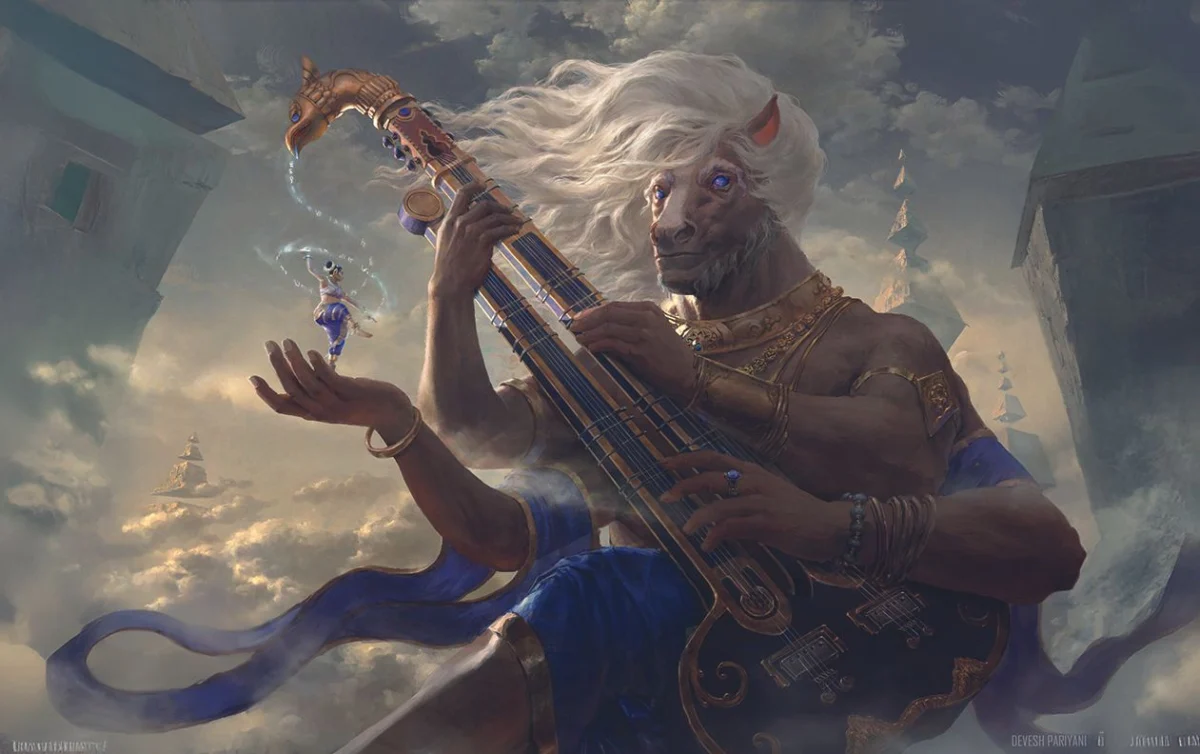
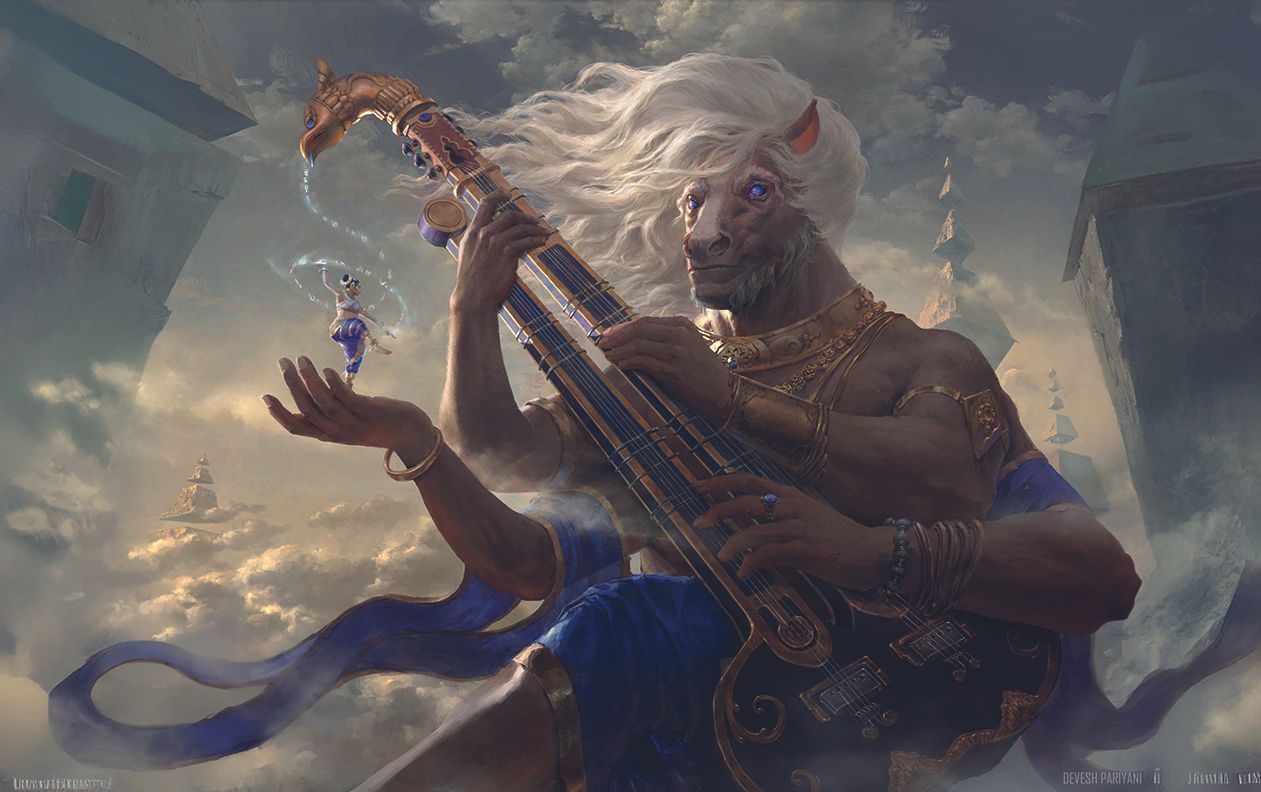
In the evolving landscape of digital illustration, few artists successfully bridge the chasm between ancient spiritual iconography and contemporary cinematic aesthetics. The latest work, Sangam, offers a breathtaking exploration of this synthesis. By re-imagining the divine union between a Gandharva—the celestial musician—and an Apsara—the celestial dancer—the piece serves as a masterclass in visual storytelling, blending historical reverence with cutting-edge technical precision.
The artwork centers on a Gandharva, depicted with a striking fusion of traditional equine features and a four-armed human anatomy. This creature serves as both a celestial guardian and the physical foundation for the Apsara’s performance, interacting with a massive, veena-inspired instrument that functions as a stage. The composition is not merely a static image; it is a rhythmic, visual manifestation of the celestial realms of Svarga, executed with a scale that demands the viewer’s undivided attention.
The Genesis of a Mythic Vision
The project began as an intellectual challenge: how to breathe new life into millennia-old mythology while maintaining the integrity of its source material. The artist’s primary goal was to create a harmonious blend of classical Indian iconography—characterized by intricate bird-headed carvings and celestial architecture—with the modern capabilities of 3D rendering and digital painting.
Phase 01: Research and Conceptualization
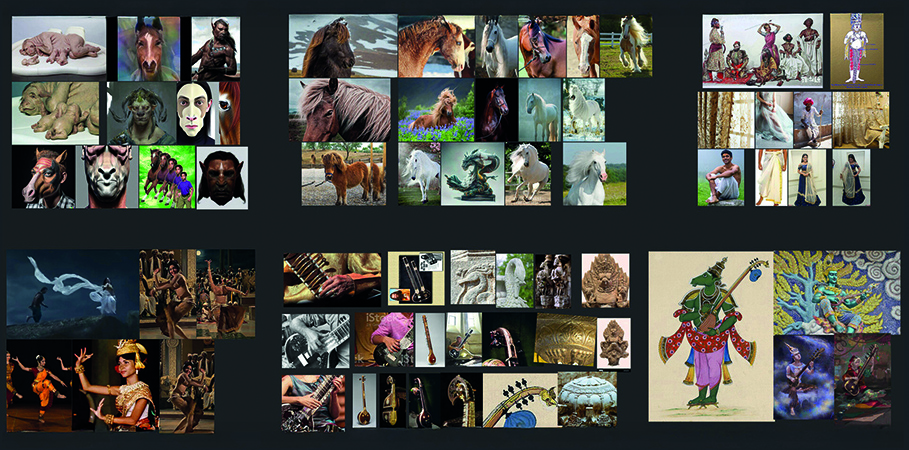
The foundation of Sangam was built upon rigorous academic and aesthetic research. Before a single stroke was rendered, the artist compiled an extensive mood board. This phase was critical for solving the anatomical puzzle of morphing a horse’s distinct facial structure into a human-like form without losing the "divine" quality of the subject.
Key areas of focus included:
- Anatomical Realism: Studying structural muscle fibers to ensure the four-armed anatomy looked functional and organic.
- Materiality: Investigating hair translucency and the way light interacts with traditional Indian silk and gold jewelry.
- Cultural Authenticity: Analyzing classical Indian dance poses (Mudras) to ensure the Apsara’s movement felt authentic and spiritually grounded.
By grounding these fantasy elements in physical reality, the artist ensured that the viewer would perceive the celestial subjects not as mere caricatures, but as beings existing within a coherent, tangible world.
The Technical Workflow: From 3D Blockout to Digital Canvas
The transition from a conceptual sketch to a fully realized digital painting is a multi-stage process that requires a delicate balance of technical software proficiency and traditional artistic intuition.
Phase 02: The 3D Blockout and Value Sketch
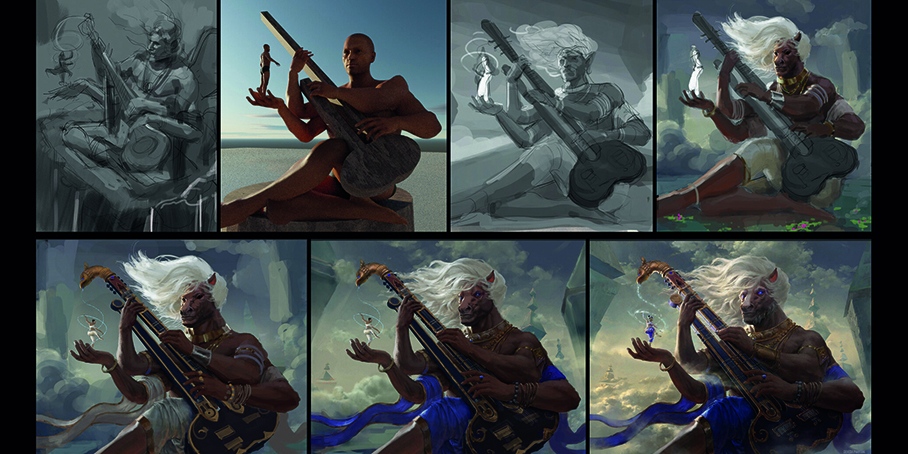
The complexity of the composition, particularly the multi-armed perspective and the sheer scale of the veena-instrument, necessitated the use of 3D modeling software. Using Blender, the artist created a "blockout"—a structural foundation that acts as a blueprint for the final painting. This stage is vital for managing complex perspectives and ensuring that the spatial relationship between the Gandharva and the Apsara remains logically consistent.
Once the 3D geometry was established, the work moved into Adobe Photoshop for the "value sketch" phase. By focusing solely on black, white, and grey, the artist established the cinematic lighting of the piece. This is where the concept of "broken edges" was introduced—a technique used to soften the harsh, perfect lines produced by 3D software, giving the final piece a more organic, painterly quality that invites the viewer to look deeper into the shadows and highlights.
Phase 03: Final Colour and Refinement
The final stage is where the "celestial" atmosphere is truly born. The artist applied subtle colour glazes, building up the richness of the gold and the vibrancy of the silks. To achieve the ethereal glow surrounding the Apsara, the artist employed custom brushwork, carefully layering light effects to ensure they felt integrated into the scene rather than overlaid on top.
Sharp specular highlights were the final piece of the puzzle. By meticulously placing these glints on the character’s jewelry and the instrument’s strings, the artist successfully separated the characters from the atmospheric background. This contrast creates a sense of depth, pulling the subjects forward and making them feel as though they are physically occupying the space of the canvas.
Implications for Digital Art and Cultural Representation
The success of Sangam lies not just in its visual splendor, but in its respectful handling of cultural mythology. In an era where digital art is often criticized for becoming derivative or overly reliant on automated tools, this work serves as a reminder of the value of intentional research.
Bridging Cultures through Technology
The implications of this methodology are significant for digital creators. By utilizing tools like Blender for structural integrity and Photoshop for stylistic flair, the artist has demonstrated a pathway for modern creators to handle sensitive cultural subjects with gravity and respect. The focus on "grounding" fantasy in reality suggests that the future of mythological art lies in the marriage of historical scholarship and high-fidelity rendering.
Furthermore, the work challenges the standard "westernized" aesthetic often found in digital fantasy art. By centering Indian iconography, the artist expands the visual lexicon of the medium, proving that global mythology offers an inexhaustible well of inspiration for digital artists.
Official Perspectives and Industry Reception
Industry critics and peers have noted the technical achievement of Sangam. The ability to render the "four-armed anatomy" in a way that feels natural, rather than cluttered, is a testament to the artist’s mastery of composition.
"The interplay between the horse-like features and the human anatomy is remarkably fluid," says one digital arts commentator. "Usually, such hybrid characters feel discordant, but here, the anatomy is treated with such anatomical sincerity that it feels like a biological reality rather than a fantasy construct."
The work has also been praised for its lighting strategy. By utilizing the veena as a central light-emitting source, the artist anchors the narrative within the instrument itself, creating a cohesive storytelling loop where the music (the instrument) and the dancer (the Apsara) are inextricably linked.
Conclusion: The Future of Mythological Digital Art
Sangam represents a pivotal moment in the intersection of tradition and technology. It proves that digital artists do not have to choose between historical accuracy and creative freedom; rather, the two can coexist to create something that feels both ancient and entirely new.
For aspiring digital artists, the takeaway is clear: the tools (Blender, Photoshop, etc.) are merely vehicles. The soul of the work is found in the research, the anatomical studies, and the respect for the cultural narratives being depicted. As digital art continues to mature, we can expect to see more creators following this blueprint, moving away from generic fantasy tropes and toward a more nuanced, research-driven approach to world-building.
Whether you are a seasoned professional or a student of digital art, Sangam provides a roadmap for how to tackle large-scale projects with patience, precision, and a profound respect for the stories that have shaped our human history.
This article originally appeared in ImagineFX. For more in-depth tutorials, industry insights, and showcases of world-class digital art, consider subscribing to ImagineFX magazine. Print and digital subscriptions are available, offering exclusive access to content from the brightest minds in the design and illustration world.
Creative Bloq is committed to providing creators with the best tools and inspiration. Download our official app on the iOS App Store or Google Play Store to access our latest tutorials, design news, and creative inspiration on the go. For those looking to master the software techniques mentioned in this piece, explore our comprehensive collection of Photoshop and 3D modeling tutorials available on our website.



 Asep Darmawan
 Raul Delapena Setiawan
 Reynand Wu


 Azzam Bilal Chamdy
 Ali Ikhwan