Nila Kartika Wati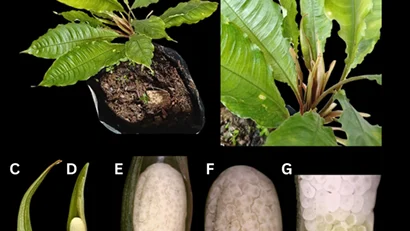
JAKARTA, Indonesia – In a testament to Indonesia’s unparalleled biodiversity, a team of dedicated researchers has unveiled a previously unknown species of taro-like plant (Araceae) deep within the lush, biodiverse forests of West Kalimantan. Named Tweeddalea capsiciformis, this diminutive botanical marvel, characterized by its distinctive chili-shaped flower spathe, represents the 15th member of the Tweeddalea genus, a group entirely endemic to the island of Borneo.
The groundbreaking discovery is the result of a collaborative effort involving the School of Life Sciences and Technology (SITH) at the Bandung Institute of Technology (ITB), the National Research and Innovation Agency (BRIN), and the private botanical institution, Jungle Farm Nursery. This inter-institutional partnership underscores the critical role of joint scientific endeavors in exploring and documenting the archipelago’s vast natural heritage, much of which remains uncharted.
The new species’ name, capsiciformis, is derived from "Capsicum," the genus name for chili peppers, a nod to the plant’s unique floral structure. Its spathe, a leaf-like sheath enclosing the flower, curves and tapers in a striking resemblance to a chili fruit, immediately distinguishing it from its known relatives. This intriguing morphology not only captivates the eye but also offers valuable insights into the evolutionary pathways within the Araceae family.
Despite the excitement surrounding its discovery, Tweeddalea capsiciformis has already been classified as ‘Data Deficient’ (DD) by the International Union for Conservation of Nature (IUCN). This preliminary conservation status highlights an immediate concern: the plant has, to date, only been found in a single, specific location within West Kalimantan. This limited known distribution underscores the urgent need for further extensive field surveys to ascertain its true population size and geographical spread, before it potentially faces threats even before being fully understood.
Unearthing the Unknown: A Chronology of Discovery
The journey to formally recognize Tweeddalea capsiciformis began with an intrepid field expedition led by Ade Agus Setiawan. It was in the remote village of Manggala, nestled within the Pinoh Selatan District of Melawi Regency, West Kalimantan, that Setiawan first encountered the peculiar plant. The dense, humid lowland forest environment, typical of Borneo’s interior, provided the perfect habitat for this elusive species.
Setiawan’s initial observation of the plant, standing a mere 19 centimeters tall, immediately piqued the interest of the research team. Its compact size, coupled with morphological characteristics that did not align perfectly with known species, suggested a potential new discovery. The initial assessment tentatively linked the specimen to the genus Ibania, another group of Araceae known to inhabit similar regions. However, this preliminary identification was merely a starting point for rigorous scientific validation.
The crucial next phase unfolded in the hallowed halls of the Herbarium Bandungense at ITB, a vital repository for botanical specimens and a hub for taxonomic research in Indonesia. Here, under the meticulous guidance of Arifin SD Irsyam, Curator of Herbarium Bandungense ITB, and Muhammad R Hariri, a dedicated researcher from BRIN, the specimen underwent a comprehensive morphological study. This intensive process involved detailed examination of its vegetative and reproductive structures, comparing them against existing type specimens and detailed descriptions of known Tweeddalea and Ibania species.
Utilizing advanced microscopy, comparative anatomy, and a deep understanding of Araceae systematics, the researchers were able to definitively confirm that the plant possessed a unique combination of traits, distinct from any previously recorded species. The intricate details of its spathe, inflorescence, leaf venation, and subterranean structures all pointed to its status as a novel entity. This thorough validation process, often painstaking and time-consuming, is the bedrock of taxonomic science, ensuring the accuracy and integrity of new species descriptions. The conclusion was unequivocal: this was indeed a new species, belonging to the genus Tweeddalea, and it had never been documented before.
The Microcosm of Borneo: Supporting Data and Scientific Rigor
The island of Borneo, shared by Indonesia, Malaysia, and Brunei, is globally recognized as one of Earth’s most vital biodiversity hotspots. Its ancient rainforests harbor an astonishing array of flora and fauna, many of which are endemic, meaning they are found nowhere else on the planet. The discovery of Tweeddalea capsiciformis adds another unique thread to this rich tapestry, underscoring the island’s continued capacity to surprise and inform the scientific community.
The genus Tweeddalea itself is a fascinating group, with all its members exclusively found on Borneo. This high level of endemism suggests a long evolutionary history shaped by the island’s unique geological and climatic conditions. Understanding the Tweeddalea genus provides critical insights into speciation processes and biogeographical patterns within Southeast Asia. The addition of Tweeddalea capsiciformis enriches our understanding of this specialized lineage, potentially revealing new adaptive strategies or ecological roles within the Araceae family.
Araceae, commonly known as the aroid family, is a diverse group of flowering plants encompassing over 4,000 species, including familiar plants like taro, philodendrons, and anthuriums. Many aroids are characterized by their distinctive inflorescence, featuring a spadix (a spike of small flowers) partially or fully enclosed by a spathe. The unique morphology of Tweeddalea capsiciformis‘s chili-shaped spathe is not merely an aesthetic curiosity; it likely plays a crucial role in its reproductive biology, potentially aiding in pollinator attraction or protection of the developing seeds. Further ecological studies will be vital to unravel the functional significance of this remarkable adaptation.
The habitat of Tweeddalea capsiciformis—a humid, shaded lowland forest—is typical for many understory aroids. These environments are characterized by high humidity, stable temperatures, and filtered light, conditions essential for the survival of many delicate forest floor species. However, these lowland forests are also among the most threatened ecosystems globally, facing relentless pressure from human activities. The specific ecological requirements of Tweeddalea capsiciformis make it particularly vulnerable to habitat disturbance, further emphasizing the urgency of its conservation.
The meticulous work at Herbarium Bandungense highlights the indispensable role of such institutions. Herbaria serve as invaluable libraries of plant life, preserving physical specimens, genetic material, and associated data for centuries. They are fundamental for comparative studies, taxonomic revisions, and ecological research, providing the foundational knowledge upon which conservation strategies are built. Without such resources and the expertise of curators like Arifin SD Irsyam, new species like Tweeddalea capsiciformis might remain unverified or even undiscovered.
Voices from the Field: Official Responses and Collaborative Spirit
The discovery of Tweeddalea capsiciformis has been met with enthusiasm and a renewed sense of purpose within the scientific community. Researchers involved emphasize the power of collaboration and the enduring mysteries hidden within Indonesia’s natural landscapes.
Dr. Arifin SD Irsyam, Curator of Herbarium Bandungense ITB, highlighted the scientific rigor underpinning the discovery. "Our comprehensive morphological analysis at the Herbarium Bandungense was critical in confirming the unique identity of Tweeddalea capsiciformis. This process involved detailed comparisons with known species, careful examination of minute features, and cross-referencing with extensive botanical literature. It’s a testament to the scientific method and the invaluable resources our herbarium provides for taxonomic research." He added, "Every new species identified not only enriches our understanding of biodiversity but also highlights the incredible evolutionary pathways plants have taken. The chili-shaped spathe is a fascinating example of natural selection at work, a feature we are eager to study further."
Muhammad R Hariri, a researcher from BRIN, underscored the national significance of such discoveries. "BRIN is committed to advancing scientific knowledge and innovation for Indonesia’s sustainable development. The discovery of Tweeddalea capsiciformis, a collaboration between BRIN and ITB, exemplifies our dedication to mapping and understanding the nation’s vast natural heritage. These discoveries are not just academic achievements; they are crucial for informing conservation policies and ensuring the long-term health of our ecosystems. It reinforces Indonesia’s position as a global leader in biodiversity research."
A representative from Jungle Farm Nursery, who preferred to remain anonymous but played a crucial role in the initial fieldwork and logistical support, commented on the importance of local expertise and ground-level engagement. "Our involvement in expeditions like these allows us to contribute directly to scientific knowledge and conservation. Local communities and private entities can be powerful allies in biodiversity exploration. Ade Agus Setiawan’s keen eye in the field was instrumental. These forests hold countless secrets, and we must work together to uncover them responsibly."
These sentiments collectively reflect a shared commitment to both scientific advancement and environmental stewardship, recognizing that each new discovery carries with it the responsibility of protection.
Profound Implications: Biodiversity, Conservation, and Future Research
The discovery of Tweeddalea capsiciformis carries profound implications, extending far beyond its taxonomic novelty. It serves as a powerful reminder of the vast, unexplored biodiversity still harbored within Indonesia’s rainforests, particularly on islands like Borneo. It suggests that countless other species, perhaps with unique ecological roles or even medicinal properties, await discovery.
Urgent Conservation Imperatives
The ‘Data Deficient’ (DD) status assigned by the IUCN is a critical warning. It signifies that there is insufficient information to properly assess the plant’s risk of extinction. While not yet ‘Endangered’ or ‘Critically Endangered,’ the fact that it’s known only from a single location immediately raises red flags. Lowland forests in Kalimantan are under immense pressure from various anthropogenic activities:
- Deforestation: Extensive logging, both legal and illegal, continues to decimate primary forests.
- Palm Oil Expansion: Vast tracts of forest are cleared for oil palm plantations, fragmenting habitats and altering ecosystems.
- Mining: Mineral extraction operations lead to widespread habitat destruction and pollution.
- Infrastructure Development: Roads, dams, and other infrastructure projects further fragment forests and open up previously inaccessible areas.
- Climate Change: Shifting rainfall patterns, increased temperatures, and more frequent extreme weather events threaten the delicate balance of these ecosystems.
For a species like Tweeddalea capsiciformis, which thrives in specific, humid, and shaded conditions, habitat loss could rapidly lead to its disappearance before scientists have even had a chance to fully study it. The call for further field surveys is not merely an academic exercise; it is an urgent plea to understand and safeguard a potentially vulnerable species. These surveys are essential to determine its actual distribution, population size, reproductive biology, and ecological interactions, all of which are vital for formulating effective conservation strategies.
Advancing Taxonomic and Ecological Research
This discovery reinvigorates the need for sustained taxonomic research in Indonesia. Despite its rich biodiversity, the country faces a shortage of trained taxonomists and resources for comprehensive biodiversity mapping. Collaborative initiatives like the one that led to Tweeddalea capsiciformis are crucial for building local capacity and accelerating the rate of species discovery.
Future research on Tweeddalea capsiciformis will undoubtedly involve:
- Genetic Analysis: DNA sequencing can reveal its precise phylogenetic relationships within the Araceae family and provide insights into its evolutionary history.
- Ecological Studies: Understanding its pollinators, seed dispersers, and specific microhabitat requirements is essential for its long-term survival.
- Reproductive Biology: Detailed studies of its unique chili-shaped spathe and flowering cycle could uncover novel pollination mechanisms.
- Biogeographical Studies: Mapping its distribution, if more populations are found, can shed light on historical landscape changes and species dispersal patterns.
A Broader Call to Action
The story of Tweeddalea capsiciformis is a microcosm of a much larger narrative unfolding across Indonesia and other biodiversity hotspots worldwide. It is a powerful reminder that while we continue to discover new forms of life, we are simultaneously losing others at an alarming rate. This dual reality places immense responsibility on governments, scientific institutions, local communities, and the global public.
Effective conservation requires a multi-faceted approach:
- Strengthening Protected Areas: Ensuring the integrity and effective management of existing national parks and reserves.
- Sustainable Land Use: Promoting sustainable forestry, agriculture, and mining practices that minimize environmental impact.
- Community Engagement: Involving local communities in conservation efforts, recognizing their traditional knowledge and dependence on forest resources.
- Policy Support: Enacting and enforcing robust environmental laws and policies that prioritize biodiversity protection.
- Public Awareness: Educating the public about the value of biodiversity and the threats it faces.
The discovery of a tiny, chili-shaped plant in the heart of Borneo might seem small in the grand scheme of things, but it represents a giant leap in our understanding of life on Earth. It is a beacon, illuminating both the wonders that still lie hidden and the urgent need to protect them before they vanish forever. As Indonesia continues to navigate the complexities of development, balancing economic growth with environmental stewardship remains its most critical challenge and its most profound responsibility to the planet.


 Siti Muinah
 Lina Hope

 Jia Lissa
 Basiran
 Sagoh
Sagoh