
 Ammar Sabilarrohman
For years, the corporate landscape was defined by an aggressive race toward "Net Zero." From boardroom presentations to glossy sustainability reports, the message was uniform: American industry was pivoting to a decarbonized future. However, a landmark data analysis from Harvard University suggests that this momentum has not only stalled but has begun to reverse.
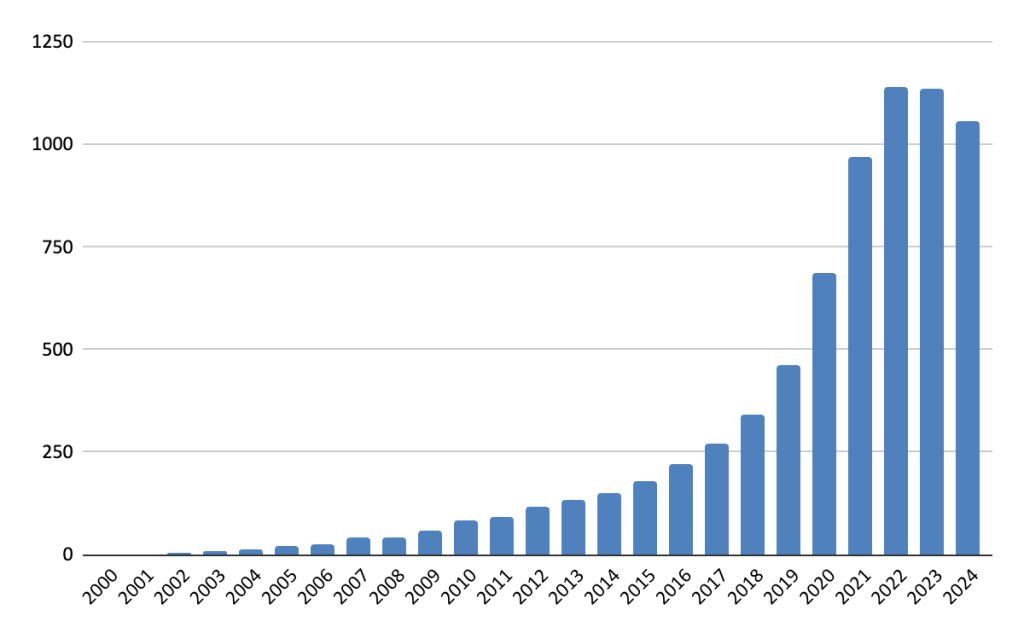
According to a comprehensive new database compiled by the Harvard Salata Institute for Climate and Sustainability, the number of U.S. companies with active, publicly stated climate targets reached its zenith in 2022 and has been in a steady, measurable decline ever since. This finding challenges the prevailing narrative of relentless corporate progress and raises fundamental questions about the fragility of voluntary climate commitments in the face of political and economic headwinds.
A Stagnating Horizon: The Main Facts
The Harvard database, published on September 21, provides the most granular look yet at the trajectory of American corporate climate action. Unlike industry-led reports that often aggregate data from disparate global sources, the Harvard team focused exclusively on the Russell 3000—an index that represents 98 percent of U.S. equities by market capitalization.
The research, which involved 27 experts over a two-year period, reveals a sobering trend. In 2022, 1,140 companies within the Russell 3000 had publicly committed to climate targets—roughly one-third of the index. Following that peak, the numbers remained stagnant throughout 2023. By 2024, the trend turned sharply downward, with 79 companies abandoning their previously established climate goals.
This decline is particularly striking because it contradicts the metrics often touted by international bodies. For instance, the Science Based Targets initiative (SBTi) recently announced it had validated its 10,000th corporate pledge globally. However, the Harvard study suggests that while global numbers may still be climbing, the domestic engine of U.S. corporate climate action is cooling significantly.
The Chronology of a Trend
To understand the current decline, one must look at the meteoric rise that preceded it. The period between 2015—the year of the Paris Agreement—and 2021 saw a massive influx of companies adopting voluntary climate goals. This was driven by a combination of investor pressure, shifting consumer expectations, and a genuine belief that decarbonization would be a competitive advantage.
- 2015–2020: The "Growth Phase." Corporations began treating climate risk as a material financial issue. Voluntary disclosure frameworks became the norm for blue-chip companies.
- 2021–2022: The "Policy Mirroring Phase." Following the U.S. government’s commitment to halve emissions by 2030, corporate pledges surged to mirror federal ambition. 2022 marked the absolute peak of this activity.
- 2023: The "Plateau." The initial rush of ambition slowed as companies grappled with the logistical realities of supply chain decarbonization and rising interest rates.
- 2024: The "Retreat." The first significant year-over-year drop-off in recorded targets, signaling a shift in corporate strategy away from voluntary climate commitments.
Beneath the Numbers: Why the Pivot?
The decline in climate pledges is not a coincidence; it is a calculated response to a changing external environment. Joseph Aldy, an environmental policy expert at Harvard who contributed to the study, points to three primary "pressure points" that have forced companies to rethink their commitments.
The "Chilling Effect" of Anti-ESG Politics
The most prominent factor is the organized political backlash against Environmental, Social, and Governance (ESG) investing. Led by a coalition of Republican attorneys general, this campaign has targeted financial institutions and corporations, framing ESG mandates as a violation of fiduciary duty.
"I think that has had a bit of a chilling effect for some of these companies," Aldy noted. The threat of litigation, investigations, and public shaming by high-ranking state officials has made climate goal-setting a liability rather than a marketing asset. For many firms, the legal and reputational costs of maintaining a "Net Zero" label now outweigh the benefits.
Policy Alignment and the "Mirroring" Trap
Corporate climate strategy has historically been tethered to federal policy. When the Biden administration set aggressive 2030 targets, corporations felt a social and political license to follow suit. However, this creates a vulnerability: when the political winds shift, the corporate targets lose their foundational rationale. Companies often adopt these goals as a way to "future-proof" against upcoming regulations; when those regulations fail to materialize or are actively dismantled, the companies see no further reason to maintain the extra costs associated with decarbonization.
Regulatory Disillusionment
Perhaps most counterintuitively, the decline in targets occurred during a period of legislative activity, including the 2022 Inflation Reduction Act (IRA). While the IRA provided massive subsidies for green technology, the complexity of implementation and the uncertainty of long-term policy consistency played a role.
Some companies reportedly analyzed the IRA’s provisions and determined that the financial support was insufficient to offset the capital expenditure required to hit their specific climate targets. With the subsequent shift in the U.S. administration and the reversal or weakening of several IRA-adjacent policies, many firms concluded that the era of government-supported decarbonization had hit a wall, leading them to quietly exit their pledges.
Implications for the Future
The retreat from climate targets by U.S. firms has profound implications for the global climate effort.
The End of "Voluntary" Efficacy
The Harvard study suggests that voluntary commitments may be reaching their limit as a mechanism for change. If climate targets are purely discretionary, they will inevitably fluctuate with the stock market, political cycles, and the mood of the electorate. Without mandatory, standardized, and legally binding disclosure requirements, the corporate sector remains highly susceptible to "climate flight."
Impact on Investor Confidence
Investors rely on long-term climate data to assess risk. If companies treat their climate pledges as "optional," it creates an environment of opacity. Institutional investors, particularly those with mandates to support the energy transition, may find it increasingly difficult to allocate capital if the target-setting landscape is characterized by constant entry and exit.
The Widening Gap
There is a growing divergence between companies that have embedded decarbonization into their core business model and those that treated it as a public relations exercise. The 79 companies that dropped their targets in 2024 likely fall into the latter category. This creates a two-tiered economy: a small group of "true believers" who are decarbonizing their operations regardless of political shifts, and a larger cohort of "fair-weather" companies whose commitments vanish at the first sign of regulatory or political friction.
Conclusion: A Turning Point for Corporate Sustainability
The Harvard Salata Institute’s database serves as a vital reality check. For a decade, the narrative has been one of linear progress—the idea that every year would see more companies, more pledges, and more commitment. The reality, as revealed by the data, is far more cyclical and volatile.
As the U.S. corporate sector enters this new phase of retrenchment, the focus will likely shift from "how many companies have a target" to "how many companies can actually execute." In an era where political backlash and policy instability are the new constants, the companies that continue to hold their climate targets may be the only ones truly prepared for the long-term risks of a warming world.
The retreat of the 79 is not just a statistical anomaly; it is a signal that the era of easy, voluntary climate action in the United States may be coming to a close, replaced by a more cautious, defensive, and fragmented approach to environmental stewardship.


 Nana Wu
 Neng Nana

 Suro Senen
 Jia Lissa
 Evan Lee Salim