
 Sagoh
Sagoh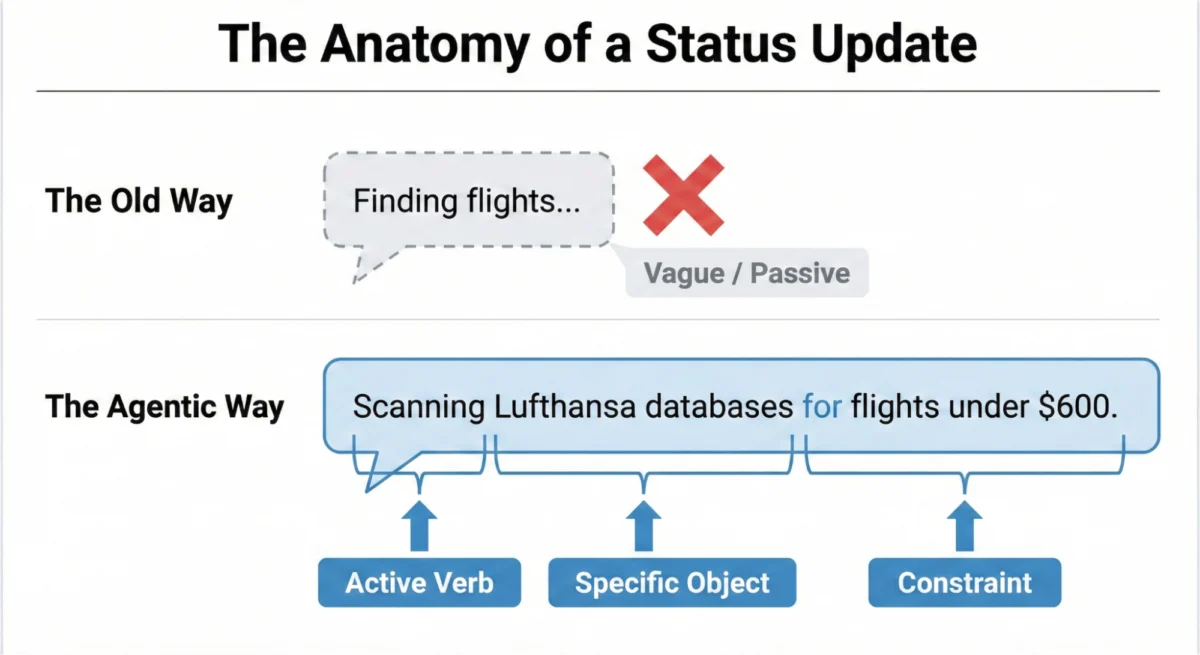
For three decades, the software industry has relied on a singular, comforting visual shorthand for latency: the spinner. Whether it is a rotating wheel, a pulsating dot, or a progress bar, these interface patterns serve a singular purpose—signaling that the system is retrieving data or waiting on a slow network connection. However, the rise of agentic AI has rendered this legacy design pattern obsolete.
When an AI agent pauses for twenty seconds, it is not simply downloading a file; it is performing complex cognitive labor. It is evaluating variables, weighing probabilistic outcomes, and executing multi-step workflows. When we force this "thinking time" into the box of a generic spinner, we create a cognitive disconnect. Users, unable to distinguish between a stalled process and an active, complex computation, feel anxiety rather than confidence. To build trust in the next generation of software, designers must move beyond mere aesthetic feedback and embrace deep, process-oriented transparency.
The Shift from Latency to Logic: A Chronology of Interface Evolution
The transition from traditional software to agentic AI requires a fundamental rethink of how we communicate system status. In the era of static software, the user’s primary concern was speed. "Is it taking too long?" was the only question that mattered. Today, the question has shifted to intent and reliability.
This evolution can be categorized into three distinct phases of user expectation:
- The Static Era (1995–2015): The focus was on connection stability. If a browser took more than five seconds to load, the user assumed a network failure. The spinner was the industry standard for indicating that the system was working as intended despite the delay.
- The Predictive Era (2015–2023): As machine learning became more prevalent, systems began providing recommendations. Transparency was often limited to "We are analyzing your preferences," but the underlying logic remained a black box.
- The Agentic Era (2024–Present): Agents now execute multi-step tasks across disparate APIs. A delay here represents the system navigating choices. The user’s need for transparency is no longer about the connection, but about the decision-making process itself.
This progression demands that designers abandon the "something is happening" approach in favor of "here is how I am solving your problem."
The Anatomy of the Agentic Update Formula
Transparency is not a purely visual design challenge; it is a linguistic one. Generic microcopy like "Working…" or "Loading…" is a relic of simpler times. To foster trust, we must employ an "Agentic Update Formula" that provides context, specific action, and boundaries.

The formula requires three pillars:
- The Action Word: A strong verb that defines the current state (e.g., "Verifying," "Analyzing," "Cross-referencing").
- The Specific Item: A clear reference to the object of the work (e.g., "flight availability," "user calendar," "financial records").
- The Limits: A nod to the parameters being respected (e.g., "within your specified budget").
By combining these, we move from the vague "Searching for flights…" to the precise: "Checking flight availability for your specified budget of $600." This transformation provides the user with an immediate mental map of the agent’s work, reducing the anxiety of the unknown.
Supporting Patterns: A Library for AI Transparency
To move beyond the spinner, we must implement a library of interface patterns that match the visibility of the message to the stakes of the task.

The Living Breadcrumb
For low-stakes, background operations, such as an AI drafting an email response or organizing local files, visual clutter is an enemy. The "Living Breadcrumb" provides a subtle, pulsing indicator that transitions through text states: "Reading thread," "Identifying tone," "Drafting response." This keeps the user informed without demanding their cognitive attention.
Dynamic Checklists
For high-stakes tasks—such as a complex financial transfer or an automated database migration—a simple bar is insufficient. The "Dynamic Checklist" is a superior pattern that lays out every step of the workflow. It clearly labels completed tasks, the task currently in progress, and the pipeline of pending items. This manages unpredictable timeframes effectively; if the "Currency Conversion" step hits a snag, the user can see exactly where the agent is, maintaining patience through visibility.
The Thinking Toggle
Transparency is not a one-size-fits-all requirement. Some users—particularly developers or analysts—demand "deep transparency." The "Thinking Toggle" acts as a progressive disclosure control, allowing users to expand a friendly summary into a sanitized log of the AI’s logic. This signal of "I have nothing to hide" is one of the most powerful trust-building tools in the interface designer’s arsenal.

The Audit Trail
Real-time status updates are fleeting. If a user walks away and returns to a final output, they have no visibility into how that conclusion was reached. A persistent "Audit Trail" or "Show Work" button on the final result screen provides a receipt of the agent’s decision-making process. This serves as a safety net, allowing users to spot-check for hallucinations or logic errors long after the agent has finished its work.
Implications of Partial Success
In traditional software, success is binary: a file saves or it does not. In agentic AI, we must design for the "grey." If an agent successfully books a trip but fails to reserve a requested restaurant, a large "Request Failed" banner is misleading and destructive to trust.
The interface must instead adopt a model of "partial success." By clearly articulating what was achieved and what requires manual intervention, the agent remains a partner rather than a failure. This nuance prevents the user from discarding the entire result due to a minor, addressable discrepancy.

When Trust Meets Reality: The Human Factor
Despite the best design efforts, some users will inevitably tune out the interface. A professional underwriter generating dozens of quotes daily will not sit and watch a progress bar. They will trigger the action, switch tabs, and return for the result.
Research shows that for these experts, the system’s "trustworthiness" is judged entirely by the final output’s proximity to their own expertise. If the output deviates from expectation, the user immediately pivots to manual rework. In this scenario, the absence of a persistent audit trail is fatal. Without a way to understand why the AI chose a specific value, the user loses faith in the tool’s underlying logic and reverts to manual processes.
Official Perspectives and Ethical Considerations
The necessity for transparency has also sparked industry-wide debates regarding AI "memory." As noted in recent observations of platforms like ChatGPT, silent personalization—where the system uses hidden historical data to shape current outputs—can lead to confusion. When an AI generates an image containing a specific geographic sign the user never mentioned, it feels like an intrusion.

The industry is moving toward a standard of "auditable personalization." Systems must be designed to show users what they "know" about them, allowing for deletion, editing, or temporary disabling of these memory features. Transparency is not merely about the current task; it is about the long-term relationship between the user and the agent.
Conclusion: Designing for Colleagues, Not Magic
We are moving away from the era of software as a black box. We are not designing magic tricks; we are designing collaborative agents. A good colleague communicates status, explains delays, and is transparent about their limitations. By adopting these practical design patterns—living breadcrumbs, dynamic checklists, thinking toggles, and audit trails—we transform AI from an opaque tool into a reliable team member.
The ultimate goal of these interface patterns is to achieve a state of informed confidence. When a user understands the process, recognizes the limits, and can verify the logic, they are no longer just passive recipients of an output. They become active participants, capable of guiding the agent toward the best possible outcome. In this new era, transparency is not just an interface feature; it is the fundamental product upon which all future AI adoption rests.



 Asep Darmawan
 Raul Delapena Setiawan
 Reynand Wu


 Azzam Bilal Chamdy
 Ali Ikhwan