
 Asep Darmawan
In the high-stakes world of global supply chain management, a persistent paradox remains: despite massive investments in digital transformation, multinational corporations continue to struggle with scaling performance and achieving true economies of scale. The industry is currently captivated by the promise of "autonomous supply chains" and the sophisticated allure of agentic AI. However, beneath the veneer of these technological advancements lies a structural fragility that many organizations are failing to address.
The core issue, according to industry experts, is a dangerous tendency to prioritize "shiny objects" over the foundational principles of supply chain management. By attempting to "AI-enable" broken or outdated processes, organizations are merely accelerating the speed of their existing inefficiencies—a phenomenon best described as "AI Stupid."
The Dance with Shiny Objects: A False Prophet
The modern supply chain narrative is dominated by the promise of automation. Vendors and consultants alike tout the capability of autonomous agents to resolve bottlenecks and optimize flow. Yet, this focus on the "how" often obscures the "what." As Henry Ford once supposedly (though likely apocryphally) noted regarding the demand for "faster horses," innovation is not found in simply optimizing existing modalities, but in deeply understanding the fundamental problem the user is experiencing.
True innovation in supply chain management does not emerge from asking users what software features they want; it emerges from a visceral, data-driven understanding of the daily obstacles faced by supply chain planners. If an organization is struggling with planning, it is rarely due to a lack of computational power; it is due to a lack of alignment with core operational realities.

Chronology of a Failed Strategy: The Path to "AI Stupid"
The current cycle of disappointment for many large enterprises follows a predictable, three-stage trajectory:
- The Assumption Phase: Organizations define their supply chain challenges based on legacy system limitations, projecting their existing (often flawed) data architectures onto future-state requirements.
- The Integration Phase: Companies deploy high-cost, autonomous agents—the "shiny objects"—on top of brittle, siloed, and high-latency data models. This is the "AI Stupid" trap, where automation is used to perform high-speed, automated errors.
- The Realization Phase: After significant capital expenditure, firms realize that while their systems are indeed "faster," they are not "better." The lack of fundamental data integrity and process discipline renders the AI output irrelevant or, worse, detrimental to decision-making.
To break this cycle, organizations must pivot toward a methodology rooted in first-principle thinking.
Supporting Data: The Case for First Principles
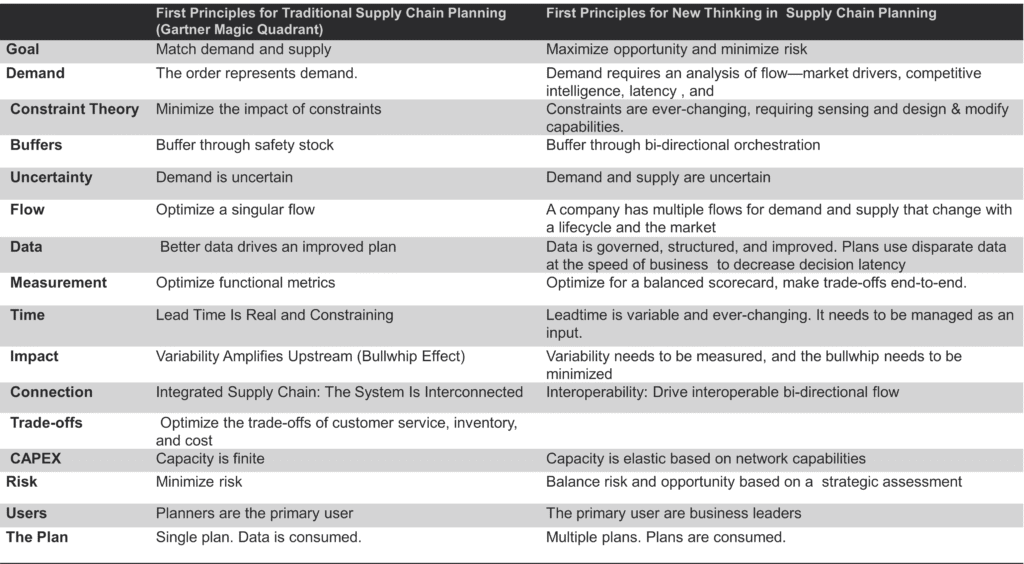
First-principle thinking requires boiling down complex supply chain processes to their most basic, undeniable truths. By stripping away the jargon and the software-imposed constraints, leaders can identify the "delta"—the gap between what a process should do and what it currently does.
The foundational pillars for this shift include:
- Rethinking the Data Relationship: Traditional processes are marred by inherent latency. To succeed in a market-driven environment, companies must move away from batch-processed, siloed data and toward a unified data model that serves as a single source of truth for planning and execution.
- The Discipline of Lead Time: In the ecosystem of a supply chain, lead time is the "gossamer thread" that binds procurement, manufacturing, and customer delivery. When this thread is broken or inaccurately measured, the entire system falls into a state of entropy.
- Probabilistic vs. Deterministic Modeling: Traditional systems rely on averages. However, in an era of increased volatility, relying on an average lead time is a recipe for disaster. Modern planning must transition to probabilistic engines that account for both the average and the variance of lead times.
The Entropy Conundrum: A Call to Order
Supply chain entropy—the accumulation of uncertainty, disorder, and inefficiency—is the silent killer of organizational performance. While often confused with the "Bullwhip Effect" (which describes the amplification of demand distortion), entropy is a much broader phenomenon. It encompasses every instance where systems are disconnected and where lead time parameters do not reflect reality.
The Mathematics of Reliability
To combat entropy, leaders must move toward quantitative measurement. The formula for Supply Chain Entropy (SE) is a composite metric involving the product of Entropy (H) and the Coefficient of Variation (CV).
- H (Entropy): Measures the unpredictability of a system. High entropy indicates that lead times are spread across a wide, unpredictable range of values.
- CV (Coefficient of Variation): The ratio of the standard deviation to the mean.
When a supply chain exhibits both high entropy and high variability, the system is essentially unmanageable. By calculating these metrics, companies can identify which segments of their supply chain (procurement, inbound logistics, or manufacturing) are the primary sources of disorder.
Official Perspectives and Expert Guidance
Leading supply chain analysts emphasize that technology is only as effective as the discipline applied to it. The "So What" of the current industry debate is simple: your current architectures were likely designed for a world that existed fifty years ago.
When questioned about the path forward, advocates of the "First Principles" approach suggest a three-step action plan:
- Conduct an Aggregate Lead Time Discovery: Map the "actuals" against the "system values" for every cycle: order, replenishment, manufacturing, procurement, and logistics. The disparity between these two numbers is usually shocking.
- Redefine Safety Stock: Most organizations fail to incorporate demand variability and actual supplier performance into their safety stock calculations. By using a robust formula—accounting for the standard deviation of both demand and lead time—planners can move from reactive firefighting to proactive stability.
- Simulate to Monetize: Use network design technologies to run simulations on the cost of entropy. When you can present a CFO or COO with the literal dollar amount of "disorder" within the supply chain, the conversation shifts from "buying new AI" to "fixing the business."
Implications for the Modern Enterprise
The implications of ignoring these fundamentals are severe. As global supply chains grow more complex, the cost of entropy will continue to rise. Organizations that persist in chasing autonomous agents without first cleaning their data and aligning their lead-time parameters will find themselves at a structural disadvantage.
The Competitive Advantage of "Boring"
The most successful companies in the near future will not necessarily be the ones with the most advanced AI bots. They will be the ones that have mastered the "boring" parts of the business:
- Data Hygiene: Ensuring that the digital twin of the supply chain actually matches the physical reality.
- Governance: Enforcing the consistent definition of lead times across all departments, from sales to shop-floor procurement.
- Operational Discipline: Recognizing that a 5% improvement in lead-time accuracy is often more valuable than a 50% improvement in automation speed.
Conclusion: The Path Forward
The journey to a market-driven supply chain is not a sprint toward the next software release; it is a marathon of refinement. The lure of "agentic" systems is powerful, but it must be tempered by the cold, hard logic of first-principle analysis.
Before investing in the next layer of "intelligence," ask yourself: Is my data model unified? Do my lead times reflect reality or just a series of outdated averages? And most importantly, am I trying to solve a fundamental problem, or am I just buying a faster horse?
By grounding the organization in the fundamentals—rethinking the relationship with data, embracing lead time as a strategic asset, and measuring the cost of entropy—leaders can build a supply chain that is not just "smarter," but inherently more resilient and capable of scaling in an unpredictable global market. The future belongs to those who do the hard work of simplification before they chase the complexity of the future.


 Sagoh
Sagoh
 Ali Ikhwan
 Raul Delapena Setiawan
 Reynand Wu


 Azzam Bilal Chamdy
