
 Reynand Wu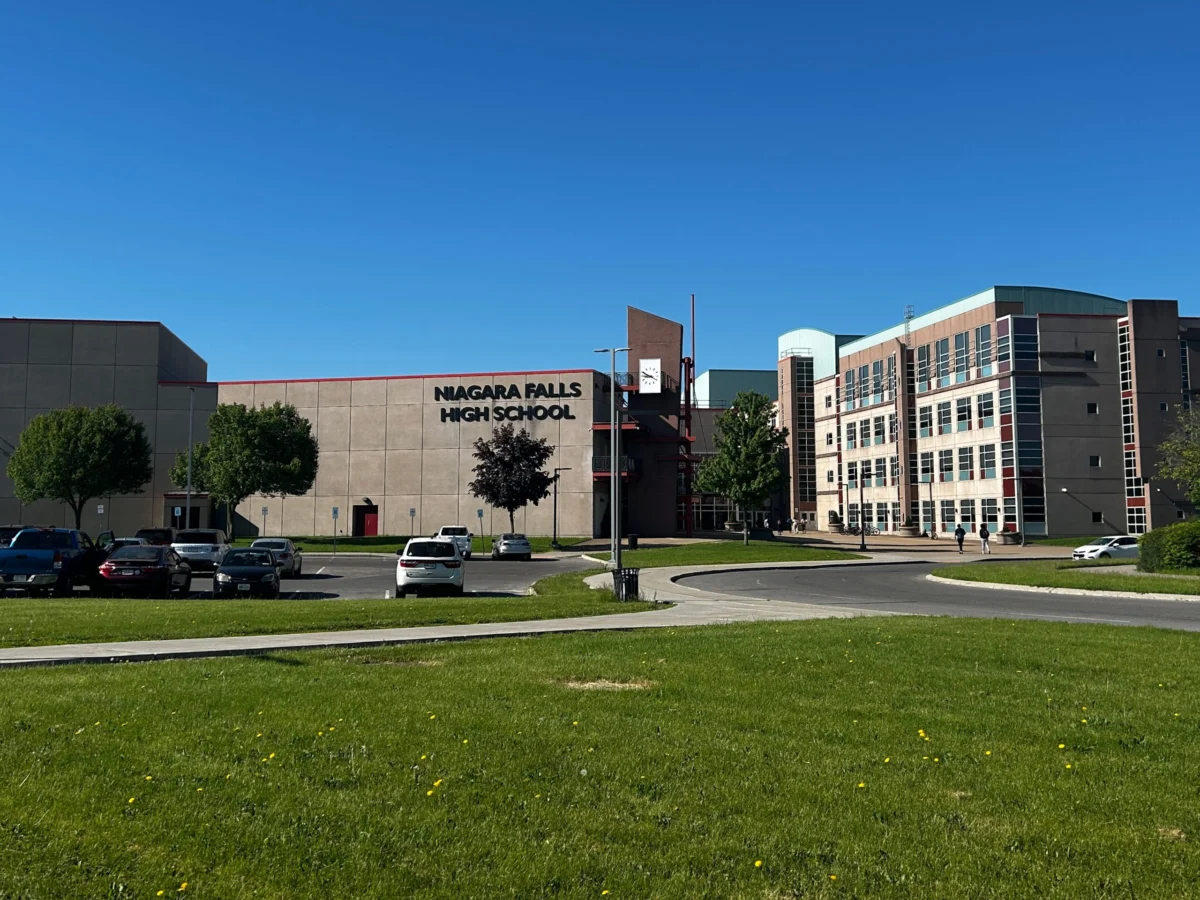
NIAGARA FALLS, N.Y. — For the past year, senior Ciara Johnson has spent her school days far removed from the traditional lecture hall. Armed with tools and determination, she has been ripping up tile, demolishing interior walls, and meticulously crafting custom cabinets. Her classroom is not a sterile laboratory, but the former cafeteria of the city’s old high school campus—a structure that once pulsed with the energy of a bustling student body and now serves as the site of a profound pedagogical experiment.
As Johnson and her peers renovate this historic space, they are doing more than learning a trade; they are dismantling the long-held assumption that a four-year university degree is the only path to a stable, middle-class life. In a community grappling with the echoes of shuttered manufacturing plants and a shifting economic landscape, Niagara Falls High School has launched an ambitious initiative to ensure its graduates are not just job-ready, but career-focused, whether they choose to stay in the city or venture beyond its borders.
The Shift Toward Career Pathways
The transformation at Niagara Falls High School is both systemic and philosophical. Since the 2023 academic year, the district has mandated that every junior and senior select a specific career pathway. This isn’t merely an elective; it is a structural redesign of the high school experience. The school has refined its entire course catalog to align with five core career categories: visual and performing arts; business, finance, and entrepreneurship; computer science and information technology; design, engineering, and construction; and human services.
This shift comes at a critical juncture. According to former Superintendent Mark Laurrie, who retired this past June, the percentage of seniors bypassing college to enter the workforce directly has climbed to one-third, up from roughly 25 percent a decade ago.
"It’s important to give them hope for the future with a career pathway—a career, not just a job—to have something to aspire to and, hopefully, keep them in the city and in the state," Laurrie said.

The school’s curriculum reflects this mission. Students now take specialized courses such as "Writing for the Workforce" and "Street Law," the latter designed for those eyeing careers in law enforcement or the judiciary. By integrating career-interest inventories as early as the ninth grade, the administration aims to expose students to the breadth of the labor market long before they are faced with graduation decisions.
A City in Transition: The Economic Context
To understand the urgency of this educational pivot, one must look at the trajectory of Niagara Falls itself. Long defined by the world-famous cataracts that draw millions of tourists, the city has experienced a painful economic decoupling from its industrial past.
For seven decades, the city’s labor market was anchored by manufacturing. As those plants closed and moved operations overseas, the local economy faced a structural crisis. Today, tourism and hospitality have become the city’s primary industries, a shift that leaves the region vulnerable to global volatility. Last year, strained diplomatic relations between the United States and Canada resulted in a 21 percent drop in border crossings, dealing a significant blow to the local economy.
The demographic toll has been equally severe. The population on the American side of the falls has plummeted from over 100,000 in 1960 to fewer than 50,000 today. As manufacturing jobs vanished, so did the families that held them, leaving behind a legacy of vacant storefronts and “for lease” signs in once-thriving neighborhoods like the Italian-American enclave around Pine Avenue.
"The Como Restaurant, this was a staple, and now it’s closed," said Principal Bryan Rotella, gesturing toward a fading red sign. "My grandma worked here for 50 years. Those cornerstone places are gone now."

National Trends: The Declining Value of the Traditional Degree
Niagara Falls is not alone in this struggle. Across the United States, school districts are confronting a confluence of challenges: falling birth rates, restricted immigration, and a widespread reassessment of the value of higher education.
Since 2010, national higher education enrollment has declined by approximately 1.5 million students. Rising tuition costs, combined with the emergence of artificial intelligence and shifting labor market demands, have left many families questioning the ROI of a four-year degree.
Emily Passias, deputy executive director of Advance CTE, a nonprofit representing state career and technical education leaders, notes that schools are under immense pressure to bridge the gap between classroom instruction and real-world labor conditions. "We see a lot of communities trying to very intentionally look at their labor market conditions and prepare young people for those types of roles," Passias explained.
However, the balance is delicate. While trade skills are in high demand, a 2024 report from Georgetown’s Center on Education and the Workforce suggests that 72 percent of jobs will still require some form of postsecondary education by 2031. This is why Niagara Falls High School has doubled down on "dual credit" options. By partnering with SUNY Niagara, the district allows students to earn college credit while still in high school, providing a pathway that is both affordable and flexible.
Bridging the Gap: Internships and Industry Ties
The school’s strategy relies heavily on professional exposure. The postsecondary success office, established in 2021, acts as a liaison between the classroom and the regional labor market.

For students in the biomedical track, the school facilitates three-week internships at the Roswell Park Comprehensive Cancer Center in Buffalo. For those interested in manufacturing or engineering, teachers organize site visits to regional powerhouses like the aerospace propulsion company Moog and the manufacturing firm Voss.
"As a public education institution, we have a moral obligation to graduate kids that not only get a degree, but have a pathway choice where they’ve had some exposure and some work to their next phase of life," Laurrie stated.
Student Perspectives: The Future of the Falls
The impact of these programs is best reflected in the students themselves. For Ciara Johnson, the construction program was a revelation. It wasn’t until she helped pour and pave a pavilion in a local park during her junior year that she found her calling. "It just clicked to me: ‘Maybe I should do this,’" she recalled. While she intends to attend trade school and eventually work in masonry, she is open to the idea of leaving the city, viewing her skills as a passport to opportunity.
Conversely, others see their education as a tool for local restoration. Emily Webber, a senior with a passion for education, has used the school’s internship program to log 25 hours in elementary classrooms. Her plan is to complete her associate degree in teaching at SUNY Niagara before transferring to a university in Buffalo. She is determined to return to Niagara Falls to teach.
"With the right assistance, I think we can bring Niagara Falls back," Webber said, echoing a sentiment of optimism that persists despite the city’s recent history.

The Road Ahead
The challenges facing Niagara Falls—and the schools tasked with preparing its youth—are immense. As Timothy Glass, a state labor market analyst, points out, while neighboring Buffalo has managed to stabilize its population through immigration and economic diversification, Niagara Falls remains in a precarious position.
The success of the "pathway" model will ultimately be measured in the coming years by whether these students can secure meaningful, well-paying work. By providing students with technical skills, college credits, and professional networking, the district is attempting to mitigate the risks of an uncertain economy.
As the school year concludes and seniors like Leo Nadrowski—who organized a local soap box derby to honor his late father—look toward the future, there is a clear message emanating from the hallways of Niagara Falls High School: whether a student leaves for the broader world or chooses to remain to rebuild their hometown, the school’s mission is to ensure they do so with a concrete plan, a set of marketable skills, and a belief in their own agency. In a town defined by the constant, thundering force of water, the students are learning that they, too, can be a force of change.


 Siti Muinah
 Nana Muazin
 Nila Kartika Wati
 Jia Lissa
 Basiran
 Sagoh
Sagoh

 Lina Hope