
 Siti Muinah
For Mitzie Westgate, a senior at the College of Charleston, the path to a doctorate in occupational therapy was supposed to be clear. Driven by a desire to support children with disabilities—a mission deeply personal to her due to her cousin’s experience with cerebral palsy—Westgate began her final year of undergraduate studies with a roadmap. Today, that map is in tatters.
Westgate finds herself caught in the crosshairs of a profound, unresolved shift in federal student loan policy. Recent legislative changes to graduate-level borrowing limits have created a "policy vacuum," leaving thousands of students like her unable to commit to graduate programs. As the 2027–28 academic year looms, the prospect of funding her education has shifted from a logistical challenge to a source of acute anxiety. "It’s kind of up in the air whether I’ll be able to pay for college," Westgate says. "I’m kind of playing it by ear."
The Main Facts: A Sea Change in Federal Lending
The crisis stems from a 2026 congressional move that reclassified dozens of graduate-level programs, effectively stripping them of their status as "professional" degrees. This change, which officially took effect on July 1, 2026, replaced the long-standing Grad PLUS loan program—which previously allowed students to borrow up to the full cost of attendance—with a rigid cap.
Under the new framework, most graduate students are now limited to $20,500 annually in federal loans, with a lifetime cap of $100,000. While 11 specific "professional" programs were granted higher limits of $50,000 annually and $200,000 total, the vast majority of health care, psychology, and social work degrees were excluded from this tier.
This reclassification has created a massive financial chasm. For students in programs like occupational therapy, nursing, and counseling, the cost of tuition at many institutions far exceeds these new federal caps. Without the safety net of Grad PLUS, these students are being forced to consider private, high-interest loans—or, in many cases, to abandon their graduate school dreams entirely.
Chronology of a Policy Crisis
The current state of uncertainty is the result of a turbulent sequence of events:
- Pre-2026: Graduate students relied on the Grad PLUS loan program, which provided federal backing for the full cost of attendance, ensuring that students’ ability to pursue a degree was based on merit rather than immediate personal liquidity.
- Late 2026: Congress passed legislation narrowing the definition of "professional" degrees, effectively creating two tiers of federal loan access.
- July 1, 2026: The new lending limits took effect, causing immediate alarm among university financial aid administrators and prospective graduate students.
- Late 2026/Early 2027: A coalition of nursing organizations and healthcare associations filed a federal lawsuit challenging the new rules. A judge subsequently issued an injunction, suspending the implementation of the stricter limits until at least December.
- Present Day: Students are in a state of suspended animation. With the lawsuit pending, universities are unable to provide definitive guidance on what financial aid packages will look like for the upcoming academic cycle.
Supporting Data: The High Cost of Uncertainty
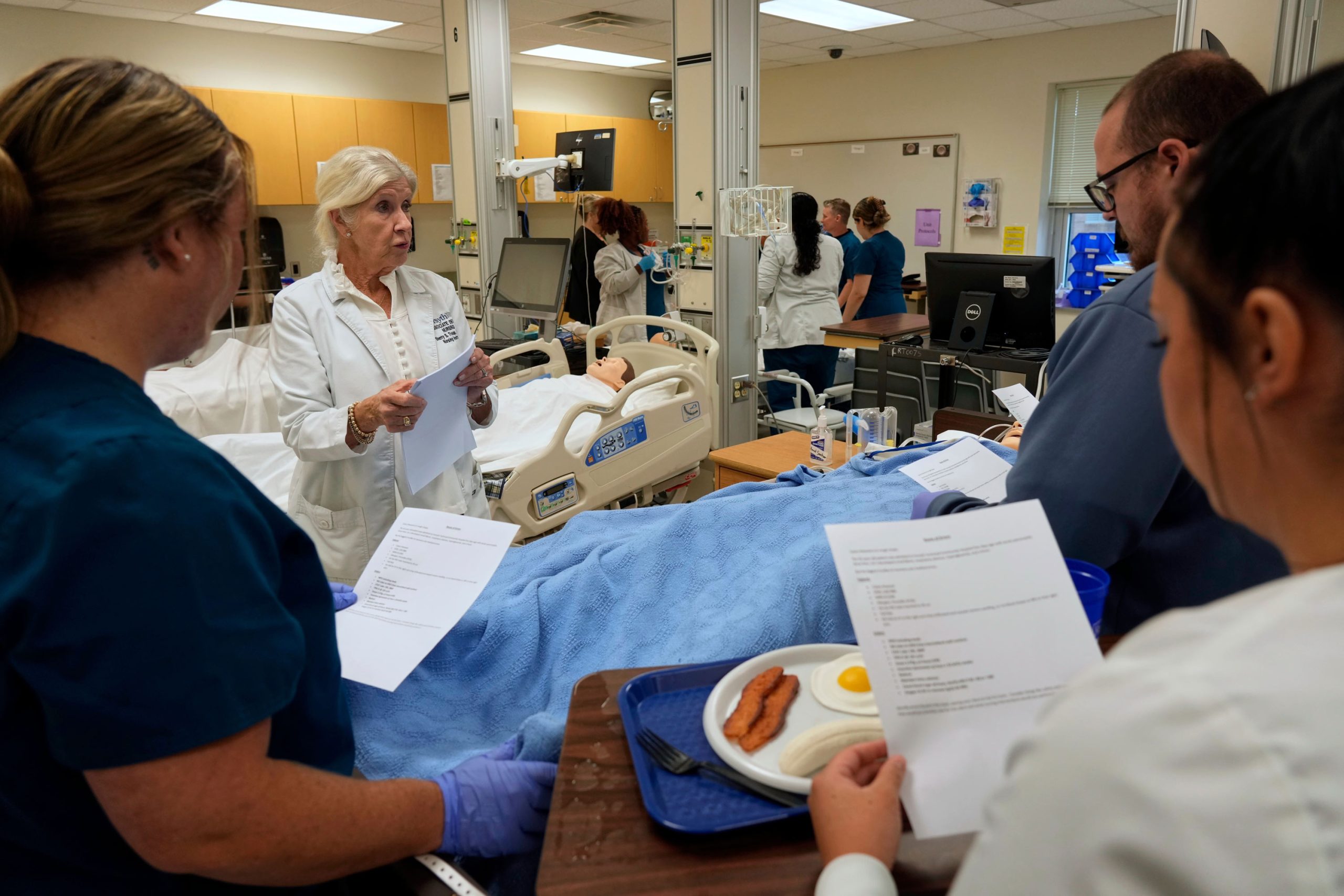
The economic implications of this policy shift are vast, particularly for fields already grappling with workforce shortages.
The Debt-to-Earnings Mismatch
Analysis from the American Enterprise Institute (AEI) highlights the inherent danger of shifting these students toward the private lending market. Unlike federal loans, which often feature income-driven repayment plans and public service loan forgiveness options, private loans are governed by market-based underwriting.
The AEI report notes that graduates in fields like social work, physical therapy, and psychology rarely see the massive salary jumps associated with fields like law or high-end finance. "Students attending more expensive programs do not, on average, earn substantially more after graduation," the report stated. "In these fields, higher debt often reflects higher tuition prices rather than higher returns."
The Lending Landscape
Private lenders, recognizing this discrepancy, are tightening their criteria. Mark Kantrowitz, a noted expert in student financial aid, observes that private lenders are increasingly targeting only the most "lucrative" students. For those in lower-earning, high-impact fields, the private market may be either prohibitively expensive—with interest rates reaching as high as 16%—or entirely inaccessible.
Official Responses and Institutional Responses
The reaction from stakeholders has been characterized by frustration and a lack of consensus.
The "Policy Vacuum"
Megan Walter, a senior policy analyst at the National Association of Student Financial Aid Administrators (NASFAA), describes the current environment as one of "whiplash." Financial aid directors across the country are currently operating without clear federal guidance, leaving them unable to advise students on whether they should accept admission offers. "We just want to see this ended so students and schools know what to do," Walter stated.
Corporate Caution
Even major lenders are signaling that the era of easy credit for graduate school is over. Rick Castellano, a spokesperson for Sallie Mae, offered a sobering assessment: "We will continue to maintain responsible underwriting, but let’s also be clear: For some people, a loan is just not the answer."
The Academic Response
Universities are currently split in their approaches. A small, elite group of wealthy institutions has begun offering internal, low-interest loan programs to bridge the gap. Others are compiling lists of "preferred" private lenders. However, there is no evidence of a systemic reduction in tuition costs. While conservative think tanks like the AEI argue that the new limits will force universities to lower prices to stay competitive, advocates for higher education access, such as Sarah Sattelmeyer of the think tank New America, remain skeptical. "Right now I don’t see evidence that we’re going to see large across-the-board tuition and price reductions," she said.

Implications: A Domino Effect on Society
The human cost of this policy, while difficult to quantify, is becoming increasingly visible.
The Nursing Shortage
Kayce Cordray, a 44-year-old doctoral nursing candidate, views the situation as a threat to national health infrastructure. "We are facing a real nursing shortage and a real rural health care shortage," she said. "We’re not even going to be able to get registered nurses if we don’t have faculty. It’s a domino effect."
For many students, particularly those with families, the prospect of having to begin repaying loans while still enrolled—a common requirement for private lenders—is a deal-breaker. Cordray notes that many of her peers, who are often mothers balancing education and work, are already at a breaking point. "If you don’t know what you’re going to be allowed to borrow, are you really going to want to commit to this program?" she asked.
The Risk of Predatory Lending
Eileen Connor, director of the Project on Predatory Student Lending, warns that the current environment is a breeding ground for exploitation. With the removal of various federal guardrails, students who are desperate to secure funding may find themselves signing contracts with hidden fees, mandatory arbitration clauses, and predatory interest rates.
Long-term Economic Mobility
For young professionals like Gracie Hayworth, who is pursuing a master’s in public health at Dartmouth, the uncertainty has forced a complete reassessment of her family’s life trajectory. She and her husband, both planning to pursue doctorates, now view their education through a lens of extreme risk management. The shift from federal to private debt could mean the difference between buying a home or starting a family, and years of crippling monthly payments.
Conclusion: A Future in Flux
As the legal battle over federal loan limits continues, the ripple effects are being felt in living rooms and administrative offices across the country. The policy was intended to curb rising student debt, but the current implementation is creating a barrier that threatens to lock talented individuals out of essential, service-oriented professions.
For Mitzie Westgate, the dream of opening a nonprofit to help children with disabilities remains, but the bridge to that future has become significantly more fragile. Whether she will eventually be able to attend a top-tier program or be relegated to a local, less connected institution depends entirely on a legal ruling that is still months away. Until then, the next generation of therapists, nurses, and social workers remain in a state of professional paralysis, waiting for the clarity that is essential to their—and the public’s—future.


 Nana Muazin

 Nila Kartika Wati
 Jia Lissa
 Basiran
 Sagoh
Sagoh

 Lina Hope